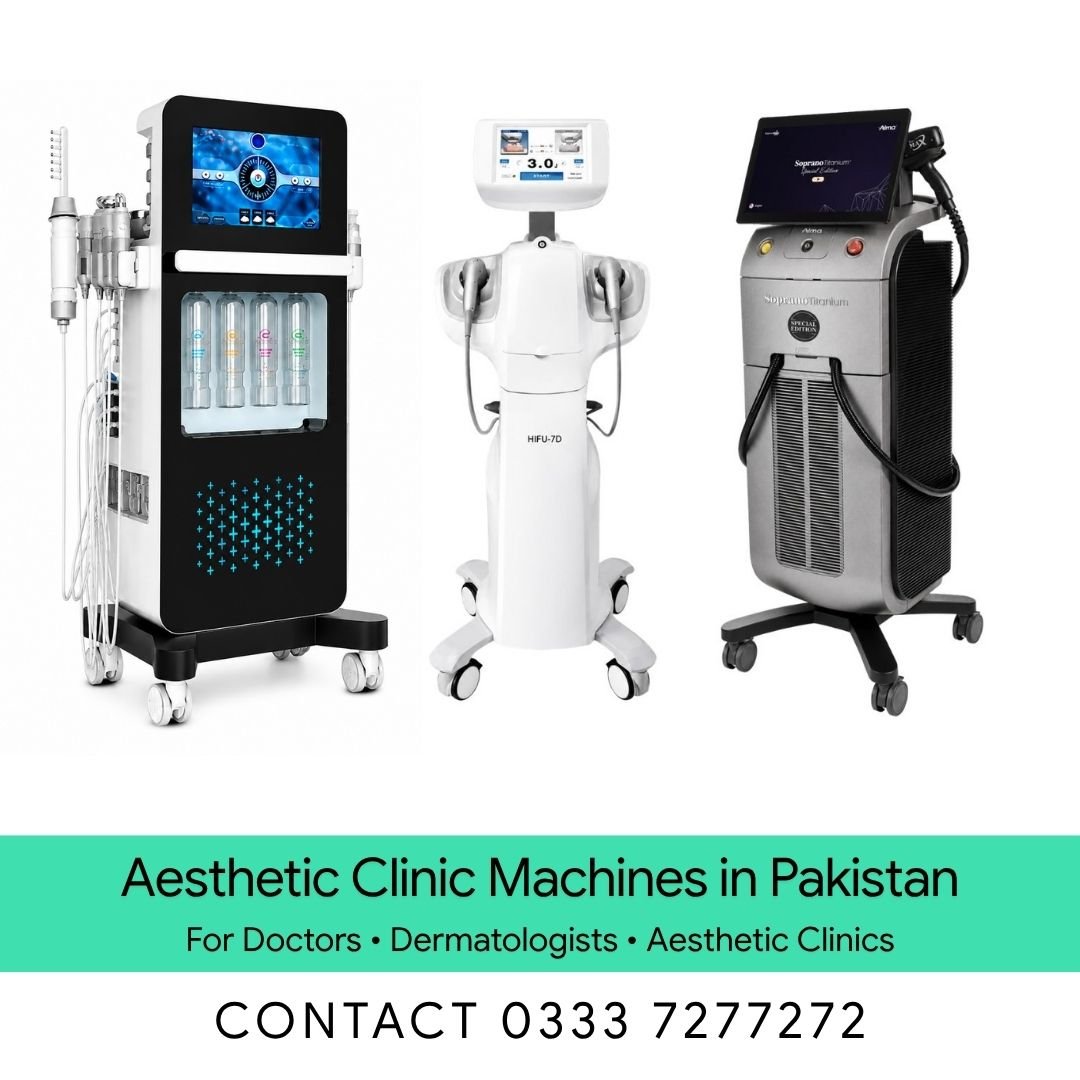
Aesthetic machines have become one of the most important investments for modern aesthetic clinics, dermatology practices, skin clinics, beauty centers, and medical aesthetics businesses in Pakistan. From laser hair removal and HydraFacial treatments to pigmentation correction, skin resurfacing, RF skin tightening, and body contouring, the right aesthetic equipment can significantly expand the range of services a clinic can offer.
The aesthetic equipment market has also evolved rapidly. Clinics in Pakistan now have access to machines manufactured by companies from different parts of the world, including Europe, the United States, China, Korea, and other major medical-device manufacturing markets.
However, buying an aesthetic machine is not simply about choosing the most expensive or most powerful device. Clinic owners and doctors need to consider the treatment they want to provide, patient demand, machine quality, manufacturer reputation, availability of consumables and spare parts, technical support, training, warranty, and return on investment.
This guide explains aesthetic machines in Pakistan, the most commonly used equipment, their importance, how to choose machines for an aesthetic clinic, and what to consider when purchasing from an aesthetic machine manufacturer, importer, or supplier.
Importance of Aesthetic Machines in Modern Clinics
Aesthetic machines play an important role in many commonly performed cosmetic and dermatological procedures.
Some treatments depend heavily on specialized equipment. Examples include:
- Laser hair removal
- HydraFacial
- Pico laser treatments
- Fractional CO2 laser treatments
- Radiofrequency skin tightening
- RF microneedling
- Oxygen facial treatments
- Electrocautery
- Skin resurfacing
- Pigmentation treatments
- Acne scar treatments
- Body contouring
- Fat reduction
- Skin tightening
- LED light therapy
- Ultrasound-based aesthetic treatments
These technologies allow clinics to provide standardized, repeatable treatments for a wide range of common aesthetic concerns.
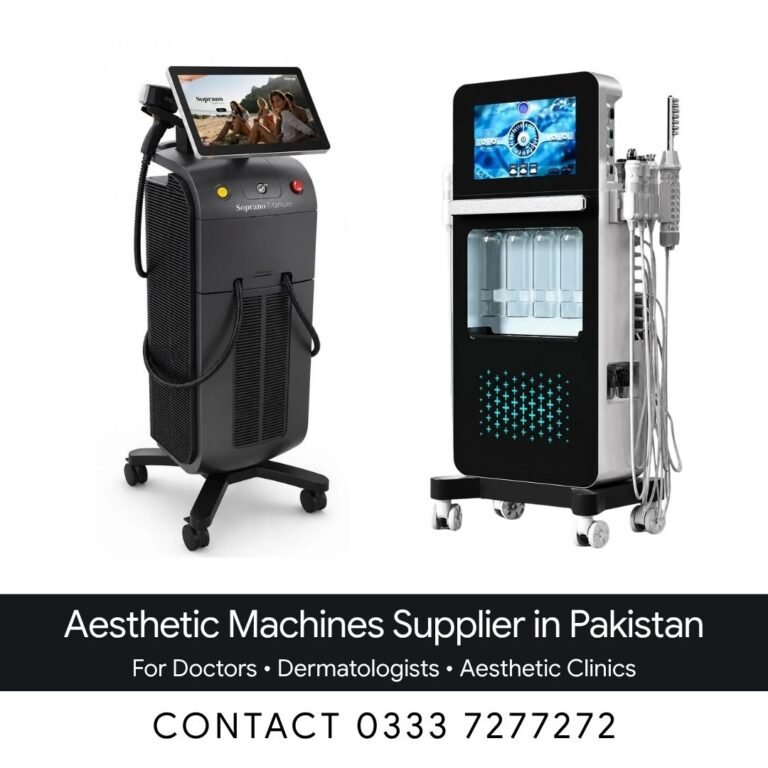
For example, laser hair removal machines are used for long-term reduction of unwanted hair, while HydraFacial-type systems are commonly used for cleansing, exfoliation, extraction, and hydration. Pico lasers are designed for applications involving pigmentation and tattoo-related treatments, while fractional lasers can be used for skin resurfacing and certain scar and texture concerns.
The technology selected by a clinic should therefore be based on the actual treatments the clinic intends to offer.
How Aesthetic Machines Can Help Grow an Aesthetic Business
Investing in the right equipment can create new revenue opportunities for an aesthetic clinic.
A clinic that initially offers only consultations and basic skincare services may expand its treatment portfolio by introducing machine-based services such as laser hair removal, HydraFacial, pigmentation treatments, skin resurfacing, and skin tightening.
1. Expanding Your Treatment Menu
Different machines allow clinics to address different cosmetic concerns.
For example:
Laser hair removal can address unwanted hair.
HydraFacial systems can provide cleansing, exfoliation, extraction, and hydration-focused treatments.
Pico lasers can be used for selected pigmentation and tattoo-related applications.
Fractional CO2 lasers can be used for skin resurfacing and texture-related treatments.
RF systems can be used for various skin-tightening and tissue-heating applications.
A broader treatment portfolio can help a clinic serve more types of clients.
2. Creating Recurring Treatment Plans
Many aesthetic treatments are performed as a series rather than a single session.
Laser hair removal is a good example. Patients commonly require multiple sessions because hair grows in different cycles.
Similarly, certain skin treatments may be planned as a series of treatments depending on the patient’s skin condition, treatment goals, and clinical assessment.
This creates opportunities for clinics to develop structured treatment packages and encourage appropriate follow-up appointments.
3. Increasing Client Retention
Aesthetic businesses depend heavily on repeat clients.
A patient who initially visits for a facial may later become interested in laser hair removal, pigmentation treatment, skin tightening, or another appropriate service.
Having a broader range of professionally selected equipment can allow clinics to provide multiple services under one roof.
4. Improving Clinic Positioning
Modern aesthetic equipment can also influence how a clinic is perceived.
Patients increasingly research technologies before booking an appointment. They may specifically search for terms such as:
- Soprano Titanium laser
- Diode laser hair removal
- Pico laser
- Fractional CO2 laser
- HydraFacial
- RF microneedling
- HIFU
- Skin tightening machine
However, clinics should avoid marketing a machine as a substitute for medical expertise. The equipment is only one part of a successful aesthetic service. Proper patient selection, qualified operators, treatment protocols, maintenance, and clinical safety are equally important.
What Aesthetic Machines Do You Need for Your Clinic?
There is no single list of machines that is suitable for every aesthetic clinic.
Before purchasing equipment, a doctor or clinic owner should first define the business model.
For example, one clinic may focus primarily on:
- Laser hair removal
- Facial treatments
- Skin rejuvenation
Another may specialize in:
- Pigmentation
- Acne scars
- Skin resurfacing
A dermatology or medical aesthetics clinic may want to offer:
- Laser treatments
- Injectables
- RF treatments
- Skin tightening
- Body contouring
- Advanced skin procedures
A plastic surgery clinic may have a completely different equipment requirement.
Therefore, the first question should not be “Which machine should I buy?”
The better question is:
“Which treatments do I want my clinic to provide, and which equipment is clinically appropriate for those treatments?”
Once the treatment plan is established, the equipment requirements become much easier to determine.
Commonly Used Aesthetic Machines in Aesthetic Clinics
The following are some of the most commonly encountered categories of aesthetic equipment.
1. Laser Hair Removal Machines
Laser hair removal is one of the most popular machine-based aesthetic services.
Different technologies are used for hair reduction, including diode, Alexandrite, and Nd:YAG laser systems.
Modern platforms may combine multiple wavelengths or use advanced cooling technologies designed to improve patient comfort and treatment experience.
Laser hair removal machines are commonly used for areas such as:
- Face
- Upper lip
- Chin
- Underarms
- Arms
- Legs
- Back
- Chest
- Bikini area
- Full body
The appropriate technology and settings depend on factors including skin type, hair characteristics, treatment area, and clinical assessment.
For a clinic, laser hair removal can be an attractive service because patients generally require multiple treatment sessions.
2. HydraFacial Machines
HydraFacial-style systems have become popular in aesthetic and skincare clinics.
These machines typically combine multiple treatment steps, which may include:
- Cleansing
- Exfoliation
- Extraction
- Hydration
- Serum infusion
Different machines available in the market may use different technologies, handpieces, tips, vacuum systems, and serum delivery mechanisms.
Clinics should therefore evaluate the actual specifications and manufacturer support rather than selecting a machine based only on the name “HydraFacial.”
3. Pico Laser Machines
Pico laser technology uses extremely short laser pulses and is used in several aesthetic applications.
Depending on the specific wavelength, platform, and clinical protocol, pico systems may be used for:
- Pigmentation concerns
- Selected skin rejuvenation applications
- Tattoo removal
- Certain uneven skin-tone concerns
Pico laser technology is an advanced category, and machine selection should consider wavelength options, pulse characteristics, energy delivery, cooling, manufacturer specifications, and clinical training.
4. Electrocautery Machines
Electrocautery and electrosurgical systems are used in medical and aesthetic settings for selected procedures.
Depending on the device and clinical application, these systems may be used for procedures involving tissue coagulation or removal of selected superficial lesions.
Because electrosurgical equipment involves electrical energy and tissue interaction, it should only be operated by appropriately trained professionals according to relevant clinical protocols.
5. Fractional CO2 Laser Machines
Fractional CO2 laser systems are used for skin resurfacing.
They may be considered for concerns such as:
- Acne scars
- Skin texture
- Fine lines
- Certain scars
- Uneven skin surface
- Photodamage
Fractional CO2 treatment is more intensive than many superficial facial procedures, so patient selection, treatment settings, aftercare, and operator training are particularly important.
6. Radiofrequency Machines
Radiofrequency technology is used across several aesthetic applications.
RF equipment can generally be divided into different categories, including:
Non-invasive RF
Non-invasive RF systems are designed to deliver radiofrequency energy to tissue without intentionally creating surgical incisions.
They are commonly marketed for applications such as:
- Skin tightening
- Facial rejuvenation
- Body contouring
- Tissue heating
RF Microneedling
RF microneedling combines microneedling with radiofrequency energy.
Depending on the device, insulated or non-insulated needles may deliver RF energy at controlled depths.
These systems are used in aesthetic practices for selected skin rejuvenation, texture, scar, and tightening applications.
Invasive RF
Some RF technologies are designed for more invasive applications and should be used only by appropriately qualified professionals in suitable clinical settings.
7. Oxygen Facial Machines
Oxygen facial machines are used by some aesthetic clinics as part of facial and skin-maintenance services.
Depending on the machine, treatment systems may incorporate oxygen delivery, serum application, spraying, infusion, or other facial technologies.
Before purchasing, clinics should examine the exact technology rather than relying solely on the marketing term “oxygen facial.”
8. HIFU Machines
High-Intensity Focused Ultrasound, commonly known as HIFU, is another technology found in aesthetic clinics.
Certain HIFU platforms are designed for aesthetic applications involving focused ultrasound energy.
Different devices have different depths, cartridges, energy delivery systems, and intended applications.
Clinics should verify the manufacturer’s specifications and regulatory status before purchasing.
9. Cryolipolysis and Body Contouring Machines
Body-contouring equipment includes several different technologies.
Depending on the device, these may include:
- Cryolipolysis
- RF body contouring
- Vacuum systems
- Ultrasound-based technologies
- Electromagnetic muscle stimulation
- Combination body-contouring platforms
These machines are often marketed for body shaping and circumference reduction rather than general weight-loss treatment.
10. LED Light Therapy Machines
LED systems are used in skincare and aesthetic environments for light-based facial treatments.
Different wavelengths are associated with different aesthetic applications, and professional devices can vary significantly in power, configuration, treatment area, and controls.
11. Skin Analyzers
Digital skin analysis systems can help clinics document and evaluate selected skin characteristics.
These devices may analyze or photograph parameters related to:
- Pigmentation
- Pores
- Texture
- Wrinkles
- Redness
- Skin condition
They can also be useful for before-and-after documentation and treatment planning when used appropriately.
Other Aesthetic Equipment for Modern Clinics
The aesthetic machine market is much broader than the basic categories mentioned above.
Depending on the clinic’s specialization, additional equipment may include:
- Microneedling machines
- RF microneedling systems
- IPL machines
- Nd:YAG lasers
- Alexandrite lasers
- Diode lasers
- Q-switched lasers
- Fractional Er:YAG lasers
- HIFU systems
- Ultrasound machines
- Vacuum therapy systems
- Body sculpting systems
- Cavitation machines
- EMS systems
- Plasma devices
- Skin scrubbers
- High-frequency facial machines
- Microdermabrasion systems
- Dermabrasion equipment
- LED therapy systems
- Digital skin analyzers
- Facial steaming systems
- Oxygen infusion systems
The exact equipment requirement depends on the services, clinical expertise, target market, available space, budget, and business model.
Aesthetic Machine Manufacturers Around the World
Aesthetic equipment is manufactured in many countries.
Some of the major manufacturing markets include:
Europe
European manufacturers are well known for producing medical and aesthetic technologies across laser, energy-based, and dermatological applications.
Countries such as Italy, France, Germany, Spain, and other European markets have established medical-device industries.
United States
The United States is another major market for medical aesthetics technology.
Several global aesthetic technology companies develop laser, RF, ultrasound, body-contouring, and other energy-based systems.
South Korea
South Korea has become an important manufacturer of aesthetic and dermatological equipment.
Korean companies produce a wide range of laser, RF, HIFU, skincare, and other aesthetic technologies.
China
China has become one of the largest manufacturing centers for aesthetic equipment.
Chinese manufacturers produce everything from entry-level facial equipment to sophisticated laser and energy-based systems.
However, quality varies significantly between manufacturers. Therefore, buyers should evaluate the manufacturer, documentation, specifications, quality-control processes, warranty, service support, and regulatory documentation rather than assuming that all machines from a particular country are equivalent.
How to Choose an Aesthetic Machine Supplier in Pakistan
Choosing the supplier can be just as important as choosing the machine.
A machine may be technically excellent, but if the supplier cannot provide proper installation, training, maintenance, or spare parts, the clinic can face significant operational problems.
Before purchasing, ask the supplier about:
Manufacturer
Who actually manufactures the machine?
Is the company an established manufacturer?
Does the manufacturer have technical documentation?
Authenticity
Ask for genuine product documentation and serial-number information where applicable.
If the machine is being marketed under a well-known international brand, verify the product and distributor relationship independently.
Warranty
Understand:
- Warranty duration
- What components are covered
- What is excluded
- Who handles warranty claims
- Whether parts and labor are included
Training
Aesthetic equipment should not simply be delivered and left at the clinic.
Ask whether the supplier provides:
- Installation
- Operator training
- Clinical orientation
- Technical training
- User manuals
- Maintenance guidance
Spare Parts
Ask whether replacement components are available in Pakistan.
This is particularly important for machines that depend on consumables, handpieces, filters, lamps, cooling components, cartridges, tips, or other replaceable parts.
After-Sales Service
A supplier should ideally have a reliable technical-support system.
A clinic may lose revenue if an important machine remains unavailable for an extended period because a small component needs replacement.
Imported vs Locally Available Aesthetic Machines
Aesthetic machines available in Pakistan can generally enter the market through different channels.
Some machines are imported directly by companies or distributors, while others are sourced through local dealers.
Imported equipment may offer access to established international brands and advanced technologies.
However, purchasing directly from overseas can also create additional responsibilities, including:
- Import documentation
- Customs
- Shipping
- Installation
- Technical support
- Warranty management
- Spare parts
- Operator training
For many clinics, purchasing through an established local supplier can simplify these issues.
The important point is to verify the supplier and machine before making a significant investment.
How Much Do Aesthetic Machines Cost in Pakistan?
The price of aesthetic machines in Pakistan varies considerably.
There is no single price for a particular category because machines can differ in:
- Manufacturer
- Technology
- Wavelength
- Energy output
- Handpieces
- Cooling technology
- Software
- Treatment modes
- Build quality
- Warranty
- Accessories
- Consumables
- Training
- After-sales support
For example, a basic facial machine and a professional medical laser system may both be described broadly as “aesthetic machines,” but their specifications, intended applications, and investment levels can be completely different.
Therefore, clinics should avoid selecting equipment solely on the basis of the lowest available price.
The better approach is to compare the total cost of ownership.
This includes:
Purchase price + installation + training + maintenance + consumables + spare parts + downtime.
Return on Investment of Aesthetic Machines
One of the most important questions for a clinic owner is whether an aesthetic machine can generate a reasonable return on investment.
ROI depends on several factors:
- Purchase price
- Treatment price
- Number of patients
- Number of sessions
- Consumable cost
- Maintenance expenses
- Staff cost
- Marketing expenses
- Machine utilization
- Competition in the local market
For example, if a clinic purchases a laser hair removal system, the business model should consider how many sessions can realistically be performed each month and what the clinic’s actual contribution margin is after operating expenses.
A machine that is used regularly may have a stronger business case than a more expensive machine that sits unused.
Do Not Buy an Aesthetic Machine Only Because It Is Popular
One of the most common mistakes is purchasing equipment simply because another clinic is using it.
A machine that works well for one business may not be the right investment for another.
Before buying, ask:
Who are my target clients?
Which treatments are they requesting?
What services are competitors offering?
What treatments can my qualified staff safely provide?
How much can I realistically invest?
How frequently will the machine be used?
What is the expected payback period?
These questions can help prevent unnecessary equipment purchases.
Aesthetic Machine Supplier in Pakistan
When searching for an aesthetic machine supplier in Pakistan, clinic owners commonly look for suppliers offering:
- Laser hair removal machines
- HydraFacial machines
- Pico lasers
- CO2 lasers
- RF machines
- HIFU machines
- RF microneedling machines
- IPL systems
- Body-contouring machines
- Facial equipment
- Skin analyzers
- Professional aesthetic devices
A reliable supplier should ideally provide more than a machine.
The complete package may include:
Machine + installation + training + warranty + technical support + spare parts + maintenance.
This is especially important for clinics purchasing expensive equipment for long-term commercial use.
Questions to Ask Before Buying an Aesthetic Machine
Before paying for an aesthetic machine, ask the supplier these questions:
- Who is the original manufacturer?
- Where is the machine manufactured?
- What technology does it use?
- What are the machine’s specifications?
- Is the product intended for professional clinical use?
- What documentation is provided?
- What warranty is included?
- Is installation included?
- Is operator training included?
- Are spare parts available?
- How quickly can technical support be provided?
- What consumables are required?
- What is the expected maintenance schedule?
- Is the machine suitable for the treatments I plan to offer?
- Can the supplier provide a demonstration?
- Can the machine’s serial number and manufacturer information be verified?
These questions can help clinics distinguish between a professional equipment supplier and a seller who is simply importing and reselling machines.
Why Machine Quality Matters
Aesthetic machines interact directly with patients and can deliver different forms of energy to the body.
Depending on the technology, these may include:
- Laser energy
- Light energy
- Radiofrequency
- Ultrasound
- Electrical energy
- Thermal energy
Incorrect equipment selection, improper settings, inadequate training, or poor maintenance can increase the risk of unwanted outcomes.
Therefore, clinics should prioritize equipment quality, appropriate training, clinical protocols, and maintenance.
A cheaper machine is not necessarily cheaper in the long run if it requires frequent repairs, has inconsistent performance, or cannot be supported with spare parts.
Build Your Aesthetic Clinic Equipment Plan
Instead of purchasing every machine at once, a clinic can develop an equipment roadmap.
Phase 1: Core Services
Start with equipment required for the clinic’s highest-demand services.
For example:
- Laser hair removal
- Facial treatments
- Basic skin treatments
Phase 2: Advanced Treatments
Once patient demand and revenue become established, the clinic can consider adding:
- Pico laser
- Fractional laser
- RF microneedling
- HIFU
- Advanced skin rejuvenation equipment
Phase 3: Specialized Equipment
A mature clinic may expand into:
- Advanced body contouring
- Combination platforms
- Specialized lasers
- Advanced diagnostic systems
- Specialized medical aesthetic equipment
This phased approach can reduce unnecessary capital expenditure.
Aesthetic Machines Are an Investment, Not Just Equipment
For an aesthetic clinic, a machine should be viewed as a business and clinical investment.
The best machine is not necessarily the newest machine, the most expensive machine, or the machine with the longest list of features.
The right machine is the one that matches:
Clinical need + patient demand + operator expertise + budget + service support + long-term business strategy.
A clinic that carefully evaluates these factors can make better equipment decisions and build a more sustainable aesthetic business.
Also you can consult Ahmed Abdullah who is one of the best aesthetic clinic marketing expert in Pakistan, with overall 10+ years of experience in health care marketing industry he can guide you properly about what is the best machines for you according to your area location and patients demands.
Final Thoughts
The aesthetic machine industry in Pakistan is growing, and clinics now have access to a wide range of technologies from international and local suppliers.
Laser hair removal, HydraFacial systems, Pico lasers, fractional CO2 lasers, RF technologies, HIFU, oxygen facial systems, electrocautery, body-contouring equipment, and other aesthetic technologies are increasingly used across modern aesthetic practices.
However, purchasing a machine should never be based only on advertisements or price.
Clinic owners and doctors should investigate the manufacturer, technology, specifications, documentation, warranty, training, after-sales service, spare parts, and expected return on investment.
If you are planning to establish or expand an aesthetic clinic in Pakistan, creating a proper equipment plan before purchasing can help you invest your budget more effectively and select machines that support both your clinical services and long-term business growth.
Frequently Asked Questions
What are the most commonly used aesthetic machines in Pakistan?
Common categories include laser hair removal machines, HydraFacial systems, Pico lasers, fractional CO2 lasers, RF machines, RF microneedling systems, HIFU machines, oxygen facial equipment, electrocautery systems, IPL devices, and body-contouring machines.
Which aesthetic machine is best for a new clinic?
There is no universal best machine. The appropriate equipment depends on the clinic’s treatment menu, target clients, budget, qualified staff, and expected patient demand.
Where can I buy aesthetic machines in Pakistan?
Aesthetic machines can be purchased through local suppliers, authorized distributors, importers, and specialized medical-aesthetic equipment companies. Buyers should verify the supplier, manufacturer, warranty, documentation, and after-sales support before purchasing.
Are Chinese aesthetic machines good?
Chinese aesthetic machines range from basic entry-level products to sophisticated professional equipment. Quality varies between manufacturers, so the country of manufacture alone should not determine the purchase decision.
How much does an aesthetic machine cost in Pakistan?
Prices vary significantly according to technology, manufacturer, specifications, accessories, warranty, and support. A professional clinic should compare total ownership cost rather than purchase price alone.
What should I check before buying an aesthetic machine?
Check the manufacturer, specifications, authenticity, warranty, installation, training, spare parts, consumables, technical support, maintenance requirements, and suitability for the intended clinical application.
Can aesthetic machines increase clinic revenue?
Yes. Properly selected equipment can allow a clinic to introduce additional services, create treatment packages, attract new clients, and increase repeat visits. However, profitability depends on patient demand, pricing, utilization, operating costs, and effective marketing.
Is after-sales service important?
Yes. Reliable technical support, maintenance, spare parts, and operator training can be extremely important for clinics that depend on machines for daily treatments.
Aesthetic Machines in Pakistan — Choose Based on Your Clinic’s Needs
Whether you are setting up a new aesthetic clinic, expanding an existing dermatology practice, or looking for a replacement machine, the purchasing decision should begin with your treatment goals.
Choose the technology first, evaluate the manufacturers, compare suppliers, verify the equipment, calculate the business case, and then make the investment.
The right aesthetic machine can become an important part of a clinic’s treatment capabilities and long-term growth strategy.