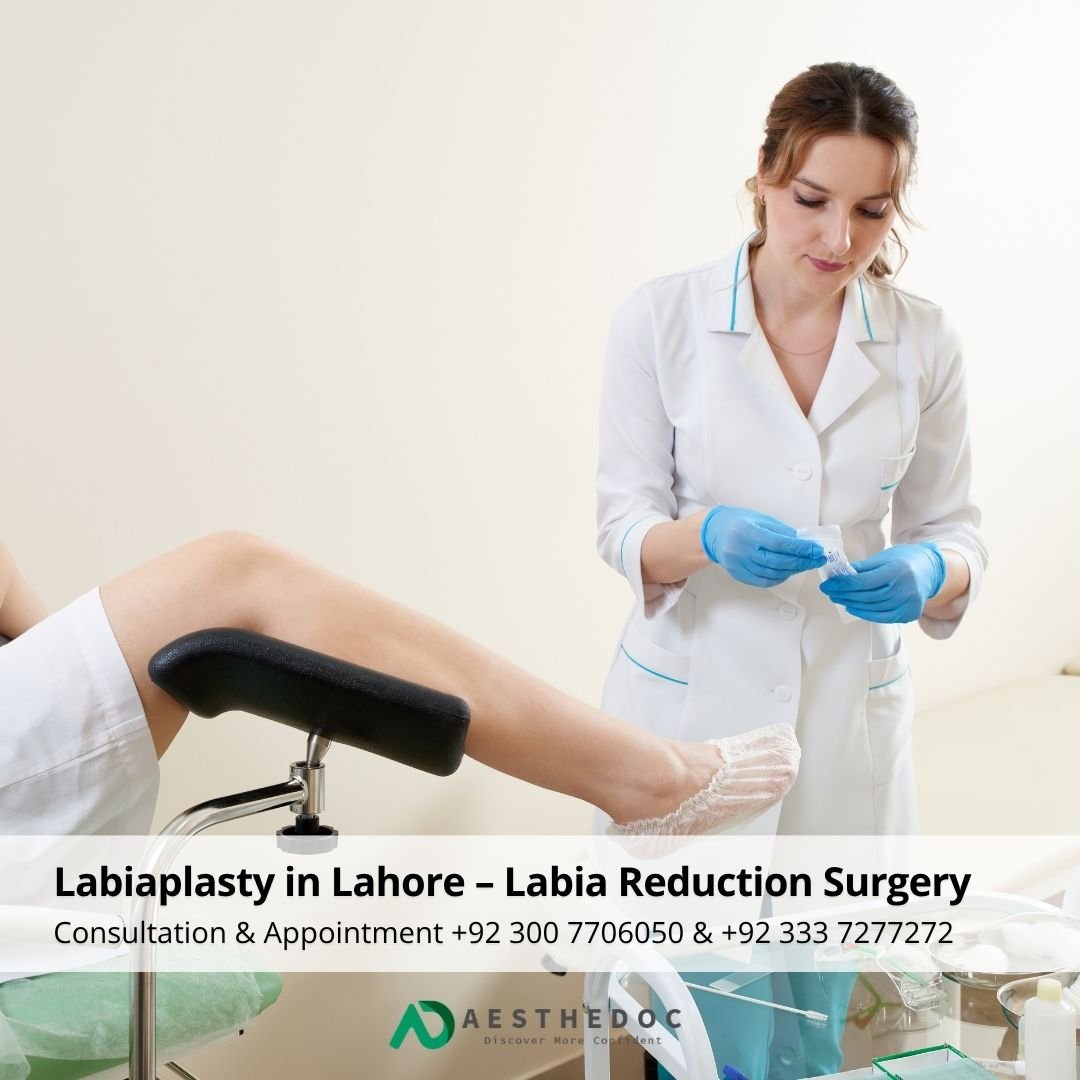
Labiaplasty is a cosmetic and reconstructive gynecological procedure that involves reshaping or reducing the labia, usually the labia minora (the inner folds of tissue surrounding the vaginal opening). Women may consider labiaplasty because of persistent physical discomfort, irritation, asymmetry or personal concerns about the appearance of their intimate anatomy.
Interest in labiaplasty in Lahore has increased as more women seek information about labia reduction surgery, surgical techniques, recovery, safety and treatment costs. Some women experience discomfort during exercise, cycling or wearing tight clothing, while others are concerned about the size or shape of their labia.
However, it is important to understand that labial anatomy varies naturally. Labia can differ in size, shape, colour and symmetry, and prominent or uneven labia are not automatically a medical problem.
Labiaplasty should be considered only after an appropriate consultation, realistic discussion of expectations and careful assessment of potential benefits and complications.
This comprehensive guide explains what labiaplasty involves, who may be suitable, how the procedure is performed, what recovery looks like and what women should consider before choosing labia reduction surgery.
What Is Labiaplasty?
Labiaplasty is a surgical procedure that reshapes or reduces the labia, most commonly the labia minora.
The labia minora are the inner folds of tissue around the vaginal opening. They vary considerably between individuals. Some are small and mostly covered by the outer labia, while others extend beyond the labia majora.
The procedure may be considered for:
- Persistent rubbing or irritation
- Discomfort during exercise or cycling
- Pulling or twisting of labial tissue
- Difficulty wearing certain clothing because of physical discomfort
- Selected concerns about labial asymmetry
- Personal aesthetic concerns after careful counselling
The goal is not to create one standard appearance. A responsible surgical approach aims to preserve healthy tissue, protect sensation and address the patient’s specific concern.
Understanding Female Labial Anatomy
The external female genital area, known as the vulva, includes several structures.
Labia majora
The labia majora are the outer folds of skin and fatty tissue surrounding the external genital area. They provide protection for the underlying structures.
Labia minora
The labia minora are the inner folds located inside the labia majora. They vary naturally in length, thickness, pigmentation and shape.
Clitoral hood
The clitoral hood is a fold of tissue that covers and protects the clitoris. It is anatomically sensitive and requires particular care during any nearby surgical procedure.
Vaginal opening
The vaginal opening is located below the urethral opening and is surrounded by the vestibular tissues and labia.
Understanding these structures is important because labiaplasty should be planned according to individual anatomy rather than an assumed aesthetic standard.
Is It Normal to Have Large or Uneven Labia?
Yes. Labial size and shape vary naturally.
Some women have labia minora that extend beyond the outer labia, while others have smaller or more symmetrical folds. Differences in pigmentation and texture are also common.
There is no single medically correct labial appearance.
Prominent labia do not automatically indicate a disease, poor hygiene or a problem with sexual function. A woman should not feel that she needs surgery simply because her anatomy differs from photographs or images seen online.
A gynecologist can assess whether symptoms are caused by labial tissue or another condition.
Why Do Women Consider Labiaplasty in Lahore?
Women may seek labiaplasty consultation for different reasons.
1. Physical irritation
Prominent labial tissue may rub against clothing or skin during movement. Some women report irritation during walking, running or exercise.
Persistent symptoms should be assessed to exclude skin conditions, infections or other causes.
2. Discomfort during exercise
Activities such as cycling, horse riding, running and gym workouts may create pressure or friction around the external genital area.
Selected women with persistent labial discomfort may discuss surgical options after appropriate assessment.
3. Discomfort when wearing clothing
Some women report pulling, rubbing or discomfort while wearing fitted trousers, underwear or sportswear.
The clinician should determine whether labial anatomy is responsible for the symptoms.
4. Labial asymmetry
It is common for one labium to be longer or shaped differently from the other.
Some women seek consultation because of a noticeable difference that causes persistent concern. Surgery should be considered only after discussing normal variation and realistic outcomes.
5. Personal aesthetic concerns
Some women are concerned about the appearance of their labia.
A responsible consultation should provide accurate information about normal anatomy and explain that surgery cannot guarantee a particular appearance or improve sexual satisfaction.
6. Changes after childbirth or ageing
Pregnancy, childbirth, hormonal changes and ageing may affect external genital tissues.
However, not every change requires surgery. Assessment is important to determine whether a specific anatomical concern is present.
Types of Labiaplasty
Labiaplasty may involve the labia minora, labia majora or selected surrounding tissues.
The procedure should be tailored to the patient’s anatomy and treatment goals.
1. Labia Minora Reduction
Labia minora reduction is the most commonly discussed form of labiaplasty.
It involves reshaping or reducing selected tissue of the inner labial folds.
The surgeon must preserve adequate tissue and protect important anatomical structures.
2. Labia Majora Reduction
Labia majora reduction may involve removing selected excess skin or tissue from the outer labial folds.
It is a different procedure from labia minora reduction and requires separate surgical planning.
3. Labia Majora Augmentation
Some women have concerns about volume loss or changes in the outer labia. Selected treatments may involve volume restoration, but suitability and evidence depend on the proposed method.
Patients should ask about the material or technique being used, its risks and the expected duration of results.
4. Asymmetry Correction
In selected cases, a surgeon may reshape one or both labia to address a significant asymmetry.
Perfect symmetry cannot be guaranteed because normal anatomy is not always symmetrical and healing varies.
5. Combined Labiaplasty
Some women enquire about combining labiaplasty with another procedure, such as clitoral hood reduction or perineal reconstruction.
Combined procedures require careful planning. Additional surgery should not be recommended unless there is a clear and appropriate reason.
Labiaplasty Surgical Techniques
There are several surgical techniques for labia minora reduction.
The choice depends on tissue shape, the location of excess tissue, pigmentation, anatomical features and the surgeon’s assessment.
1. Trim Technique
The trim technique involves removing a selected strip of tissue along the edge of the labia minora.
Potential considerations include:
- Allows reduction along the free edge
- May address selected irregular or elongated edges
- Requires careful preservation of adequate tissue
- Can alter the natural edge appearance
- May result in visible scarring or changes in pigmentation
2. Wedge Technique
The wedge technique involves removing a selected section of tissue while preserving much of the natural labial edge.
Potential considerations include:
- Preserves more of the natural free edge
- Can be suitable for selected anatomical patterns
- Requires careful tissue planning
- May involve wound separation or healing complications at the closure site
Neither technique is universally superior. The appropriate approach depends on individual anatomy and the surgeon’s experience.
Who May Be Suitable for Labiaplasty?
Suitability depends on the patient’s symptoms, medical history, anatomy and expectations.
A woman may be considered for surgery when:
- She has a clearly identified concern involving the labia.
- Persistent physical symptoms have been assessed.
- She understands natural anatomical variation.
- She has realistic expectations.
- She is making the decision voluntarily.
- Her general health is suitable for surgery.
- She understands the potential risks and limitations.
The patient should have an opportunity to discuss alternatives, including conservative management.
Who Should Avoid or Delay Labiaplasty?
Surgery may need to be postponed or reconsidered in situations such as:
- Active genital infection
- Untreated vulvar skin conditions
- Unexplained genital lesions or bleeding
- Pregnancy
- Recent childbirth before adequate healing
- Medical conditions that increase surgical risk
- Unresolved genital pain
- Unrealistic expectations
- External pressure or coercion
Women with persistent itching, burning, skin changes or pain should first be assessed for conditions such as vulvar dermatitis, lichen sclerosus, infection or other gynecological problems.
Removing labial tissue will not treat every cause of genital discomfort.
How Is Labiaplasty Performed?
Labiaplasty is performed in an appropriate surgical setting using an anaesthesia plan selected according to the procedure and patient’s needs.
A general overview includes the following stages.
Step 1: Consultation
The doctor discusses the patient’s concerns, medical history, symptoms and expectations.
Previous surgery, childbirth history, medication use and allergies may also be reviewed.
Step 2: Examination
With informed consent, the surgeon examines the labia and surrounding structures.
The assessment may include:
- Labial size and shape
- Symmetry
- Tissue quality
- Location of the area causing discomfort
- Clitoral hood anatomy
- Skin conditions or inflammation
Step 3: Surgical planning
The surgeon explains the recommended technique, amount of tissue to be treated, anaesthesia options, risks and expected recovery.
The plan should prioritise tissue preservation and protection of sensation.
Step 4: Anaesthesia
Depending on the case, local anaesthesia with or without sedation or another suitable anaesthesia approach may be used.
Step 5: Tissue reshaping
The surgeon removes or reshapes selected tissue using the planned technique.
Absorbable sutures are commonly used to close the surgical area.
Step 6: Postoperative observation
The patient is monitored according to the procedure and anaesthesia plan.
The clinical team provides instructions about hygiene, medication, activity and follow-up.
Benefits of Labiaplasty
Potential benefits depend on the patient’s reason for surgery and individual anatomy.
For selected patients, labiaplasty may:
- Reduce persistent friction associated with prominent tissue
- Address selected labial asymmetry
- Reduce pulling or irritation during movement
- Improve comfort in certain activities
- Address a specific personal aesthetic concern
However, results vary. Surgery cannot guarantee perfect symmetry, a particular appearance or improved sexual function.
Does Labiaplasty Affect Sexual Sensation?
The labia and surrounding structures contain sensitive tissues. Therefore, preserving normal anatomy and sensation is essential.
Labiaplasty should not be performed with the promise of increasing sexual pleasure.
Potential complications include:
- Altered sensation
- Persistent tenderness
- Pain during intercourse
- Scarring
- Excessive tissue removal
- Changes in the natural contour
The surgeon should explain these risks and the importance of conservative surgical planning.
Does Labiaplasty Affect Pregnancy or Childbirth?
Labiaplasty is generally an external genital procedure and does not directly involve the uterus or ovaries.
However, pregnancy and childbirth may affect genital tissues and the appearance of the vulva.
Women planning pregnancy should discuss timing with their surgeon. It may be sensible to consider whether future childbirth could alter the surgical result.
Labiaplasty vs Vaginoplasty: What Is the Difference?
These procedures address different anatomical structures.
| Feature | Labiaplasty | Vaginoplasty |
|---|---|---|
| Main area | Labia minora or majora | Vaginal canal and selected supporting tissues |
| Main purpose | Reshaping or reduction of labial tissue | Vaginal reconstruction or selected tissue repair |
| Common concerns | Labial prominence, asymmetry or friction | Selected vaginal structural concerns |
| Surgical approach | External genital tissue reshaping | Internal vaginal tissue reconstruction, depending on indication |
| Recovery | Depends on extent of labial surgery | Depends on the vaginal procedure |
A woman seeking treatment for labial discomfort does not automatically need vaginoplasty.
Recovery After Labiaplasty
Recovery varies according to the technique, extent of surgery and individual healing.
Some swelling, bruising, tenderness and sensitivity are expected during the early recovery period.
First few days
Patients may experience:
- Swelling around the labia
- Mild spotting
- Tenderness
- Discomfort while sitting or walking
- Local sensitivity
The surgeon may recommend appropriate pain relief and local care.
First few weeks
Patients may be advised to:
- Avoid strenuous exercise
- Avoid cycling and activities that cause friction
- Wear comfortable, loose clothing
- Follow hygiene instructions
- Avoid sexual intercourse until cleared
- Avoid inserting anything into the vagina until advised
- Attend follow-up appointments
When can patients return to work?
The timing depends on the nature of the work, discomfort and healing. Patients with physically demanding jobs may require more time than those with desk-based work.
When can exercise resume?
Exercise should resume gradually and only according to the surgeon’s advice. Activities that create pressure or friction around the labia may need to be avoided until healing is adequate.
When can sexual intercourse resume?
Patients should avoid intercourse until the surgeon confirms that the surgical area has healed sufficiently.
There is no universal recovery interval for every patient.
Possible Risks and Complications of Labiaplasty
Labiaplasty is surgery and carries potential complications.
These may include:
- Bleeding
- Infection
- Swelling and bruising
- Wound separation
- Delayed healing
- Scarring
- Uneven appearance
- Excessive tissue removal
- Persistent pain
- Altered sensation
- Pain during intercourse
- Need for revision surgery
- Dissatisfaction with the result
Excessive removal of labial tissue may be difficult or impossible to reverse fully.
Patients should understand that a surgical result may not match digitally edited images or idealised photographs.
Is Labiaplasty Permanent?
Labiaplasty permanently removes or reshapes selected tissue. However, the long-term appearance can still be influenced by ageing, hormonal changes, pregnancy, childbirth and individual healing.
The result cannot be guaranteed to remain identical throughout life.
A surgeon should explain what changes are intended and what limitations remain.
Labiaplasty Cost in Lahore
The cost of labiaplasty in Lahore varies according to the type and complexity of the operation.
Factors that may influence the total price include:
- Trim or wedge technique
- Labia minora or labia majora treatment
- Whether one or both sides require surgery
- Surgeon’s fee
- Anaesthesia requirements
- Surgical facility charges
- Preoperative investigations
- Medication
- Postoperative follow-up
Patients should obtain a personalised quotation after assessment.
The estimate should clarify what is included and whether additional facility, anaesthesia or investigation charges may apply.
How to Choose a Labiaplasty Surgeon in Lahore
Selecting a qualified gynecologist and an appropriate surgical facility is essential.
Before proceeding, consider the following:
1. Verify qualifications: Check the surgeon’s recognised medical qualifications and relevant specialist registration.
2. Ask about labiaplasty experience: Ask how frequently the surgeon performs the specific procedure being considered.
3. Discuss tissue preservation: Understand how the surgeon plans to preserve adequate tissue and protect normal sensation.
4. Ask about surgical techniques: Request an explanation of the trim, wedge or other proposed technique and why it is appropriate.
5. Discuss complications: Ask about scarring, wound separation, persistent pain and possible changes in sensation.
6. Confirm the facility: Understand where the operation will be performed and who will provide anaesthesia.
7. Review expectations: Discuss what can realistically be achieved and what cannot be guaranteed.
8. Protect privacy: Confirm that examinations, medical records and clinical photographs are handled confidentially.
A responsible clinician should allow enough time for questions and should not pressure a woman into elective surgery.
Frequently Asked Questions About Labiaplasty in Lahore
1. What is labiaplasty?
Labiaplasty is a surgical procedure that reshapes or reduces the labia, usually the labia minora. It may be considered for selected physical symptoms or personal aesthetic concerns.
2. Is it normal to have large labia?
Yes. Labia vary naturally in size, shape, colour and symmetry. Prominent labia are not automatically a medical problem.
3. Is labiaplasty painful?
Some discomfort, swelling and tenderness can occur after surgery. The anaesthesia and pain management plan should be discussed with the surgeon.
4. What is the difference between trim and wedge labiaplasty?
The trim technique removes selected tissue along the labial edge, while the wedge technique removes a section of tissue while preserving much of the natural edge. The choice depends on anatomy and surgical planning.
5. Does labiaplasty improve sexual pleasure?
There is no guarantee of improved sexual pleasure. The procedure may address selected physical discomfort, but it can also cause altered sensation or pain.
6. Can labiaplasty reduce discomfort during exercise?
Some women with persistent friction-related discomfort may benefit from treatment. A clinical assessment is necessary to determine whether the labia are the actual cause.
7. Does labiaplasty affect the vagina?
Labiaplasty primarily involves the external labial tissue. It is different from vaginoplasty, which involves the vaginal canal and selected supporting structures.
8. How long does recovery take after labiaplasty?
Recovery varies by technique and individual healing. Patients should follow their surgeon’s instructions about exercise, work, hygiene and sexual activity.
9. Can labiaplasty be performed after childbirth?
Selected women may be suitable after childbirth once adequate recovery has occurred. The timing should be determined by a gynecologist.
10. Can labiaplasty affect future pregnancy?
Labiaplasty does not directly involve the reproductive organs, but pregnancy and childbirth can affect the appearance of external genital tissues. Future pregnancy plans should be discussed before surgery.
11. What are the risks of labiaplasty?
Possible risks include bleeding, infection, scarring, wound separation, altered sensation, persistent pain, asymmetry and dissatisfaction with the result.
12. How much does labiaplasty cost in Lahore?
The cost depends on the surgical technique, complexity, anaesthesia, facility charges and follow-up care. A personalised estimate is available after consultation.
13. How can I book a labiaplasty consultation with Aesthedoc?
Contact Aesthedoc to enquire about consultation arrangements, surgical suitability and appointment availability with Dr. Maimunah Faruque.
Final Thoughts
Labiaplasty is a surgical option for selected women who have persistent physical discomfort or specific concerns about labial anatomy. However, labial size and shape vary naturally, and surgery is not medically necessary simply because the labia are prominent or asymmetrical.
The most important steps are understanding normal anatomy, identifying the cause of symptoms, discussing conservative alternatives and choosing a qualified surgeon who prioritises tissue preservation, sensation and patient safety.
For women researching labiaplasty in Lahore, an individual consultation can help determine whether labia reduction surgery is appropriate and what outcomes can realistically be expected.
Book a Consultation with Aesthedoc
For information about labiaplasty, labia reduction surgery and other cosmetic gynecology procedures, contact Aesthedoc.
Consultation with: Dr. Maimunah Faruque
Qualifications: MBBS, FCPS, F.MAS
Speciality: Gyne Endoscopy and Laparoscopic Surgeon | Cosmetic Gynecologist
Phone: 03337277272
Phone: 03007706050
Email: info@aesthedoc.com
Patients travelling from Lahore can contact the team to enquire about consultation arrangements and confirm appointment availability before travelling.