A hair transplant can restore hair growth, improve facial balance and help patients regain confidence. However, not every procedure produces a satisfactory result. Some patients experience unnatural hairlines, visible graft placement, poor density, patchy growth, donor-area depletion or other complications that require careful clinical assessment.
Correcting an unsatisfactory hair transplant is often more challenging than performing a primary procedure. The surgeon must understand what went wrong, assess the remaining donor supply, evaluate existing grafts and scars, and develop a realistic treatment plan without creating further damage.
For doctors entering hair restoration, learning how to assess and manage these cases is an important part of developing advanced surgical judgment.
Corrective hair transplant training for doctors focuses on the clinical reasoning, surgical planning and technical considerations involved in revision hair restoration. It is relevant to medical professionals who want to understand failed FUE procedures, repair unnatural hairlines, manage graft-related problems and plan complex restoration cases.
This guide explores the principles of corrective hair transplantation, common causes of unsatisfactory outcomes, revision FUE techniques, donor management, patient selection and the value of supervised practical training.
What Is Corrective Hair Transplant Surgery?
Corrective hair transplant surgery, also called hair transplant repair or revision hair restoration, refers to procedures intended to improve the appearance or function of a previous hair transplant that has produced an unsatisfactory result.
Unlike primary hair transplantation, revision surgery begins with an existing surgical outcome. The patient may have transplanted follicles, depleted donor areas, scar tissue, altered hair direction or limited remaining graft availability.
The objective is not simply to add more hair. It is to identify the underlying problem and determine whether it can be improved safely.
Corrective procedures may involve:
- Repairing an unnatural or excessively low hairline.
- Improving irregular graft distribution.
- Addressing visible plugs or poorly positioned grafts.
- Improving density in selected areas.
- Managing donor-area overharvesting.
- Evaluating and treating visible surgical scars.
- Planning restoration after poor graft growth.
- Considering removal, redistribution or camouflage of unsuitable grafts.
- Developing a long-term restoration plan for progressive hair loss.
Not every unsatisfactory transplant requires another operation. Some patients may benefit from medical management, observation, camouflage techniques or a combination of approaches. A revision surgeon must be able to recognize when surgery is appropriate and when it is better to avoid further intervention.
Why Corrective Hair Transplant Training Is Important for Doctors
Hair restoration is not limited to extracting follicles and implanting them into recipient areas. Surgical judgment, aesthetic planning, donor preservation and long-term management are equally important.
Revision cases make these skills particularly important because the surgeon has less control over the starting conditions.
A patient may have undergone multiple procedures, received grafts from different surgeons or developed progressive hair loss after the original operation. The surgeon must understand the previous treatment history before deciding on the next step.
Advanced corrective training helps doctors develop a structured approach to:
- Evaluating previous hair transplant results.
- Identifying the likely reasons for an unsatisfactory outcome.
- Examining the donor and recipient areas.
- Assessing the feasibility of additional graft harvesting.
- Planning a realistic corrective strategy.
- Understanding the limitations of revision surgery.
- Counseling patients about risks, uncertainty and expected improvement.
- Recognizing cases that require referral or a non-surgical approach.
For doctors planning to establish a hair restoration practice, understanding revision cases is also important for responsible patient selection and long-term clinical decision-making.
Common Reasons for an Unsuccessful or Unsatisfactory Hair Transplant
A patient may describe a previous transplant as unsuccessful even when some grafts have grown. The problem may relate to appearance, density, hair direction, scarring or expectations rather than complete graft failure.
A proper assessment should distinguish between these different problems.
1. Unnatural Hairline Design
An unnatural hairline is one of the most recognizable reasons patients seek corrective hair transplantation.
A hairline may appear artificial when it is:
- Positioned too low for the patient’s age.
- Excessively straight or symmetrical.
- Designed without appropriate irregularity.
- Too dense at the frontal edge.
- Inconsistent with facial proportions.
- Unsuitable for the patient’s long-term hair-loss pattern.
Hairline design requires an understanding of facial harmony, age, hair characteristics and future progression of androgenetic alopecia.
In some cases, selected grafts may need to be removed or repositioned. In others, carefully planned additional transplantation may soften the appearance of the hairline. The appropriate approach depends on the location, orientation and condition of the existing grafts.
2. Visible Pluggy Grafts
Older hair transplant techniques sometimes produced clusters of hair follicles that appeared unnatural, particularly along the frontal hairline.
Patients may describe these as plugs or doll-like hair growth.
Corrective planning must consider:
- The number and location of visible grafts.
- The size and orientation of the follicular units.
- The condition of surrounding skin.
- Whether the grafts can be safely removed.
- The availability of suitable donor hair for reconstruction.
The goal is to create a more natural transition rather than simply covering every visible graft with additional hair.
3. Poor Hair Growth or Low Density
Some patients experience less growth than expected after transplantation. Others develop uneven density, leaving visible gaps between transplanted areas.
Potential contributing factors may include:
- Graft handling and storage problems.
- Extraction or implantation trauma.
- Poor recipient-site planning.
- Medical or biological factors affecting hair growth.
- Postoperative complications.
- Inadequate donor or recipient area assessment.
- Unrealistic expectations regarding achievable density.
A surgeon should not automatically assume that poor density means the original grafts have failed. The patient needs an appropriate examination and a review of the previous procedure, timeline and medical history.
4. Incorrect Hair Direction and Angulation
Hair direction is a major factor in natural-looking restoration.
When transplanted hair grows at an inappropriate angle or in an inconsistent direction, the result may look artificial even if the grafts survive.
Corrective planning requires evaluation of:
- Existing hair direction.
- Natural growth patterns in surrounding areas.
- Hairline transition.
- Recipient-site orientation.
- The relationship between transplanted and native hair.
Additional implantation alone may not correct an established direction problem. Selected graft removal or other carefully planned interventions may be considered in suitable cases.
5. Donor Area Overharvesting
The donor area is a limited resource. Excessive extraction can create visible thinning, patchiness and an uneven appearance.
Patients may present with:
- Reduced donor density.
- Scattered extraction marks.
- Patchy thinning.
- Visible areas of depletion.
- Poor cosmetic appearance with short hairstyles.
Donor assessment is especially important before revision surgery. The surgeon must estimate what remains available and avoid repeating the original problem.
A revision plan may involve conservative harvesting, alternative restoration strategies or declining further extraction when the donor area is unsuitable.
6. Visible Scarring
Scarring may occur in the donor or recipient area after previous hair restoration procedures.
The appearance and significance of scars depend on factors such as surgical technique, healing, skin characteristics, infection, wound complications and previous procedures.
A corrective assessment should establish:
- The location and extent of scarring.
- Whether the scar is stable.
- The surrounding hair density.
- The quality of available donor hair.
- Whether additional surgery is likely to improve the appearance.
Scar camouflage through transplantation may be considered in selected cases, but it does not guarantee complete scar removal or normal skin appearance.
7. Progressive Hair Loss After Transplantation
Hair transplantation does not stop the underlying progression of androgenetic alopecia.
A patient may initially be satisfied with the result but later experience further loss of native hair. This can create an isolated transplanted area, an unnatural density pattern or a mismatch between the hairline and the remaining hair.
Long-term planning should account for the patient’s age, pattern of hair loss, family history, donor capacity and suitability for medical management.
How to Assess a Patient Before Corrective Hair Transplant Surgery
A revision procedure should begin with a detailed consultation rather than an immediate surgical recommendation.
The surgeon needs to understand the patient’s concerns, previous procedures and current hair restoration status.
1. Review the Previous Surgical History
The consultation should establish:
- When the previous transplant was performed.
- How many procedures the patient has undergone.
- The approximate number of grafts used, if known.
- Whether FUE, FUT or another method was used.
- Which areas were treated.
- Whether complications occurred.
- What postoperative care was provided.
- Whether the patient received medical treatment for hair loss.
Previous surgical records and photographs can help clarify the history. If these are unavailable, the surgeon should document the limitations of the assessment.
2. Examine the Recipient Area
The recipient area should be assessed for density, direction, distribution, scarring and the condition of existing transplanted follicles.
The examination should identify the specific concern rather than treating the entire scalp as one problem.
For example, a patient may have a well-restored frontal region but an unnatural temporal transition. Another patient may have reasonable hairline design but insufficient density in the mid-scalp.
A targeted diagnosis helps prevent unnecessary additional graft placement.
3. Evaluate the Donor Area
Donor assessment is one of the most important parts of revision planning.
The surgeon should examine:
- Current donor density.
- Distribution of previous extraction sites.
- Signs of overharvesting.
- Scarring and skin quality.
- Hair calibre and characteristics.
- The potential for additional harvesting.
- Long-term donor limitations.
The safe donor area should not be assumed to have unlimited capacity. A patient who has undergone several procedures may have very limited options.
4. Assess Hair Loss Progression
A revision procedure should be planned in the context of the patient’s ongoing hair loss.
If native hair continues to miniaturize, adding grafts without a long-term plan may produce an unbalanced result.
The surgeon should evaluate the pattern of alopecia, consider appropriate medical management and discuss how future hair loss could affect the appearance of the revised transplant.
5. Understand the Patient’s Expectations
Some patients expect a revision procedure to restore the appearance of their hair completely. Others may request an extremely low hairline or high density despite limited donor availability.
The surgeon should explain what can realistically be improved, what cannot be reversed and whether more than one treatment stage may be required.
Informed consent should address uncertainty, possible complications, alternative treatments and the possibility that the final result may remain imperfect.
Advanced FUE Techniques in Corrective Hair Transplantation
Follicular Unit Extraction (FUE) is an important technique in modern hair restoration. It involves removing individual follicular units from a donor area for transplantation into selected recipient sites.
FUE may be considered in some corrective procedures, but revision surgery is not simply a repeat of primary FUE.
Previous extraction, scarring and changes in tissue characteristics can make the procedure more complex.
Donor Management in Revision FUE
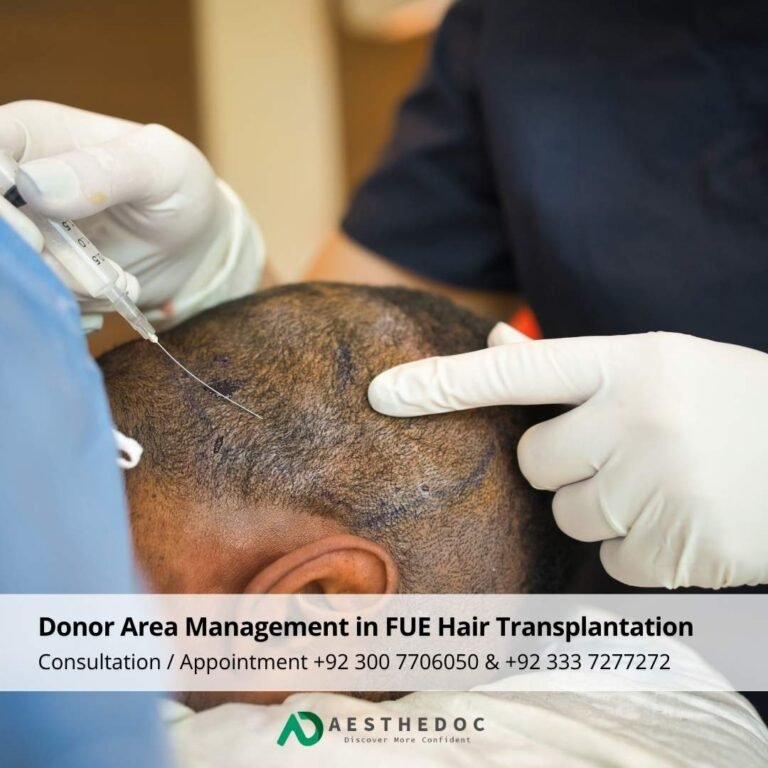
The donor area must be assessed before any additional harvesting.
A revision surgeon needs to consider whether the remaining follicles can be harvested without producing visible depletion. Extraction planning should account for the previous distribution of grafts and the patient’s future needs.
The principle of donor preservation is especially important in patients who have undergone multiple procedures.
Graft Extraction and Handling
Graft quality is relevant to both primary and corrective transplantation.
The clinical process involves attention to:
- Follicular unit identification.
- Punch selection.
- Extraction angle and direction.
- Minimizing transection.
- Careful graft handling.
- Appropriate storage conditions.
- Avoiding unnecessary trauma.
In revision cases, the surgeon must also recognize that previously operated tissue may present additional technical challenges.
Recipient Site Creation
Recipient-site planning determines the distribution, direction and placement of transplanted follicles.
In corrective cases, the surgeon must consider existing grafts, native hair, scars and the intended aesthetic improvement.
A well-planned procedure should prioritize a natural appearance and the responsible use of available donor hair rather than pursuing an arbitrary graft number.
Graft Implantation
Implantation planning should reflect the patient’s hair characteristics, recipient-area anatomy and desired outcome.
The surgeon must consider the direction and orientation of existing hair and avoid unnecessary trauma to surrounding follicles.
The technique used should be selected according to the case, the surgeon’s training and the clinical setting.
Correcting an Unnatural Hairline
Hairline repair is one of the most demanding aspects of corrective hair restoration because the frontal hairline is highly visible.
A poorly designed hairline can affect the appearance of the entire face.
Identifying the Problem
Before recommending revision, the surgeon should identify whether the problem relates to:
- Excessively low positioning.
- A straight or artificial frontal border.
- Incorrect temporal angles.
- Multi-hair grafts in the frontal edge.
- Irregular density.
- Incorrect direction of growth.
- An imbalance between the hairline and facial proportions.
Different problems require different approaches.
Hairline Softening
In selected cases, the appearance of a harsh hairline may be improved through careful planning of additional single-hair follicular units and an appropriate transition zone.
However, adding grafts may not be suitable when the existing grafts are positioned incorrectly or when the donor supply is limited.
Graft Removal and Redistribution
Some patients may have visible grafts that require consideration for removal or redistribution.
These interventions are technically demanding and carry risks, including scarring, damage to surrounding follicles and incomplete correction.
The surgeon should assess whether the potential improvement justifies the intervention.
Age-Appropriate Planning
A hairline that appears acceptable in a young adult may become less natural as facial features and hair-loss patterns change with age.
Corrective planning should avoid repeating an overly aggressive design. A conservative approach may preserve more options for future treatment.
Managing Poor Growth and Low-Density Results
Poor growth is a common reason for revision consultations, but it requires careful diagnosis.
The surgeon should first establish whether sufficient time has passed to assess the outcome. Hair transplantation involves a growth cycle, and the appearance of the scalp changes during recovery.
A patient who presents too early may not yet have a stable result.
Distinguishing Between Different Causes
Low density may result from several different factors:
- Inadequate graft numbers for the intended area.
- Uneven distribution.
- Poor graft survival.
- Progressive loss of native hair.
- Incorrect expectations about density.
- A combination of surgical and biological factors.
A detailed examination is necessary to distinguish these possibilities.
Planning Density Improvement
When additional transplantation is appropriate, the surgeon should consider the available donor supply, recipient-site condition and the long-term hair-loss pattern.
More grafts do not automatically produce a better result. Excessive density planning may increase surgical trauma and place unnecessary pressure on the donor area.
A responsible revision strategy balances the desired cosmetic improvement with the patient’s available resources.
Corrective Surgery for Donor Area Overharvesting
Donor overharvesting can be particularly difficult to manage because the donor area may have limited remaining follicles.
Patients may present with patchy thinning, visible extraction marks or an uneven appearance after multiple FUE procedures.
Donor Area Examination
A careful assessment should establish the extent and distribution of depletion.
The surgeon should consider the patient’s hairstyle preferences, hair calibre, skin characteristics and whether further harvesting would worsen the appearance.
Treatment Planning
Depending on the case, possible approaches may include:
- Avoiding additional extraction.
- Considering suitable camouflage options.
- Evaluating whether carefully selected grafts can be used.
- Discussing the limitations of donor repair.
- Referring the patient for specialist assessment where appropriate.
The most important decision may be to avoid further surgery when the likely harm outweighs the potential benefit.
Scar and Burn-Related Hair Restoration
Scalp scars and burn-related hair loss may require a different approach from routine androgenetic alopecia.
Scar tissue can differ from normal scalp tissue in vascularity, elasticity, thickness and healing characteristics. These differences may influence the suitability and planning of transplantation.
Before considering surgery, the clinician should assess:
- Whether the scar is stable.
- The cause and history of the scar.
- The condition of surrounding tissue.
- The availability of suitable donor follicles.
- The patient’s medical and surgical history.
- The realistic potential for cosmetic improvement.
Not all scars are appropriate for transplantation. Selected patients may be considered after a detailed examination and discussion of the limitations.
The Aesthedoc course page lists scar and burn-related restoration among its advanced hair restoration training topics. <Cite ref=”turn753093view0″/>
Corrective Hair Transplantation: Primary Surgery vs Revision Surgery
Understanding the difference between primary and corrective hair transplantation helps doctors recognize why revision cases require additional planning.
| Clinical factor | Primary hair transplant | Corrective hair transplant |
|---|---|---|
| Starting condition | Untreated recipient area in many cases | Previously operated recipient area |
| Donor assessment | Initial donor evaluation | Reassessment of remaining donor supply |
| Surgical history | Usually limited | May involve multiple previous procedures |
| Tissue condition | Often unoperated | May contain scars or altered tissue |
| Hairline planning | Initial design | Assessment and possible correction of existing design |
| Graft availability | Based on initial donor assessment | May be significantly restricted |
| Patient expectations | First-time restoration goals | Often focused on correcting dissatisfaction |
| Planning complexity | Depends on the case | Frequently increased by previous surgery |
Revision surgery is not automatically more advanced simply because it is a second procedure. Its complexity depends on the original outcome, donor availability, tissue condition and the patient’s goals.
When Should a Doctor Recommend Against Revision Surgery?
One of the most important skills in corrective hair restoration is knowing when not to operate.
A patient may request another procedure even when the available donor supply is inadequate or the expected benefit is limited.
Surgery may be inappropriate or should be deferred when:
- The donor area is severely depleted.
- The cause of hair loss has not been adequately assessed.
- The previous procedure is too recent for a reliable outcome assessment.
- Active scalp disease requires evaluation or treatment.
- The patient has unrealistic expectations.
- The recipient area is unsuitable for further surgery.
- The risks outweigh the likely cosmetic benefit.
- The patient’s medical condition makes surgery unsuitable.
The surgeon should explain alternative options and arrange appropriate specialist assessment when needed.
Ethical patient selection is a fundamental part of safe hair restoration practice.
Patient Counseling and Informed Consent in Revision Hair Restoration
Patients seeking corrective procedures may have experienced disappointment, financial loss or emotional distress after previous treatment.
Consultations should therefore be handled with patience, clear communication and realistic expectations.
The surgeon should discuss:
What can potentially be improved: The specific aesthetic concerns that may be addressed.
What cannot be guaranteed: Complete restoration, perfect symmetry, full scar correction or a particular density cannot be promised.
The limitations of donor supply: Previously harvested follicles cannot simply be replaced.
Possible complications: Infection, bleeding, scarring, poor growth, shock loss, altered sensation and other procedure-related risks should be discussed as clinically relevant.
Recovery and follow-up: The patient should understand the postoperative process and the importance of follow-up assessment.
Alternative approaches: Medical management, camouflage or no further surgery may sometimes be more appropriate.
Good counseling is not merely a communication skill. It is part of clinical decision-making and patient safety.
What Doctors Should Learn in a Corrective Hair Transplant Training Course
A structured hair transplant training programme should cover the principles required to understand both primary and advanced hair restoration cases.
For doctors interested in corrective procedures, important learning areas include:
1. Hair Loss Diagnosis and Patient Selection
Doctors should understand the different patterns of alopecia, indications and contraindications for surgery, and the distinction between medical and surgical treatment planning.
2. Hairline Design and Aesthetic Principles
Training should develop an understanding of age-appropriate hairline design, facial harmony, natural density distribution and relevant hair characteristics.
3. Donor Area Assessment
Doctors should learn how to evaluate the donor region, estimate density, identify the safe donor area and understand the risks associated with overharvesting.
4. FUE Extraction and Graft Handling
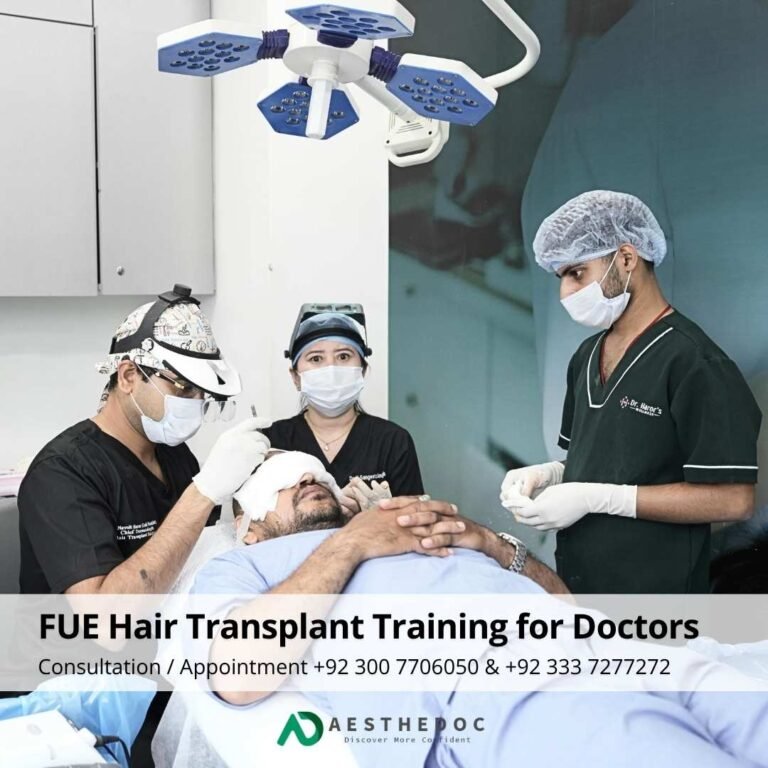
Practical FUE education includes punch selection, extraction technique, graft handling, storage, recipient-site creation and implantation methods.
5. Advanced Hair Restoration Cases
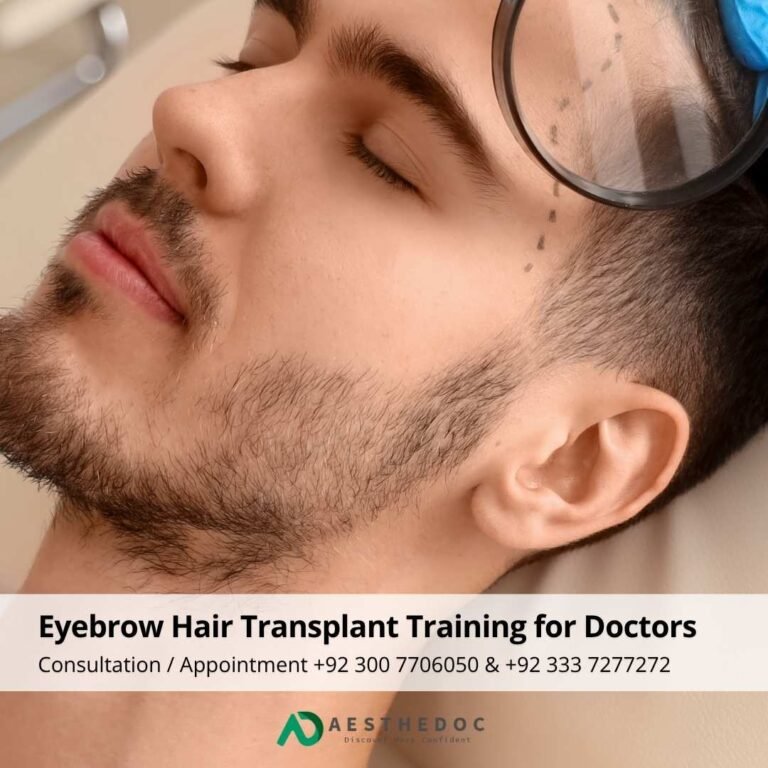
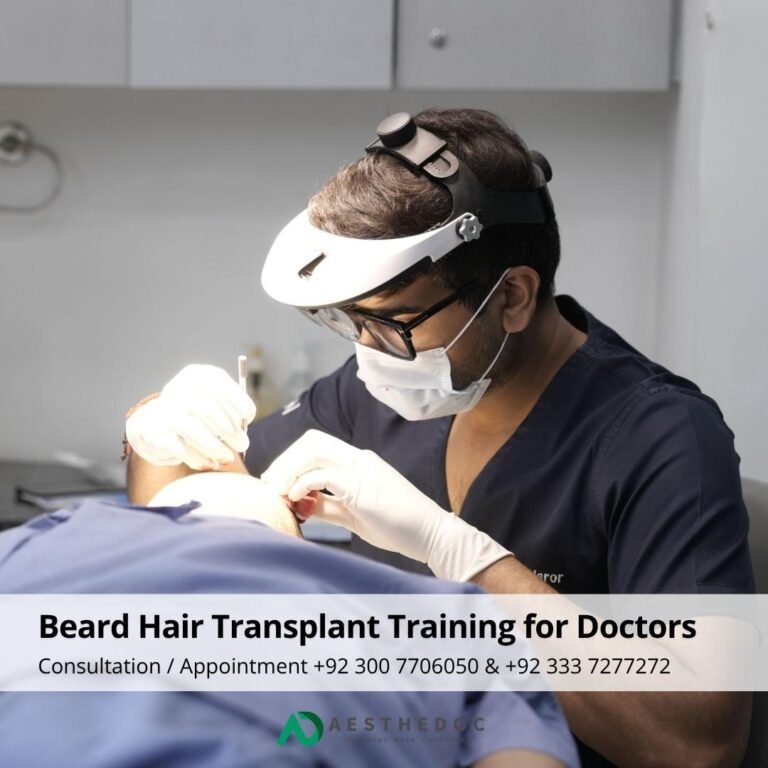
Advanced topics may include beard and eyebrow transplantation, corrective and repair cases, scar and burn-related restoration and density optimization.
6. Postoperative Care and Complication Management
Doctors should understand infection prevention, shock loss management, poor growth troubleshooting and revision planning.
These topics are listed on Aesthedoc’s published hair transplant course page. <Cite ref=”turn753093view0″/>
Practical Training: Why Surgical Exposure Matters
Hair transplant surgery involves technical skills that cannot be fully understood through theoretical lectures alone.
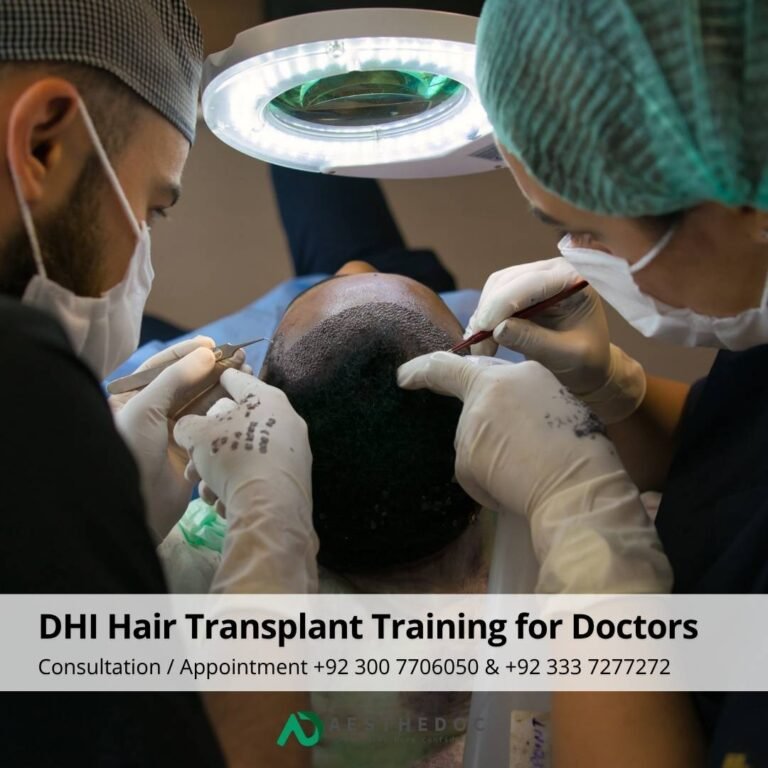
Doctors need to understand the sequence of the procedure, the responsibilities of the surgical team, patient preparation, sterile technique, graft handling and postoperative protocols.
A structured training environment can help participants connect theoretical knowledge with clinical practice.
Important elements of practical education include:
- Observing appropriate patient assessment.
- Understanding preoperative planning.
- Learning the sequence of FUE surgery.
- Observing extraction and implantation principles.
- Understanding graft handling and storage.
- Reviewing recipient-site planning.
- Discussing postoperative care.
- Learning how complications and unexpected findings are assessed.
Hands-on participation must always be supervised and consistent with the trainee’s qualifications, local laws, patient consent and the clinical facility’s policies.
A short training course should not be presented as a substitute for the full surgical experience, specialist qualifications or legal authorization required to practise independently.
Who Should Consider Advanced Hair Transplant Training?
Corrective hair transplant education may be relevant to qualified medical professionals who want to expand their understanding of hair restoration.
Potential participants include:
MBBS Doctors
Medical graduates seeking structured education in hair loss assessment, patient selection and the principles of surgical hair restoration.
General Surgeons
Surgeons interested in developing additional knowledge of FUE procedures, graft handling and hair restoration planning.
Plastic Surgeons
Plastic surgeons may find hair restoration relevant to their understanding of facial aesthetics, scalp anatomy, hairline design and reconstructive planning.
Dermatologists
Dermatologists already involved in diagnosing and managing hair disorders may wish to understand the surgical side of hair restoration.
Aesthetic Physicians
Qualified aesthetic physicians interested in hair restoration should understand the distinction between medical hair-loss management, surgical procedures and the professional requirements for performing surgery.
Doctors Planning a Hair Restoration Clinic
Medical professionals considering a hair restoration practice need knowledge of patient selection, clinical workflows, equipment, surgical planning, postoperative care and ethical service delivery.
Admission requirements and the scope of permitted practical participation should be confirmed directly with the training provider.
How to Choose the Right Hair Transplant Training Programme
Not all hair transplant courses provide the same educational experience.
Before enrolling, doctors should assess the programme carefully.
Trainer Qualifications
Review the trainer’s relevant credentials, clinical experience and involvement in hair restoration.
Curriculum Structure
Look for a curriculum that covers patient assessment, donor management, hairline design, FUE fundamentals, complications and postoperative care.
Practical Learning
Ask whether the programme includes demonstrations, live patient exposure, supervised participation or only classroom-based teaching.
Revision and Complication Education
A strong educational programme should address what happens when results are unsatisfactory, complications arise or further treatment is being considered.
Mentoring and Feedback
One-to-one guidance and opportunities to discuss clinical decisions can help trainees understand why different approaches are selected.
Ethical and Regulatory Standards
Confirm that patient consent, infection prevention, supervision and local regulatory requirements are respected.
Clear Course Information
Before paying a fee, request written details about course duration, learning objectives, practical exposure, eligibility, certificate, accommodation arrangements and any additional costs.
Why International Doctors Consider Hair Transplant Training in Pakistan
Pakistan is one option for international medical professionals exploring hair transplant education abroad.
The published Aesthedoc programme is positioned for doctors and surgeons seeking structured theoretical education, practical FUE exposure and mentoring.
International trainees should compare programmes based on educational quality rather than location or price alone.
When evaluating training in another country, consider:
- Trainer credentials and relevant experience.
- The programme’s actual curriculum.
- The nature of live-patient exposure.
- Supervision and patient safety arrangements.
- Accommodation and travel requirements.
- Visa and entry requirements.
- Total course and travel costs.
- Recognition and professional requirements in the country where you intend to practise.
Training completed in one country does not automatically authorize a doctor to perform hair transplant surgery in another. Each participant should verify the licensing, registration and scope-of-practice requirements applicable in their intended country of practice.
Aesthedoc Hair Transplant Training for Doctors and Surgeons
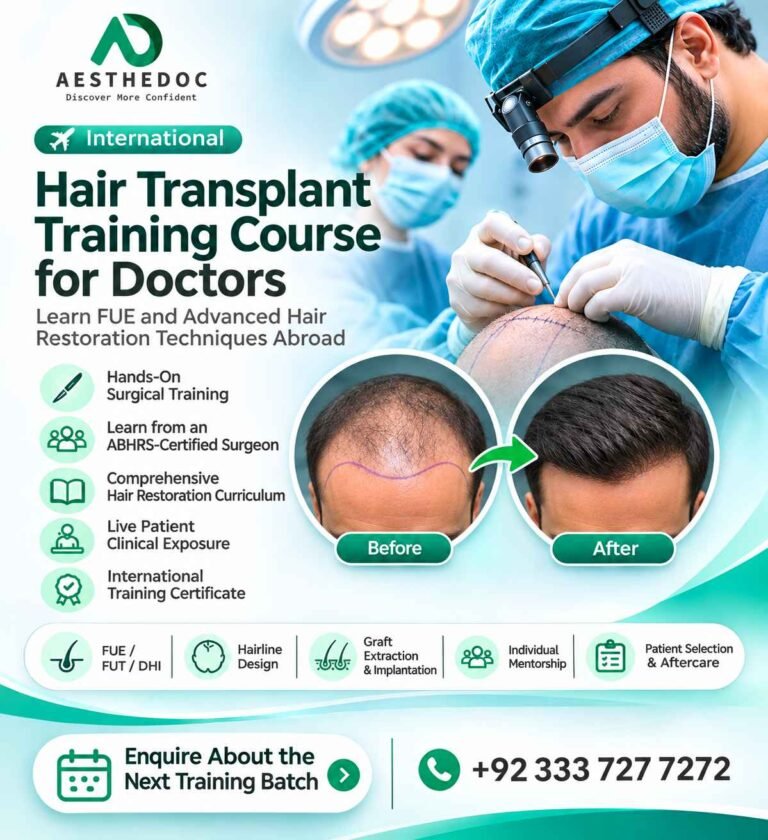
Aesthedoc offers a hair transplant training programme in Pakistan for doctors and surgeons interested in developing their knowledge of FUE hair restoration and related surgical principles.
The published programme is led by Dr. Adnan Bashir, identified on the course page as an ABHRS-certified hair transplant surgeon. The page describes his experience in FUE procedures, corrective cases, beard and eyebrow transplantation, and burn-related restoration. <Cite ref=”turn753093view0″/>
What the Published Programme Includes
According to the Aesthedoc course information, the programme includes:
- Structured theoretical training.
- Full hands-on FUE surgical exposure.
- Live patient cases.
- One-to-one mentoring.
- Preoperative planning.
- Postoperative care protocols.
- Complication management.
The listed curriculum covers hair loss fundamentals, patient selection, hairline design, donor area assessment, FUE extraction, graft handling, recipient-site creation, implantation methods and advanced restoration topics.
Corrective and repair cases, scar and burn-related restoration, beard and eyebrow transplantation, and density optimization are also included among the advanced topics listed on the course page. <Cite ref=”turn753093view0″/>
Who Can Apply?
The programme identifies the following audiences:
- MBBS doctors.
- General surgeons.
- Plastic surgeons.
- Dermatologists.
- Aesthetic physicians.
- Medical professionals planning hair restoration clinics.
Interested doctors should contact Aesthedoc to confirm eligibility, course dates, practical arrangements and the precise scope of supervised participation.
Course Fee and Contact Information
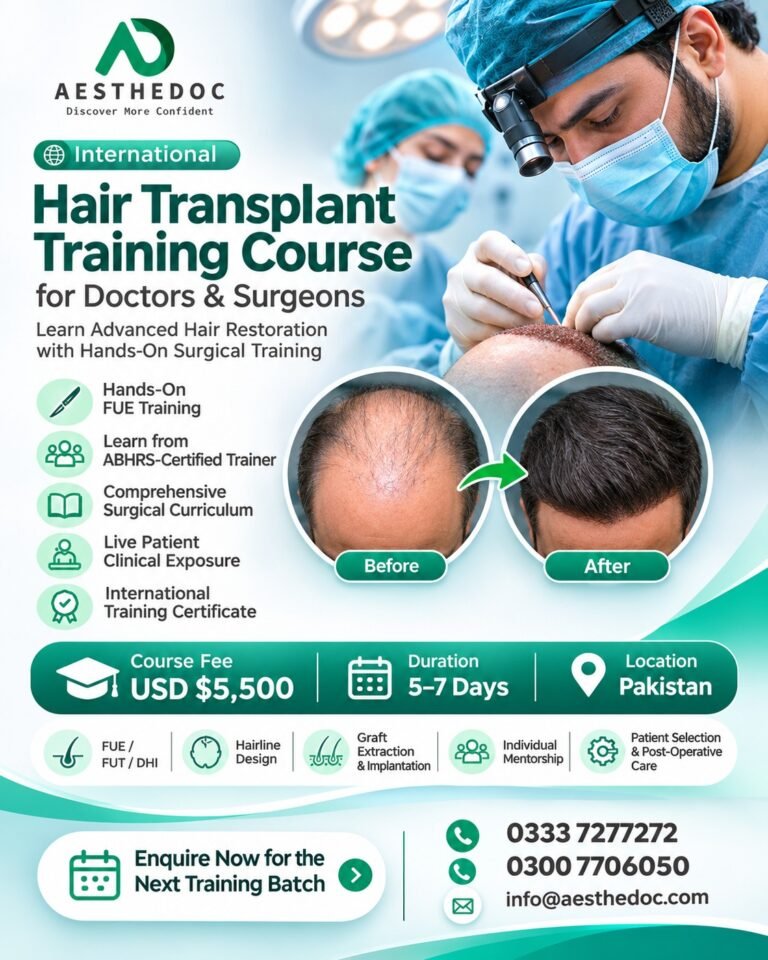
The published course page lists the programme fee as USD $5,500. Confirm the current fee and inclusions directly before making travel or payment arrangements. <Cite ref=”turn753093view0″/>
Aesthedoc Hair Transplant Training
- Location: Pakistan
- Trainer: Dr. Adnan Bashir
- WhatsApp / Call: +92 333 727 7272
For doctors seeking additional information about the programme, curriculum or international enrolment, contact the training team directly.
Frequently Asked Questions About Corrective Hair Transplant Training
1. What is corrective hair transplant training?
Corrective hair transplant training is advanced education focused on assessing and understanding unsatisfactory hair transplant outcomes. It covers revision planning, donor assessment, hairline correction, graft-related problems, scarring and other complex hair restoration considerations.
2. Why is revision hair transplant surgery more complex than primary surgery?
Revision procedures involve previously operated donor and recipient areas. Existing grafts, scars, altered tissue and reduced donor availability can make planning more challenging than a first-time transplant.
3. Can an unnatural hairline be corrected?
Some unnatural hairlines can be improved through carefully selected corrective approaches. The treatment depends on graft position, direction, density, donor availability and the patient’s scalp condition. Complete correction cannot be guaranteed.
4. Can overharvested donor areas be repaired?
Selected cases may be improved through carefully planned restoration or camouflage strategies. However, donor follicles are limited, and severe overharvesting may restrict the available options.
5. Can failed FUE hair transplants be corrected?
Some unsatisfactory FUE results may be improved after a detailed assessment. The surgeon must identify the reason for poor growth or appearance and determine whether additional surgery is safe and likely to help.
6. Is corrective hair transplant surgery always necessary after poor growth?
No. The patient may need additional time for growth, medical evaluation or alternative management. Revision surgery should only be considered after the cause of the problem has been assessed.
7. What is the role of donor management in revision surgery?
Donor management helps determine whether additional graft harvesting is possible without causing further visible depletion. It is particularly important in patients who have already undergone multiple procedures.
8. Do hair transplant courses teach revision surgery?
The curriculum differs between training providers. Doctors should check whether the course covers corrective cases, donor limitations, complications and revision planning rather than assuming these subjects are included.
9. Does Aesthedoc include corrective hair restoration topics?
Yes. Aesthedoc’s published hair transplant course curriculum lists corrective and repair cases, scar and burn-related restoration, and density optimization among its advanced hair restoration topics.
10. Who can enrol in the Aesthedoc hair transplant course?
The published programme identifies MBBS doctors, general surgeons, plastic surgeons, dermatologists, aesthetic physicians and medical professionals planning hair restoration clinics as its intended audience. Applicants should confirm eligibility and practical participation requirements with Aesthedoc.
11. Does completing a hair transplant course authorize independent surgical practice?
No. Course completion does not automatically provide a specialist qualification, medical licence or independent surgical privileges. Doctors must meet the applicable regulatory, licensing and professional requirements in the country where they intend to practise.
12. Where can international doctors learn hair transplantation in Pakistan?
Aesthedoc offers a hair transplant training programme in Pakistan. Doctors can review the curriculum and contact the training team to confirm current dates, eligibility and course arrangements.
Conclusion: Develop a Deeper Understanding of Corrective Hair Restoration
Corrective hair transplantation requires more than the ability to perform FUE extraction and implantation. It demands careful assessment, an understanding of previous surgical outcomes, responsible donor management and realistic planning.
Doctors interested in advanced hair restoration should develop the ability to identify why a previous procedure produced an unsatisfactory result, determine whether revision is appropriate and understand the limitations of further surgery.
For medical professionals seeking structured hair transplant education in Pakistan, Aesthedoc offers a programme covering FUE fundamentals, practical surgical exposure, mentoring, complications and advanced restoration topics, including corrective and repair cases.
To learn more about the curriculum, eligibility and upcoming training arrangements, visit the official course page or contact Aesthedoc.
WhatsApp / Call: +92 333 727 7272
Aesthedoc – Hair Transplant Training for Doctors and Surgeons in Pakistan