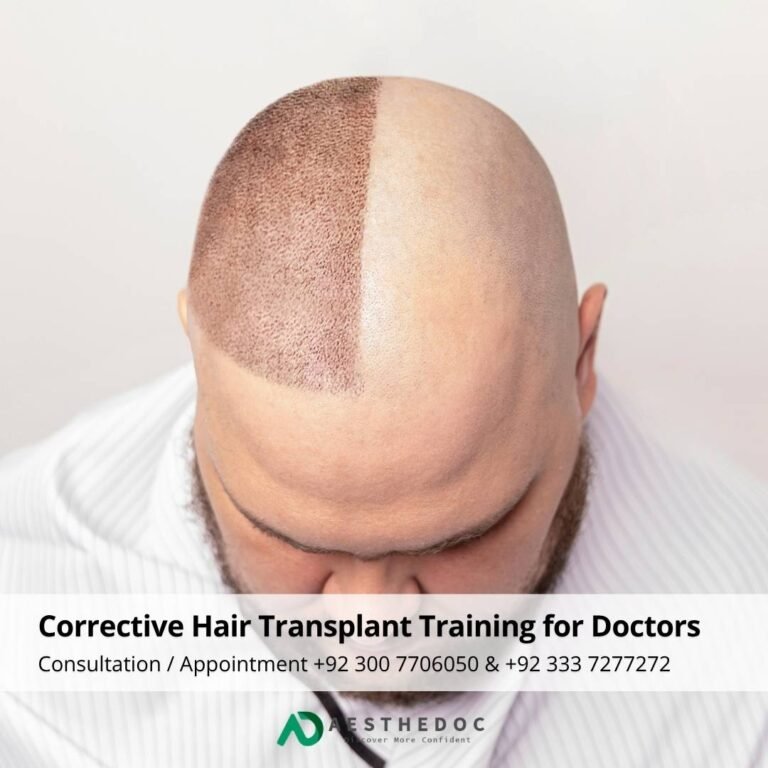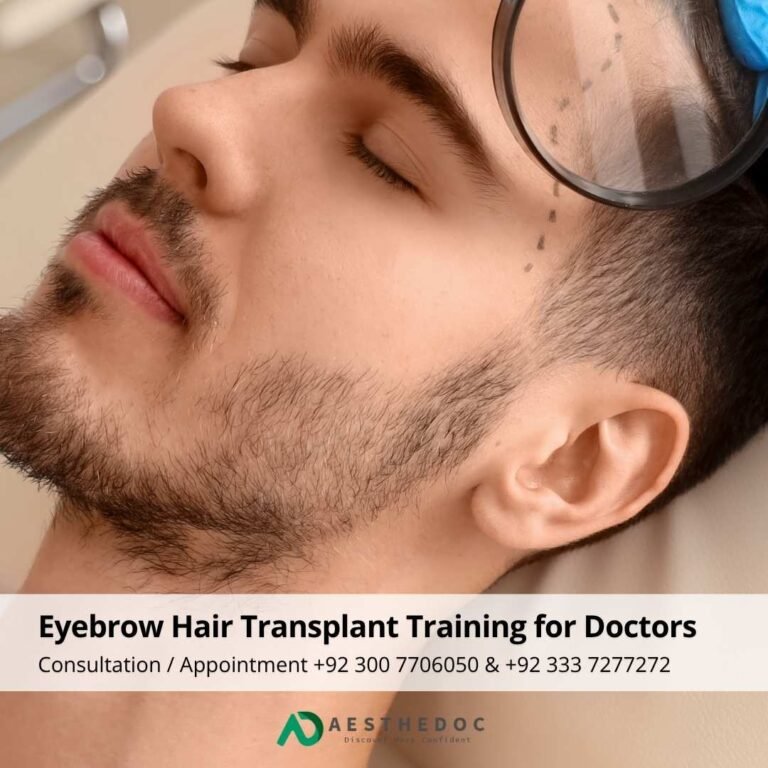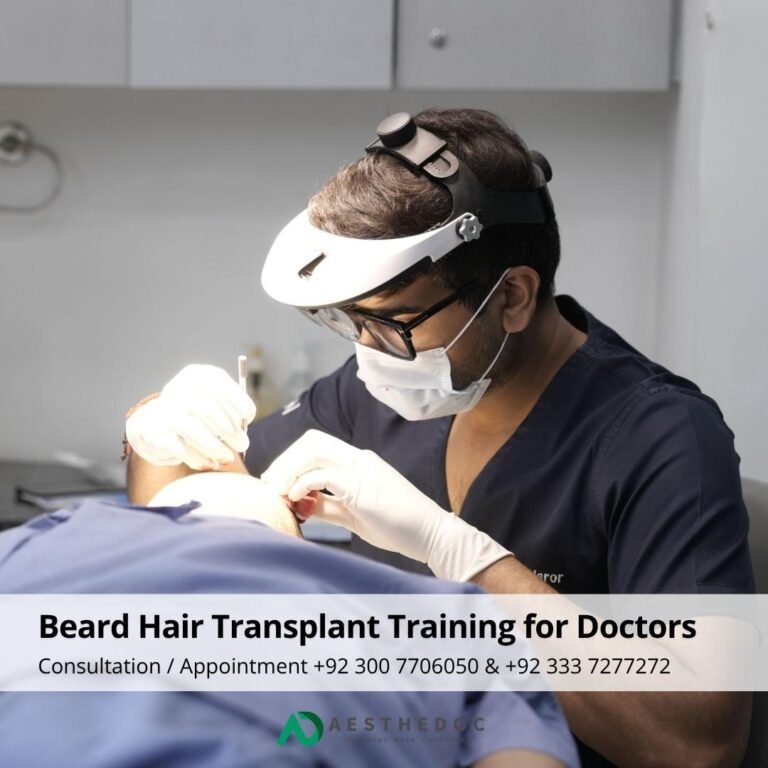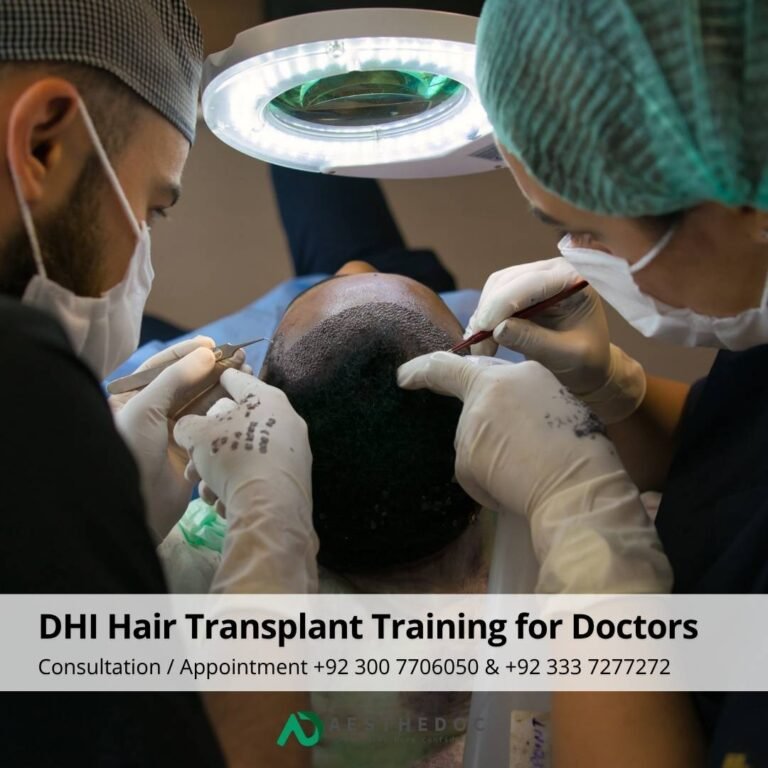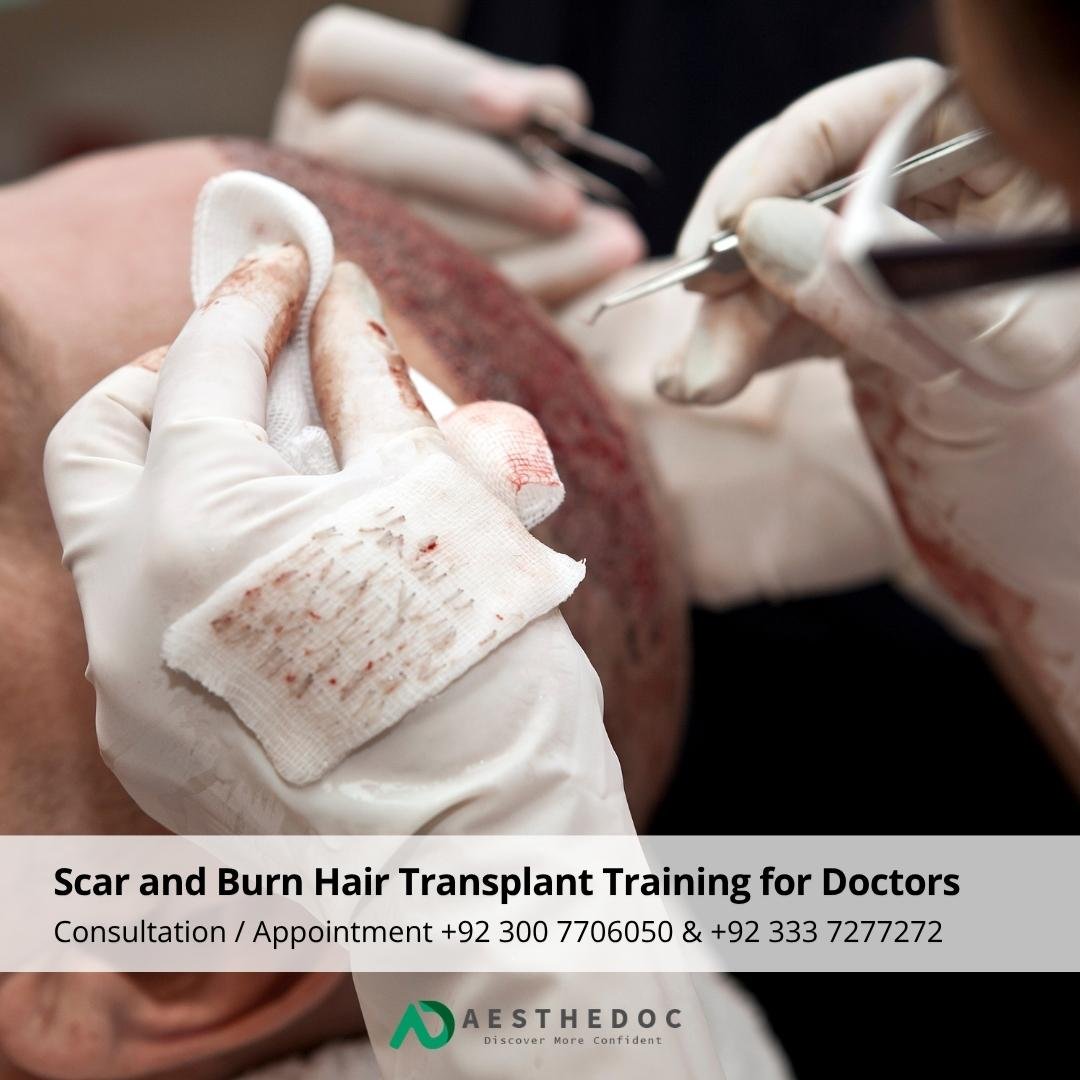
Hair loss caused by burns, accidents, surgical procedures and traumatic injuries can have a significant impact on a person’s appearance and confidence. When the scalp is damaged, hair follicles may be permanently destroyed, leaving areas of baldness that cannot recover through ordinary hair growth treatments.
Hair transplantation may offer a reconstructive option for selected patients with stable scalp scars and suitable donor hair. However, restoring hair in scarred or previously injured tissue is different from treating routine pattern hair loss. The surgeon must evaluate the scar, understand the condition of the underlying tissue, assess blood supply, examine donor availability and determine whether transplantation is likely to provide a meaningful improvement.
For doctors interested in advanced hair restoration, understanding scar and burn-related transplantation is an important area of clinical education.
Scar and burn hair transplant training for doctors introduces the principles of assessing traumatic hair loss, selecting suitable patients, planning FUE procedures, managing donor resources and understanding the limitations of transplantation in scarred tissue.
This article explains the clinical considerations involved in scar-related hair restoration and the educational areas doctors should explore when choosing an advanced hair transplant training programme.
What Is Scar and Burn Hair Transplantation?
Scar and burn hair transplantation is a reconstructive hair restoration approach in which hair follicles are transplanted into selected areas of scalp hair loss caused by injury, burns, surgery or other forms of tissue damage.
In normal scalp tissue, hair follicles grow within a relatively predictable biological environment. A scarred scalp may have a different structure, thickness, elasticity and blood supply. These differences can affect the feasibility and outcome of transplantation.
The procedure may be considered for patients with:
- Scalp scars following accidents or injuries.
- Hair loss after thermal burns.
- Bald areas following previous scalp surgery.
- Scars after neurosurgical or other medical procedures.
- Selected traumatic scars with permanent follicular destruction.
- Stable areas of hair loss after reconstructive treatment.
- Certain scars associated with previous hair restoration procedures.
The objective is to improve hair coverage and camouflage the affected area where clinically appropriate. Hair transplantation does not remove the underlying scar, restore normal skin architecture or guarantee complete coverage.
The suitability of each patient depends on the characteristics of the scar, the surrounding scalp, the available donor hair and the patient’s medical history.
Why Is Hair Transplantation in Scar Tissue More Challenging?
Scar tissue is not biologically identical to normal scalp tissue. Following an injury, the body repairs damaged tissue through a healing process that can produce collagen-rich scar formation.
The resulting tissue may differ from normal scalp in several ways.
1. Changes in Blood Supply
Adequate tissue perfusion is important for wound healing and graft survival.
Some scars have reduced or altered vascularity compared with normal scalp. If the recipient area has an inadequate blood supply, transplanted follicles may not establish successfully.
The surgeon should assess the condition of the recipient tissue and consider whether additional evaluation or staged treatment is appropriate.
2. Altered Tissue Thickness and Elasticity
Scar tissue may be thicker, firmer or less flexible than surrounding skin.
These characteristics can influence surgical planning, recipient-site creation and the handling of the tissue.
A surgeon should not assume that the same approach used for normal scalp will be suitable for every scar.
3. Fibrosis and Tissue Irregularity
Scar formation can produce irregular tissue architecture.
The affected area may contain uneven thickness, adhesions or areas of altered texture. These features can make recipient-site planning more complex.
4. Reduced or Absent Natural Follicles
When an injury destroys hair follicles, the affected area may develop permanent hair loss.
In such cases, ordinary hair growth treatments cannot recreate destroyed follicles. Hair transplantation may be considered if the scar is stable and the recipient tissue is suitable.
5. Unpredictable Healing
Healing can vary according to the cause of injury, scar characteristics, patient health and previous treatment.
A surgeon must consider these factors before deciding whether a transplant is appropriate.
Types of Scalp Scars That May Be Considered for Hair Restoration
Not all scars are suitable for hair transplantation. Their origin, stability, depth, size and tissue characteristics influence the treatment plan.
1. Burn Scars
Burn-related scalp hair loss may occur after thermal injuries that damage the skin and underlying hair follicles.
The extent of injury varies. Some patients may have limited areas of hair loss, while others may experience extensive tissue damage.
Burn scars may be associated with:
- Permanent follicular destruction.
- Thick or raised scar tissue.
- Contracture or reduced tissue flexibility.
- Changes in scalp contour.
- Irregular skin texture.
- Areas with altered blood supply.
The surgeon must first establish whether the affected tissue is stable and suitable for reconstruction.
2. Traumatic Scalp Scars
Accidents, lacerations and other injuries may produce scars that permanently interrupt normal hair growth.
A patient may present with a linear scar, an irregular bald patch or a larger area of hair loss.
The treatment plan depends on the scar’s size, location, surrounding hair density and available donor supply.
3. Post-Surgical Scars
Some patients develop visible hair loss following scalp or cranial surgery.
The appearance may depend on the surgical incision, healing process, tissue damage and the location of the scar.
Hair transplantation may be considered after the treating team confirms that the scar is stable and the patient is an appropriate candidate.
4. Scars Following Previous Hair Transplantation
Previous hair restoration procedures may leave visible scars or areas of uneven density.
Some patients seek treatment to camouflage scars or improve the appearance of the donor region.
These cases overlap with corrective hair transplantation and require careful evaluation of remaining donor resources.
5. Scars Associated With Other Medical Conditions
Certain inflammatory or scarring scalp conditions can produce permanent hair loss.
However, active inflammatory or progressive scarring alopecia requires appropriate diagnosis and management before transplantation is considered.
Hair transplantation should not be used as a substitute for treating an active underlying disease.
Patient Assessment Before Scar Hair Transplant Surgery
A detailed clinical assessment is essential before planning transplantation into scarred tissue.
The surgeon must understand the original injury, the healing process, the current condition of the scalp and the patient’s expectations.
1. Understand the Cause of the Scar
The first step is to establish why the scar developed.
Relevant history may include:
- Thermal or chemical burns.
- Road traffic accidents.
- Workplace injuries.
- Surgical procedures.
- Previous hair transplant operations.
- Infections or wound complications.
- Inflammatory scalp conditions.
The cause of the injury can provide important information about the expected tissue condition and possible reconstructive options.
2. Establish Scar Stability
The scar should be evaluated to determine whether it has reached a stable stage.
Ongoing changes in scar size, inflammation, breakdown, contracture or symptoms may indicate that additional assessment is required before transplantation.
The timing of surgery should be individualized. There is no single waiting period that is suitable for every type of injury.
3. Examine the Recipient Area
The recipient area should be examined for:
- Scar dimensions.
- Tissue thickness.
- Skin texture.
- Elasticity.
- Signs of inflammation.
- Evidence of previous surgery.
- Surrounding hair density.
- Areas of healthy tissue.
- Cosmetic concerns and scalp contour.
The surgeon should identify whether the entire scar is potentially suitable for treatment or whether only selected areas should be considered.
4. Evaluate the Donor Area
Donor hair is a limited resource. Its availability is particularly important when a patient has a large scar or extensive burn-related hair loss.
The surgeon should evaluate:
- Donor density.
- Hair calibre.
- Follicular unit characteristics.
- Previous extraction sites.
- Signs of donor depletion.
- The amount of hair potentially available.
- Future hair restoration requirements.
The objective is to avoid exhausting the donor area in an attempt to cover a recipient area that may not support the planned grafts.
5. Review Medical History
The assessment should include relevant medical conditions, medications, allergies, smoking history, wound-healing concerns and previous reconstructive procedures.
Where necessary, the surgeon should coordinate with the patient’s treating specialist or reconstructive team.
6. Discuss Expectations
Patients should understand that scar transplantation is intended to improve appearance, not necessarily eliminate the scar.
The surgeon should explain the limitations of graft survival, the possibility of incomplete coverage, the need for staged treatment and the potential requirement for alternative reconstructive procedures.
Is Every Burn Scar Suitable for Hair Transplantation?
No. A burn scar should not automatically be considered suitable for FUE transplantation.
The condition of the tissue is more important than simply identifying an area without hair.
A stable, relatively suitable scar may be considered differently from a thick, contracted or poorly vascularized scar.
Factors That Influence Suitability
| Clinical factor | Why it matters |
|---|---|
| Scar stability | Ongoing changes may make surgical planning premature |
| Tissue vascularity | Blood supply is relevant to graft survival and healing |
| Scar thickness | May influence recipient-site creation |
| Tissue elasticity | Can affect surgical access and planning |
| Scar size | Determines the potential graft requirement |
| Donor availability | Limits the amount of hair that can be transplanted |
| Medical history | May influence healing and surgical risk |
| Patient expectations | Helps determine whether the likely improvement is acceptable |
When Additional Reconstructive Assessment May Be Needed
Some patients with extensive burn injuries may require reconstructive treatment before hair transplantation is considered.
Depending on the injury, the treating team may evaluate options such as scar revision, tissue expansion or other reconstructive procedures.
These interventions are not interchangeable with FUE transplantation. The appropriate approach depends on the patient’s anatomy, scar characteristics and reconstructive goals.
FUE Hair Transplant Technique for Scarred Scalp Areas
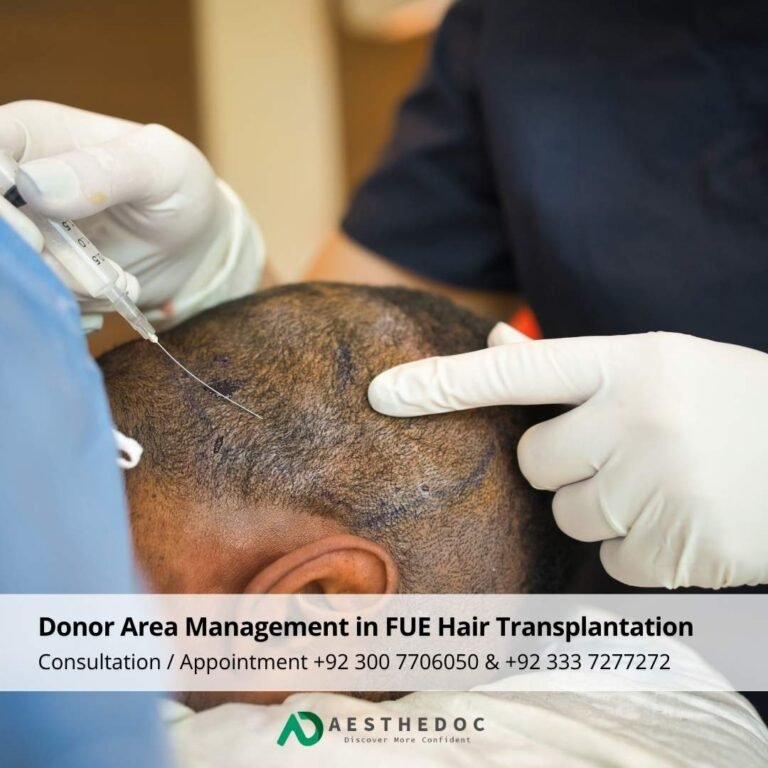
Follicular Unit Extraction, commonly known as FUE, involves harvesting individual follicular units from a donor area and placing them into selected recipient sites.
FUE may be used in selected scar-related hair restoration cases, but the presence of scar tissue introduces additional considerations.
Donor Graft Extraction
The donor area must be evaluated before harvesting begins.
Important technical considerations include:
- Appropriate punch selection.
- Understanding follicular direction.
- Careful extraction planning.
- Minimizing follicular transection.
- Avoiding excessive donor depletion.
- Proper graft handling.
- Appropriate graft storage.
The surgeon should use a conservative donor strategy, particularly when a large recipient area may require multiple treatment stages.
Recipient-Site Creation
Recipient-site creation is an important part of hair transplantation.
In scarred tissue, the surgeon must consider the differences between normal scalp and the affected area.
The clinical plan should account for:
- Scar thickness.
- Tissue flexibility.
- Existing hair distribution.
- Intended graft direction.
- Recipient-area dimensions.
- The suitability of the tissue for implantation.
The technique must be individualized. There is no universal recipient-site approach for every burn or traumatic scar.
Graft Implantation
The implantation stage involves placing the prepared follicular units into the planned recipient sites.
The surgeon should consider the natural direction of surrounding hair and the intended cosmetic pattern.
Graft survival cannot be guaranteed, particularly in tissue with compromised characteristics. The patient should be informed about this uncertainty before surgery.
Understanding Graft Survival in Scar Tissue
Graft survival is a major consideration in scar-related hair restoration.
A follicular unit must remain viable during extraction, handling, storage and implantation. Once placed, the recipient environment also influences its ability to establish and grow.
Factors That May Influence Graft Survival
Recipient tissue condition: The characteristics of scar tissue can influence the suitability of the recipient area.
Blood supply: Tissue perfusion is relevant to healing and graft establishment.
Surgical trauma: Excessive trauma during site creation or implantation may negatively affect tissue healing.
Graft handling: Careful handling and appropriate storage are important throughout the procedure.
Patient-related factors: Medical history, wound-healing characteristics and postoperative care may influence recovery.
Scar characteristics: Different scars have different tissue properties, so outcomes can vary considerably.
Why Realistic Expectations Matter
Patients may assume that transplanted hair will grow in a scar exactly as it does in normal scalp tissue.
This is not a safe assumption.
The surgeon should explain that the degree of coverage and growth may vary, and that the final cosmetic result may be less predictable than in an uncomplicated primary hair transplant.
One-Stage vs Staged Hair Restoration in Burn Scars
The decision to perform one procedure or multiple stages depends on the clinical condition and treatment objectives.
One-Stage Approach
A one-stage procedure may be considered in selected patients with relatively limited, stable scars and suitable recipient tissue.
The surgeon should still consider graft availability, recipient-area characteristics and the expected cosmetic improvement.
Staged Approach
Some patients may benefit from a staged treatment plan.
A staged approach may be considered when:
- The scar is extensive.
- The tissue requires additional assessment.
- The available donor supply is limited.
- The recipient area has variable characteristics.
- The surgeon wants to assess the response before considering further treatment.
- Additional reconstructive procedures may be required.
Staging should be based on clinical judgment rather than a predetermined number of procedures.
Hairline and Aesthetic Planning in Scar Reconstruction
Hair transplantation is both a surgical and aesthetic procedure.
In scar-related cases, the surgeon must consider the location of the injury and how hair restoration will integrate with the patient’s existing hair pattern.
Natural Hair Direction
The direction of hair growth should be planned in relation to surrounding hair.
Incorrect orientation can produce an unnatural appearance, even when transplanted follicles grow.
Density Distribution
The goal is not necessarily to create the same density as normal scalp.
Available donor supply, recipient tissue and the size of the affected area must be considered together.
Facial and Scalp Proportions
When scars involve the frontal scalp or hairline, the surgeon should consider facial proportions and the patient’s natural hairline characteristics.
Camouflage and Cosmetic Improvement
The purpose of transplantation is often to reduce the visual contrast between the scar and surrounding hair-bearing scalp.
The patient should understand that hair restoration may improve camouflage without completely concealing the scar’s texture or colour.
When Hair Transplantation May Not Be the Best Option
A responsible hair restoration specialist must recognize when transplantation is unlikely to provide an acceptable result.
Hair transplantation may need to be deferred, avoided or considered only after additional specialist assessment when:
- The scar is unstable.
- There is active inflammation or infection.
- The recipient tissue is unsuitable.
- There is significant contracture requiring reconstructive management.
- Donor hair is insufficient.
- The underlying diagnosis remains uncertain.
- The patient’s medical condition increases surgical risk.
- The expected cosmetic improvement is very limited.
- The patient expects complete scar removal through transplantation.
Alternative approaches may include observation, scar management, reconstructive surgery, camouflage or referral to an appropriate specialist.
Complications and Postoperative Considerations
Scar-related hair restoration requires careful postoperative planning.
Patients should receive clear instructions and appropriate follow-up based on the procedure performed and their individual clinical needs.
Potential complications and concerns may include:
- Infection.
- Bleeding.
- Delayed wound healing.
- Scarring.
- Poor graft growth.
- Uneven hair distribution.
- Temporary shock loss.
- Persistent cosmetic irregularity.
- Need for additional treatment.
Patients with previous burns or reconstructive procedures may require individualized postoperative monitoring.
The surgeon should explain warning signs that require medical review and ensure that follow-up arrangements are clear.
What Doctors Should Learn in Scar and Burn Hair Transplant Training
Doctors interested in advanced hair restoration should develop an understanding of both routine FUE principles and the additional considerations involved in scar-related cases.
A structured educational programme should help participants understand the relationship between patient selection, donor management, recipient-site planning and postoperative care.
1. Hair Loss and Scalp Assessment
Doctors should understand the causes of permanent hair loss, the distinction between scarring and non-scarring alopecia, and the importance of identifying active disease.
2. Patient Selection
Training should address indications, contraindications, medical history, scar stability and realistic patient counseling.
3. Donor Area Assessment
Doctors should understand donor density, safe donor zone identification, extraction planning and long-term donor preservation.
4. FUE Surgical Fundamentals
Important subjects include punch selection, extraction angles, graft handling, storage, recipient-site creation and implantation methods.
5. Scar and Burn-Related Restoration
Doctors should learn the principles of evaluating scarred recipient areas and understanding the limitations of hair transplantation in damaged tissue.
6. Complication Management
Training should include infection prevention, postoperative care, poor growth troubleshooting and the principles of revision planning.
7. Ethical and Professional Practice
Doctors should understand patient consent, supervision, clinical documentation and the regulatory requirements governing surgical practice.
Why Practical Hair Transplant Training Matters
Hair restoration is a technical discipline. Understanding the theory of FUE is important, but doctors also need to understand how the surgical process works in a clinical setting.
A structured practical learning environment can help participants connect the different stages of treatment.
Educational exposure may include:
- Patient assessment and consultation.
- Preoperative planning.
- Donor area evaluation.
- FUE extraction demonstrations.
- Graft handling and storage.
- Recipient-site planning.
- Implantation methods.
- Postoperative care protocols.
- Complication discussions.
For scar and burn-related cases, the opportunity to understand complex patient assessment is particularly valuable.
Practical participation must remain within the trainee’s professional scope, appropriate supervision arrangements, patient consent and local clinical regulations.
A short course should not be treated as a replacement for specialist training, independent surgical experience or legal authorization to perform procedures.
Who Should Consider Advanced Hair Transplant Training?
Scar and burn-related restoration education may be relevant to qualified medical professionals interested in developing their knowledge of hair restoration.
MBBS Doctors
Medical graduates seeking structured education in hair loss assessment, FUE principles and patient selection.
General Surgeons
Surgeons interested in understanding hair restoration procedures and the surgical considerations involved in scalp reconstruction.
Plastic Surgeons
Plastic surgeons may find this subject relevant to their knowledge of reconstructive surgery, tissue characteristics, scar assessment and aesthetic outcomes.
Dermatologists
Dermatologists managing hair loss and scalp conditions may wish to develop a deeper understanding of surgical hair restoration.
Aesthetic Physicians
Qualified aesthetic physicians interested in hair restoration should understand surgical indications, patient selection and the professional requirements for performing or participating in surgical procedures.
Doctors Planning a Hair Restoration Clinic
Medical professionals establishing a hair restoration service need to understand clinical assessment, surgical workflows, donor management, postoperative care and ethical patient selection.
Eligibility for any training programme should be confirmed with the training provider.
How to Choose a Hair Transplant Training Programme
Choosing a course requires more than comparing fees or course duration.
Doctors should evaluate the programme’s educational structure, trainer credentials and the nature of its practical learning opportunities.
Trainer Credentials and Experience
Review the trainer’s relevant qualifications, surgical experience and involvement in hair restoration.
Curriculum Coverage
A comprehensive programme should address hair loss diagnosis, patient selection, hairline design, donor assessment, FUE techniques, graft handling, postoperative care and complications.
Advanced Case Exposure
Ask whether the curriculum discusses corrective procedures, scar-related restoration, burn-related hair loss and complex donor management.
Practical Supervision
Clarify whether the programme provides demonstrations, supervised participation, live-patient exposure or theoretical instruction only.
Patient Safety
Ask how the programme addresses consent, infection prevention, supervision and clinical responsibilities.
Course Documentation
Before enrolling, obtain written information about:
- Course duration.
- Eligibility criteria.
- Learning objectives.
- Practical training arrangements.
- Trainer credentials.
- Certificate details.
- Course fees.
- Accommodation and travel arrangements.
- Any additional costs.
Professional Recognition
A training certificate should not be confused with a specialist qualification or a licence to practise surgery. Doctors should verify the requirements of their medical regulator and intended country of practice.
Hair Transplant Training at Aesthedoc, Pakistan
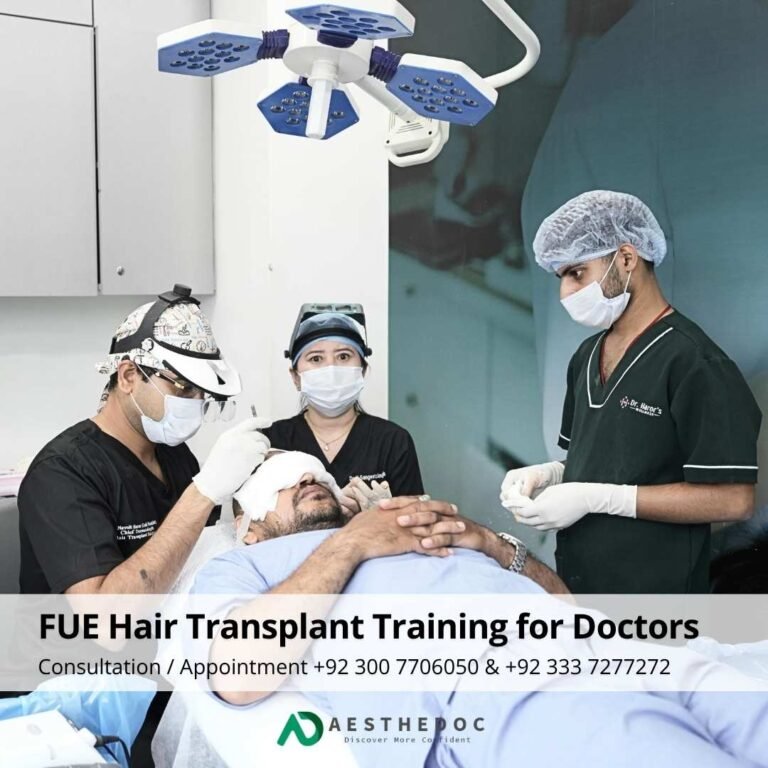
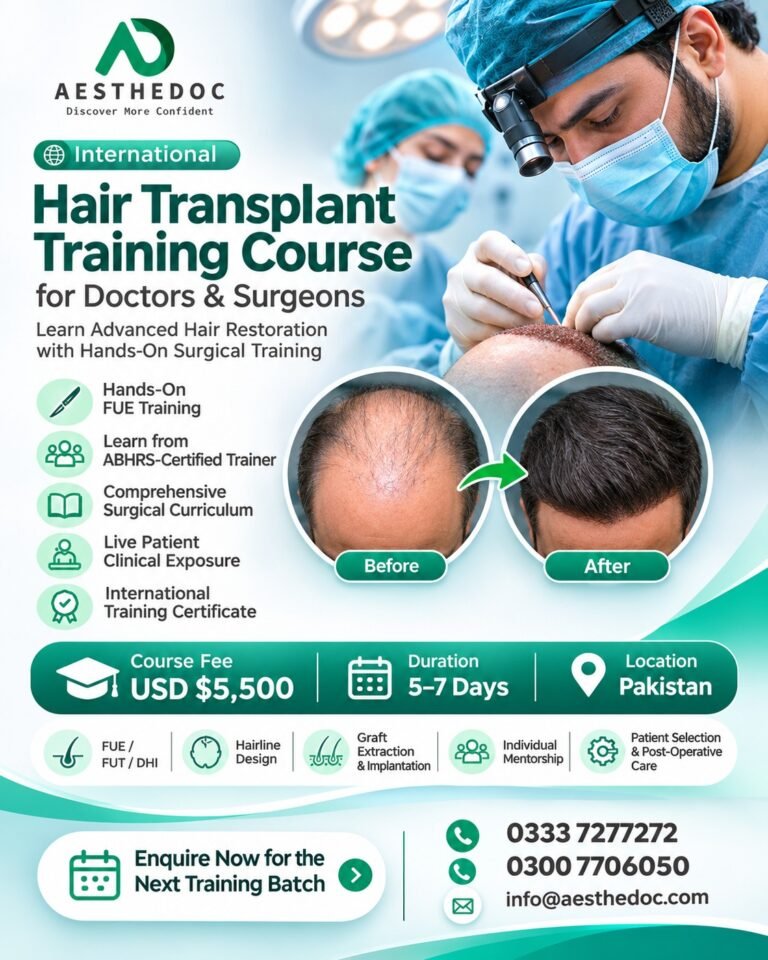
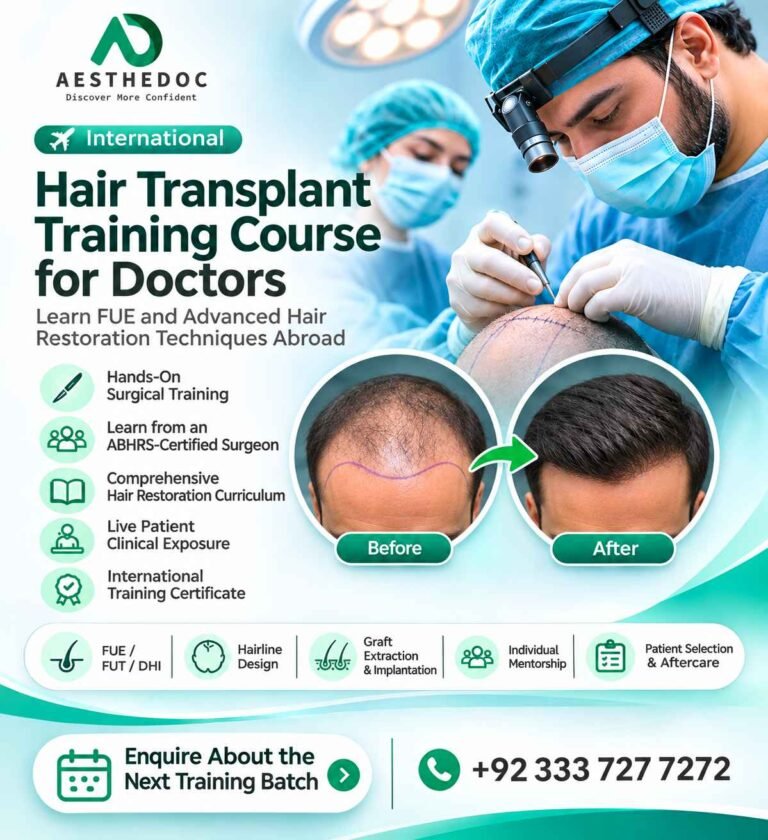
Aesthedoc offers a hair transplant training programme in Pakistan for doctors and surgeons interested in FUE hair restoration and advanced surgical principles.
The published programme is led by Dr. Adnan Bashir, identified on the course page as an ABHRS-certified hair transplant surgeon. The page describes experience in FUE procedures, corrective cases, beard and eyebrow transplantation, and burn-related restoration.
The course curriculum specifically lists scar and burn-related restoration as an advanced hair restoration topic. It also includes corrective and repair cases, density optimization, donor assessment and FUE surgical fundamentals.
Published Course Structure
According to the Aesthedoc course page, the programme includes:
- Structured theoretical training.
- Full hands-on FUE surgical exposure.
- Live patient cases.
- One-to-one mentoring.
- Preoperative planning.
- Postoperative care protocols.
- Complication management.
The published curriculum also covers:
- Types of alopecia.
- Patient selection and contraindications.
- Hairline design and facial harmony.
- Safe donor zone identification.
- Density calculation.
- Overharvesting prevention.
- Punch selection and extraction angles.
- Graft handling and storage.
- Recipient-site creation.
- Implantation methods.
- Beard and eyebrow transplantation.
- Corrective and repair cases.
- Scar and burn-related restoration.
- Density optimization.
- Infection prevention and poor growth troubleshooting.
These are programme topics listed on Aesthedoc’s official course page. The exact level of practical exposure to any specific scar or burn case should be confirmed with the training team before enrolment.
Training Led by Dr. Adnan Bashir
The published course page identifies Dr. Adnan Bashir as a Master Aesthetic Trainer and ABHRS-certified hair transplant surgeon. It describes his experience in hair restoration, including corrective, beard, eyebrow and burn-related transplantation.
For doctors comparing training providers, reviewing the trainer’s qualifications, clinical experience, teaching structure and practical arrangements is an important part of making an informed decision.
Who Can Enquire?
The programme identifies the following intended participants:
- MBBS doctors.
- General surgeons.
- Plastic surgeons.
- Dermatologists.
- Aesthetic physicians.
- Medical professionals planning hair restoration clinics.
Applicants should confirm eligibility, practical participation requirements and professional scope before enrolling.
Course Fee and Contact Details
The published Aesthedoc course page lists a fee of USD $5,500. Confirm the current fee, inclusions and payment arrangements directly with the training team.
Aesthedoc Hair Transplant Training
- Location: Pakistan
- Trainer: Dr. Adnan Bashir
- WhatsApp / Call: +92 333 727 7272
- Official course page: https://www.aesthedoc.com/hair-transplant-course/
International doctors can contact the team to discuss course dates, eligibility, travel arrangements and curriculum details.
Frequently Asked Questions About Scar and Burn Hair Transplant Training
1. Can hair be transplanted into a burn scar?
Hair transplantation may be considered for selected patients with stable burn scars and suitable recipient tissue. The condition of the scar, blood supply, donor availability and medical history must be assessed before surgery.
2. Can FUE be performed on scar tissue?
FUE may be used in selected scar-related restoration cases. However, scar tissue can differ from normal scalp in thickness, elasticity and vascularity. The surgical approach must be individualized.
3. Does transplanted hair always grow in burn scars?
No. Graft growth is not guaranteed. Recipient tissue characteristics and other clinical factors may influence the outcome. Patients should receive realistic counseling before surgery.
4. How long should a patient wait after a scalp burn before considering hair transplantation?
There is no single waiting period appropriate for every burn injury. The scar should be stable, and the patient should undergo an assessment by an appropriately qualified clinician before transplantation is considered.
5. Can hair transplantation completely remove a scalp scar?
No. Hair transplantation does not remove the underlying scar. It may improve hair coverage and camouflage the affected area in selected cases, but scar texture and colour may remain visible.
6. Can hair be transplanted into a thick burn scar?
Suitability depends on the characteristics of the scar, including its stability, tissue condition and vascularity. Some thick or contracted scars may require additional reconstructive assessment.
7. Is one hair transplant procedure enough for burn-related hair loss?
That depends on the size of the affected area, donor availability, recipient tissue and treatment goals. Some cases may be considered for staged treatment, while others may not be suitable for transplantation.
8. What is the role of donor management in scar hair transplantation?
Donor management determines how many follicles may be available and how they can be used responsibly. It is especially important when large scarred areas require coverage.
9. Which doctors can benefit from scar and burn hair transplant training?
Qualified doctors, including MBBS doctors, general surgeons, plastic surgeons, dermatologists and aesthetic physicians, may benefit from education in hair restoration, subject to the course’s eligibility requirements.
10. Does Aesthedoc include scar and burn-related hair restoration in its course?
Yes. Scar and burn-related restoration is specifically listed among the advanced hair restoration topics on Aesthedoc’s published hair transplant course page.
11. Does the Aesthedoc course include practical FUE training?
The published programme lists full hands-on FUE surgical exposure, live patient cases and one-to-one mentoring. Doctors should confirm the exact practical arrangements and supervised participation available for their enrolment.
12. Where can doctors learn hair transplantation in Pakistan?
Aesthedoc offers a hair transplant training programme in Pakistan for doctors and surgeons. Interested medical professionals can review the curriculum and contact the training team for current details.
13. Does completing a hair transplant course provide a licence to perform surgery?
No. A course certificate does not automatically provide a medical licence, specialist status or independent surgical privileges. Doctors must meet the relevant professional and regulatory requirements in their country.
Conclusion: Building Advanced Knowledge in Scar and Burn Hair Restoration
Scar and burn-related hair transplantation requires a careful combination of reconstructive understanding, donor management, FUE knowledge and realistic aesthetic planning.
Unlike routine hair restoration, these cases involve tissue that may have been permanently altered by injury, burns or previous surgery. A surgeon must assess the recipient area, understand the limitations of scar tissue and determine whether transplantation offers a reasonable prospect of improvement.
For doctors interested in advanced hair restoration, education in scar and burn-related cases can help develop a broader understanding of patient selection, surgical planning and complex FUE considerations.
Aesthedoc’s hair transplant training programme in Pakistan lists scar and burn-related restoration among its advanced curriculum topics, alongside FUE fundamentals, corrective cases, donor management and postoperative care.
To explore the programme and discuss enrolment, visit the official course page or contact the Aesthedoc training team.
Aesthedoc – Hair Transplant Training for Doctors and Surgeons
WhatsApp / Call: +92 333 727 7272