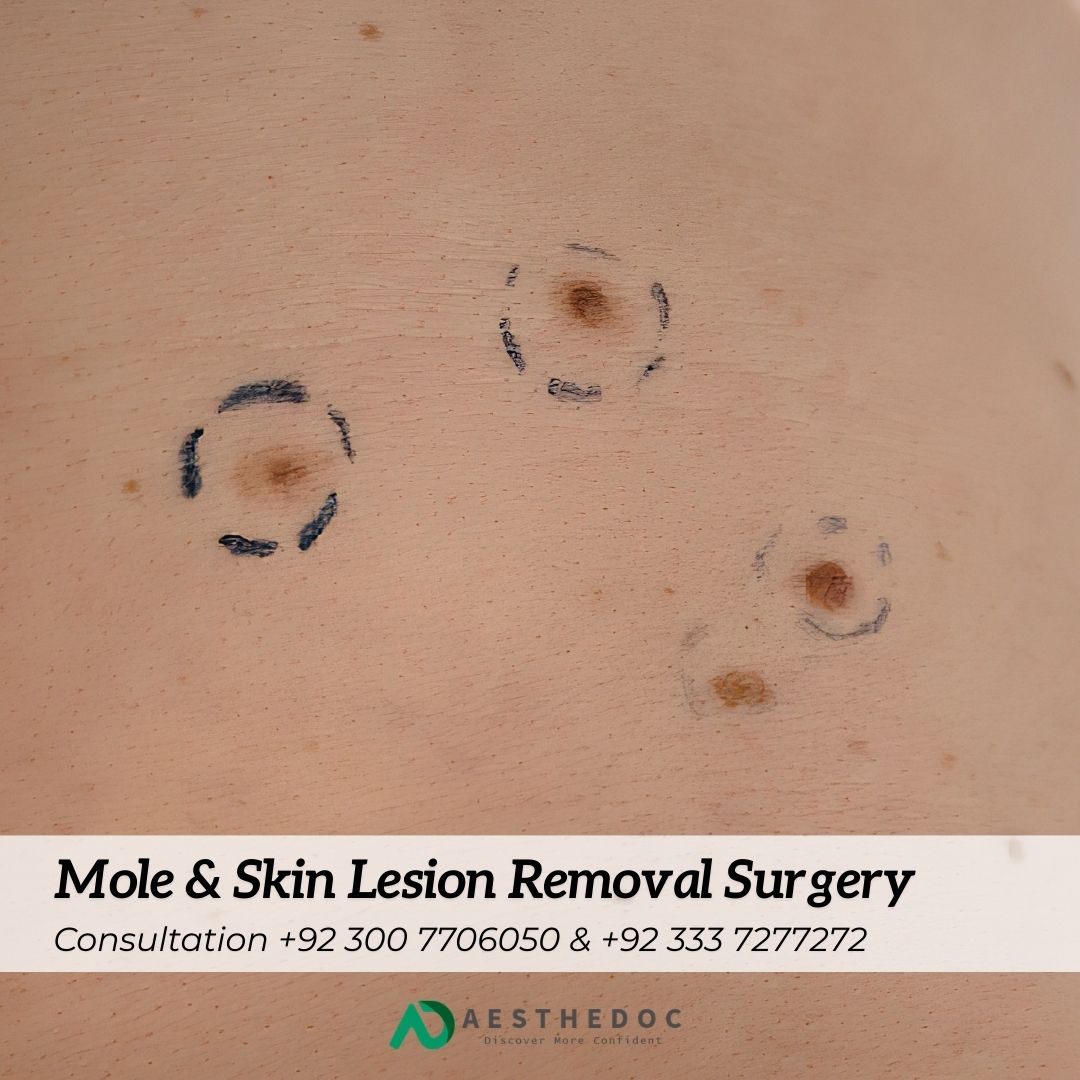
Healthy, clear skin is not just about beauty — it is about confidence, comfort, and long-term health. Moles and skin lesions are extremely common, and most are harmless. However, changes in size, color, or shape can sometimes signal medical concerns, while raised or visible lesions may affect your appearance and self-esteem.
Mole & Skin Lesion Removal is a precise minor surgical procedure performed by a qualified plastic surgeon to safely remove unwanted, suspicious, or cosmetically concerning skin growths while minimizing scarring and ensuring optimal healing.
In this comprehensive guide, you will learn:
- What moles and skin lesions are
- When removal is medically necessary
- Cosmetic vs medical mole removal
- Types of skin lesions treated
- Surgical and non-surgical removal methods
- Healing timeline and scar care
- Cost factors in Pakistan
- Why choosing a board-certified plastic surgeon matters
If you are searching for mole removal in Islamabad, skin lesion removal in Rawalpindi, or a safe and scar-conscious approach by a qualified plastic surgeon, this detailed guide will answer all your questions.
Understanding Moles and Skin Lesions
What Is a Mole?
A mole (medically called a melanocytic nevus) is a common skin growth formed by clusters of pigment-producing cells called melanocytes. Moles can appear anywhere on the body and vary in:
- Color (brown, black, skin-colored, pink)
- Size (flat or raised)
- Texture (smooth or rough)
- Shape (round or irregular)
Most people have 10–40 moles by adulthood.
What Is a Skin Lesion?
A skin lesion refers to any abnormal growth, lump, patch, or discoloration on the skin. It includes:
- Moles (nevi)
- Skin tags
- Warts
- Cysts
- Lipomas
- Seborrheic keratosis
- Actinic keratosis
- Suspicious pigmented lesions
Not all skin lesions are dangerous — but some may require evaluation.
When Should You Consider Mole & Skin Lesion Removal?
1️⃣ Medical Reasons
Removal is recommended if the lesion:
- Changes in size, shape, or color
- Has irregular borders
- Bleeds or ulcerates
- Itches persistently
- Grows rapidly
- Becomes painful
- Has uneven pigmentation
Doctors often use the ABCDE rule:
- A – Asymmetry
- B – Border irregularity
- C – Color variation
- D – Diameter larger than 6 mm
- E – Evolution (changes over time)
If any of these are present, removal and biopsy may be advised.
2️⃣ Cosmetic Reasons
Many patients choose mole removal for:
- Facial moles
- Raised neck moles
- Moles on lips or eyelids
- Large visible birthmarks
- Skin tags on neck or underarms
- Unwanted skin growths affecting appearance
In cosmetic cases, the goal is:
✔ Safe removal
✔ Minimal scarring
✔ Natural skin blending
✔ Precision closure
Types of Moles and Lesions That Can Be Removed
A qualified plastic surgeon can treat:
Benign Lesions
- Intradermal nevi
- Junctional nevi
- Compound nevi
- Skin tags
- Seborrheic keratosis
- Epidermoid cysts
- Lipomas
- Warts
Potentially Suspicious Lesions
- Dysplastic moles
- Rapidly growing pigmented lesions
- Ulcerated moles
- Recurrent moles after previous removal
Proper evaluation determines whether histopathology (biopsy testing) is required.
Mole & Skin Lesion Removal Techniques
The choice of method depends on:
- Size
- Location
- Depth
- Suspicion of malignancy
- Cosmetic importance of the area
- Patient’s skin type
1️⃣ Surgical Excision (Gold Standard)
This is the most reliable method, especially for:
- Suspicious lesions
- Large moles
- Deep moles
- Recurrent lesions
Procedure:
- Local anesthesia
- Lesion removed with small margin
- Fine sutures placed
- Sample sent for biopsy if needed
Benefits:
✔ Complete removal
✔ Lowest recurrence risk
✔ Suitable for cancer rule-out
✔ Precise scar placement
2️⃣ Shave Excision
Used for:
- Raised benign moles
- Skin tags
- Small protruding lesions
Procedure:
- Local anesthesia
- Lesion shaved at skin level
- No stitches usually required
Best for cosmetic removal of small superficial growths.
3️⃣ Laser Removal
Best for:
- Small superficial pigmented lesions
- Certain cosmetic cases
Limitations:
- Not ideal for suspicious moles
- Cannot provide biopsy tissue
Laser is usually avoided when malignancy needs to be ruled out.
4️⃣ Cautery or Radiofrequency
Used for:
- Skin tags
- Small benign lesions
Quick and effective for minor superficial growths.
Why a Plastic Surgeon Is Preferred Over General Removal
Many clinics offer mole removal, but expertise matters.
A board-certified plastic surgeon ensures:
- Correct diagnosis
- Oncological safety
- Precise incision planning
- Scar-minimizing closure techniques
- Functional preservation (eyelids, lips, nose)
- Natural aesthetic outcome
This is especially important for:
- Face
- Neck
- Scalp
- Breast
- Genital area
- Children
What Happens During Your Consultation?
At Aesthedoc Clinic, consultation includes:
- Detailed medical history
- Examination of lesion
- Dermoscopic evaluation (if needed)
- Discussion of removal method
- Scar expectations
- Cost explanation
- Biopsy recommendation if required
Patients are educated about:
- Healing time
- Scar care
- Risks
- Recurrence possibility
Step-by-Step Mole Removal Procedure
1️⃣ Skin cleaning and sterilization
2️⃣ Local anesthesia injection
3️⃣ Precise removal
4️⃣ Hemostasis control
5️⃣ Fine suturing (if required)
6️⃣ Dressing application
Procedure time: 20–40 minutes (depending on complexity)
Is Mole Removal Painful?
No. The procedure is performed under local anesthesia.
You may feel:
- Mild injection discomfort
- Slight pressure during removal
After procedure:
- Mild soreness for 1–2 days
- Easily managed with oral painkillers
Healing Timeline After Mole Removal
Day 1–3
- Mild swelling
- Light redness
- Small dressing
Day 5–7
- Sutures removed (if non-absorbable)
Week 2–3
- Skin surface healed
Month 1–3
- Scar matures and fades
Scar appearance improves gradually over 6–12 months.
Scar Minimization Techniques
Plastic surgeons use:
- Fine sutures
- Tension-free closure
- Layered suturing
- Precise incision placement along skin lines
Post-care may include:
- Silicone gel
- Silicone sheets
- Sunscreen use
- Scar massage
- Laser resurfacing (if needed)
Risks of Mole & Skin Lesion Removal
All minor surgeries carry minimal risks:
- Infection (rare)
- Bleeding
- Scar formation
- Pigmentation change
- Recurrence (rare if fully excised)
Choosing an experienced plastic surgeon significantly reduces complications.
What If the Mole Is Cancerous?
If biopsy shows abnormal cells:
- Early detection ensures complete cure
- Further excision may be advised
- Additional tests may be recommended
Early removal saves lives.
Mole Removal on Face – Special Considerations
Facial mole removal requires:
- Aesthetic planning
- Natural skin crease alignment
- Micro-suturing techniques
- Minimal visible scarring
Special care is required for:
- Eyelids
- Lips
- Nose
- Cheeks
- Forehead
Plastic surgical expertise is crucial.
Mole Removal for Children
Children may require removal if:
- Lesion grows rapidly
- Repeated irritation
- Cosmetic concern
- Suspicion of abnormality
Procedure is safe under local anesthesia in cooperative children.
Frequently Asked Questions (FAQ)
Can moles grow back after removal?
If completely excised surgically, recurrence is very rare.
Will there be a scar?
Yes, but a fine line scar that fades over time.
Can I remove multiple moles in one session?
Yes, depending on size and location.
Is mole removal safe during pregnancy?
Usually postponed unless medically urgent.
How long before I can resume work?
Most patients return to work next day.
Cost of Mole & Skin Lesion Removal in Pakistan
Cost depends on:
- Size of lesion
- Location
- Complexity
- Number of lesions
- Need for biopsy
- Sutures required
In Islamabad & Rawalpindi, approximate range:
- Small lesion removal: Moderate range
- Large excision with sutures: Higher range
- Multiple lesion removal: Customized pricing
Exact cost is provided after consultation.
Why Choose Aesthedoc Clinic for Mole & Skin Lesion Removal?
✔ Board-certified Plastic Surgeon
✔ Advanced minor surgery setup
✔ Sterile environment
✔ Biopsy facility
✔ Minimal scar techniques
✔ Personalized care
✔ Clinics in Islamabad & Rawalpindi
Meet the Plastic Surgeon
Dr Nadiya Tariq – Plastic Surgeon
Academic Qualifications
- FCPS (Plastic Surgery) – College of Physicians & Surgeons Pakistan (CPSP), 2025
- MBBS – University of Health Sciences (UHS), Lahore, 2016
Professional Registrations
- Pakistan Medical & Dental Council (PMDC) – Active Registration
- Irish Medical Council (IMC) – Active Registration
With structured postgraduate training in plastic surgery and aesthetic procedures, Dr Nadiya Tariq focuses on safe, ethical, and scar-conscious surgical care.
Clinic Locations
Aesthedoc – Islamabad
I-8 Markaz, Islamabad
📞 +92 333 7277272
📧 info@aesthedoc.com
Instagram: @aesthe_doc
Mon – Sun 9:00 – 19:00
Aesthedoc Clinic – Rawalpindi
3rd Floor, Rajas United Height, Opposite Future World School, Bahria Town Phase 8, Rawalpindi
📞 +92 300 7706050
📧 info@aesthedocclinic.com
Instagram: @aesthedocclinic
Mon – Sun 9:00 – 19:00
Book Your Consultation Today
If you are concerned about a changing mole, a raised facial lesion, or an unwanted skin growth, do not ignore it.
Early evaluation ensures:
- Peace of mind
- Cosmetic improvement
- Medical safety
Schedule your consultation at Aesthedoc Clinic in Islamabad or Rawalpindi today and receive expert assessment by a qualified plastic surgeon.
Clear skin. Safe removal. Minimal scar. Professional care.