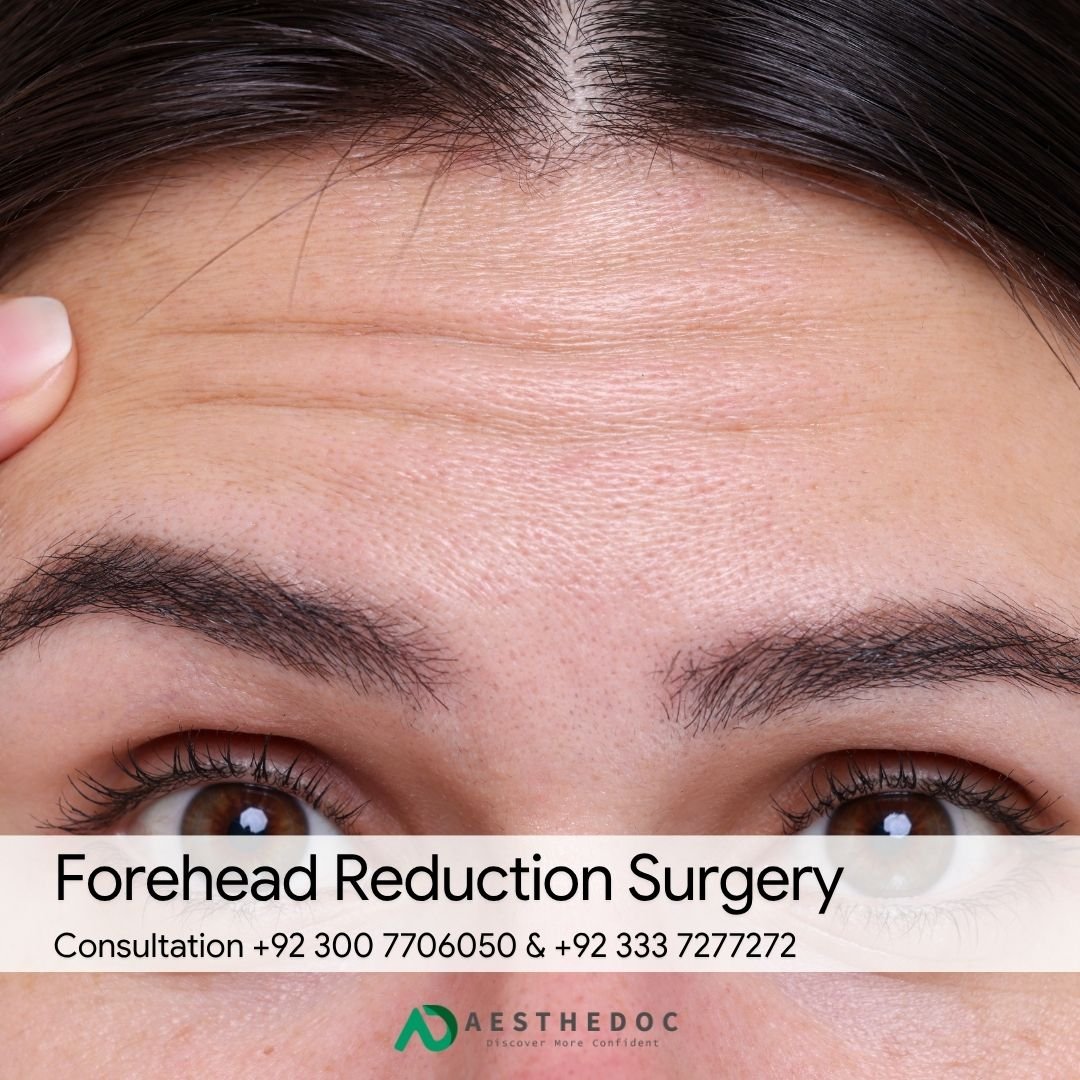
Forehead Reduction Surgery, also known as Hairline Lowering Surgery, Hairline Advancement Surgery, or Forehead Shortening Surgery, is a cosmetic facial procedure designed to reduce the height of the forehead by advancing the hairline to a lower position. This procedure helps create more balanced facial proportions and is an effective option for individuals with a naturally high hairline or a large forehead.
A high forehead may result from genetics, naturally high hairline placement, or certain patterns of hair loss. While some patients seek treatment for cosmetic reasons, others desire improved facial harmony and increased confidence. Forehead Reduction Surgery permanently lowers the hairline by removing a strip of forehead skin and advancing the scalp forward, producing immediate improvement in forehead height.
Unlike hair transplantation, which gradually increases hair density over several months, Hairline Lowering Surgery provides an instant reduction in forehead size. In selected patients, it may also be combined with hair transplantation to further refine the hairline or improve density.
Forehead Reduction Surgery may improve:
- Large forehead
- High hairline
- Long upper face
- Facial disproportion
- Congenital high forehead
- Feminization of facial proportions (selected patients)
- Hairline asymmetry
- Confidence related to forehead appearance
Many patients combine Forehead Reduction Surgery with:
- Brow Lift
- Facelift
- Blepharoplasty
- Rhinoplasty
- Chin Augmentation
- Hair Transplantation
- Facial Fat Grafting
At Aesthedoc Clinic, Forehead Reduction Surgery is performed by experienced Plastic, Reconstructive and Cosmetic Surgery Specialists using advanced surgical techniques that prioritize patient safety, natural hairline design, and balanced facial aesthetics. Every treatment plan is customized according to the patient’s forehead dimensions, scalp flexibility, hairline characteristics, and cosmetic goals.
What is Forehead Reduction Surgery?
Forehead Reduction Surgery is a cosmetic surgical procedure that lowers the hairline by advancing the scalp forward after removing a carefully measured strip of forehead skin. The procedure immediately shortens the vertical height of the forehead and improves facial balance.
The primary goals of Forehead Reduction Surgery include:
- Lowering the hairline
- Reducing forehead height
- Improving facial proportions
- Creating a natural hairline
- Correcting hairline asymmetry
- Enhancing overall facial harmony
Unlike hair restoration procedures that rely on transplanted hair growth, this surgery provides an immediate improvement in forehead dimensions.
Forehead and Hairline Anatomy
Successful Hairline Lowering Surgery requires a thorough understanding of scalp and forehead anatomy.
Important anatomical structures include:
- Forehead skin
- Hair-bearing scalp
- Hair follicles
- Galea aponeurotica
- Frontalis muscle
- Temporalis muscle
- Supraorbital nerves
- Supratrochlear nerves
- Scalp blood vessels
- Hairline transition zone
Protecting these structures while achieving a natural-looking hairline is a key objective of modern Forehead Reduction Surgery.
Understanding Forehead Proportions
Facial harmony depends on balanced proportions between the upper, middle, and lower thirds of the face.
A forehead that is disproportionately tall may make the:
- Face appear longer
- Hairline seem excessively high
- Eyes appear lower on the face
- Facial proportions appear unbalanced
Forehead Reduction Surgery helps restore these proportions by shortening the upper facial third while preserving a natural hairline contour.
Why is Forehead Reduction Surgery Performed?
Patients seek Hairline Lowering Surgery for several cosmetic reasons.
Common concerns include:
- Naturally high hairline
- Large forehead
- Long facial appearance
- Hairline asymmetry
- Congenital forehead prominence
- Cosmetic dissatisfaction with forehead size
- Desire for permanent forehead reduction
The procedure aims to improve facial aesthetics while maintaining a natural appearance.
Conditions Treated by Forehead Reduction Surgery
Large Forehead
Patients with a naturally large forehead often seek surgery to improve facial proportions and create a more balanced appearance.
High Hairline
A high hairline can make the forehead appear excessively tall. Hairline advancement lowers the hairline to a more aesthetically pleasing position.
Hairline Asymmetry
Uneven hairline positioning may be improved through individualized surgical planning and scalp advancement.
Congenital High Forehead
Some individuals are born with a naturally high hairline despite having healthy hair density. Hairline Lowering Surgery offers a permanent solution for suitable candidates.
Long Facial Appearance
Reducing forehead height can improve overall facial balance by shortening the upper third of the face.
Facial Feminization (Selected Patients)
In selected cases, lowering the hairline may contribute to softer, more traditionally feminine facial proportions as part of a broader facial aesthetic plan.
Benefits of Forehead Reduction Surgery
Potential benefits include:
- Immediate forehead shortening
- Permanent hairline advancement
- Improved facial proportions
- More balanced upper facial third
- Natural-looking hairline
- Increased confidence
- Correction of hairline asymmetry
- No need to wait for transplanted hair growth
- Can be combined with other facial procedures
- Long-lasting cosmetic results
Who is a Good Candidate?
You may be a suitable candidate if you:
- Have a naturally high hairline
- Have a large forehead
- Possess good scalp flexibility (scalp laxity)
- Have healthy hair density behind the hairline
- Are in good general health
- Have realistic cosmetic expectations
- Do not smoke or are willing to stop before surgery
A detailed consultation and scalp examination are essential to determine whether Hairline Lowering Surgery is appropriate for you.
Who May Not Be a Suitable Candidate?
Forehead Reduction Surgery may not be recommended for individuals with:
- Progressive hair loss
- Limited scalp flexibility
- Active scalp infections
- Significant scarring disorders
- Poor wound healing
- Uncontrolled medical conditions
- Unrealistic cosmetic expectations
Alternative procedures, such as hair transplantation, may be more appropriate in some cases.
Types of Forehead Reduction Procedures
Standard Hairline Lowering Surgery
This is the most commonly performed technique.
A strip of forehead skin is removed, and the scalp is advanced forward to lower the hairline.
Hairline Lowering with Brow Lift
Selected patients with forehead aging or eyebrow descent may benefit from combining Hairline Lowering Surgery with a Brow Lift.
Hairline Lowering with Hair Transplantation
Hair transplantation may be performed after Hairline Lowering Surgery to:
- Refine the hairline
- Improve density
- Camouflage scars
- Enhance natural transitions
Staged Hairline Reconstruction
Patients with severe forehead prominence or limited scalp mobility may require staged procedures for optimal outcomes.
Forehead Reduction Surgery vs Hair Transplant
| Feature | Forehead Reduction Surgery | Hair Transplant |
|---|---|---|
| Immediate Hairline Lowering | ✔ | ✘ |
| Permanent Hairline Advancement | ✔ | Limited |
| Requires Scalp Laxity | ✔ | ✘ |
| Suitable for Progressive Hair Loss | Limited | ✔ |
| Hair Growth Waiting Period | ✘ | ✔ |
| Surgical Scar | Small hairline scar | Tiny graft sites |
| Best for Large Forehead | ✔ | Variable |
Both procedures have different indications, and some patients benefit from a combination approach.
Consultation and Evaluation
Every successful Forehead Reduction Surgery begins with a detailed consultation.
Your specialist will assess:
- Forehead height
- Hairline position
- Hair density
- Hairline shape
- Scalp flexibility
- Hair loss history
- Facial proportions
- Medical history
- Cosmetic goals
Clinical photographs and precise facial measurements assist in planning a personalized surgical approach.
Preparing for Forehead Reduction Surgery
Before surgery, patients are generally advised to:
- Stop smoking at least 4–6 weeks before surgery
- Avoid aspirin and certain blood-thinning medications under medical supervision
- Complete recommended laboratory investigations
- Wash the hair according to preoperative instructions
- Maintain a healthy diet and hydration
- Arrange transportation home after surgery
- Follow fasting instructions if general anesthesia is planned
- Carefully follow all personalized preoperative instructions provided by the surgical team
Proper preparation contributes to safe surgery, optimal wound healing, and successful long-term results.
Preparing for Forehead Reduction Surgery
Careful preparation before Hairline Lowering Surgery helps improve healing, reduce complications, and optimize cosmetic outcomes. During your consultation, your Plastic, Reconstructive and Cosmetic Surgery Specialist will evaluate your forehead height, hairline position, scalp flexibility, hair density, and facial proportions before developing a personalized surgical plan.
Patients are generally advised to:
- Complete all recommended medical evaluations
- Review current medications and supplements
- Undergo laboratory investigations if required
- Stop smoking at least 4–6 weeks before surgery
- Avoid aspirin and certain blood-thinning medications under medical supervision
- Wash the hair according to the preoperative instructions
- Maintain a healthy, balanced diet
- Stay well hydrated
- Arrange transportation home after surgery
- Follow fasting instructions if general anesthesia is planned
- Carefully follow all instructions provided by the surgical team
Proper preparation helps promote safe surgery and supports optimal healing.
Step-by-Step Forehead Reduction Surgery Procedure
Although every treatment plan is individualized, most Hairline Lowering procedures follow a similar sequence.
Step 1 – Anesthesia
Forehead Reduction Surgery is usually performed under:
- General anesthesia
- Local anesthesia with intravenous (IV) sedation (selected patients)
The choice depends on:
- Extent of surgery
- Patient preference
- Whether additional facial procedures are being performed
- Overall health
Throughout surgery, the anesthesia team continuously monitors:
- Heart rate
- Blood pressure
- Oxygen saturation
- Breathing
- Overall patient safety
Step 2 – Hairline Design
One of the most important stages of surgery is designing the new hairline.
The surgeon carefully evaluates:
- Current hairline
- Natural hairline shape
- Hair density
- Facial proportions
- Forehead height
- Hair direction
- Future aging considerations
The objective is to create a lower hairline that appears completely natural and harmonizes with the patient’s facial features.
Step 3 – Surgical Markings
Precise surgical markings are made before anesthesia.
The markings identify:
- Existing hairline
- Planned hairline position
- Skin to be removed
- Incision design
- Areas requiring symmetry correction
Careful planning helps maximize cosmetic precision.
Step 4 – Hairline Incision
A carefully planned incision is made immediately along the natural hairline.
Modern incision techniques are designed to:
- Preserve nearby hair follicles
- Minimize visible scarring
- Allow hair growth through the scar
- Create a smooth hairline transition
Every effort is made to camouflage the incision within the natural hairline.
Step 5 – Forehead Skin Removal
After the incision is made, a carefully measured strip of forehead skin is removed.
The amount removed depends on:
- Forehead height
- Desired reduction
- Scalp flexibility
- Facial proportions
Most patients achieve a reduction of approximately 1.5 to 3 centimeters, although the exact amount varies depending on individual anatomy and surgical planning.
Step 6 – Scalp Mobilization
The hair-bearing scalp is gently released from the underlying tissues.
This allows the scalp to advance forward with minimal tension.
Adequate scalp mobilization is essential for:
- Hairline advancement
- Reduced wound tension
- Improved scar quality
- Long-term stability
Step 7 – Hairline Advancement
The scalp is carefully advanced toward the eyebrows until the planned hairline position is achieved.
The surgeon continuously checks:
- Facial symmetry
- Hairline contour
- Hair direction
- Forehead proportions
Small adjustments are made before closure to ensure optimal aesthetic results.
Step 8 – Layered Wound Closure
The incision is closed in multiple layers.
This technique helps:
- Reduce tension
- Improve healing
- Minimize scar widening
- Support long-term hairline stability
Fine sutures or surgical clips may be used depending on the surgical technique.
Step 9 – Dressing Application
After closure:
- The incision is cleaned
- Protective dressings are applied if required
- A light head dressing may be placed
- Postoperative instructions are reviewed before discharge
Most patients return home on the same day.
Combination Procedures
Hairline Lowering Surgery is frequently combined with other facial procedures for comprehensive facial rejuvenation.
Common combinations include:
- Forehead Reduction + Brow Lift
- Forehead Reduction + Rhinoplasty
- Forehead Reduction + Blepharoplasty
- Forehead Reduction + Facelift
- Forehead Reduction + Hair Transplantation
- Forehead Reduction + Facial Fat Grafting
- Forehead Reduction + Chin Augmentation
Combining procedures may provide more balanced facial proportions while reducing the need for multiple recovery periods.
How Long Does Forehead Reduction Surgery Take?
The duration depends on the complexity of surgery and whether additional procedures are performed.
| Procedure | Estimated Surgical Time |
|---|---|
| Standard Forehead Reduction | 2–3 hours |
| Hairline Lowering + Brow Lift | 3–5 hours |
| Hairline Lowering + Rhinoplasty | 4–6 hours |
| Hairline Lowering + Hair Transplant (same session in selected cases) | 5–8 hours |
| Combined Facial Cosmetic Surgery | 6–8 hours |
Recovery After Forehead Reduction Surgery
Recovery varies between individuals, but gradual improvement occurs over several weeks and months.
First 24 Hours
Patients commonly experience:
- Mild to moderate swelling
- Forehead tightness
- Mild discomfort
- Temporary numbness
- Small amount of bruising
The head should remain elevated during the early recovery period.
Days 2–7
During the first week:
- Swelling often reaches its peak
- Bruising may become more noticeable before gradually improving
- Mild itching around the incision is common
- Walking is encouraged
- Heavy lifting should be avoided
Patients attend their first postoperative review during this period.
Week Two
Most patients notice:
- Significant reduction in swelling
- Improved comfort
- Better forehead mobility
- Continued incision healing
Depending on the surgeon’s preference, sutures or clips may be removed during this stage if non-absorbable materials were used.
Weeks 3–6
Healing continues as:
- Bruising resolves
- Swelling decreases further
- Hairline begins to appear more natural
- Scar maturation begins
Most patients resume normal daily activities, including light exercise, after medical clearance.
Months 2–6
During this period:
- Hair begins growing through and around the incision
- Numbness gradually improves
- Scar continues to soften
- Hairline settles into its final position
The cosmetic result becomes increasingly refined.
Six to Twelve Months
By this stage:
- The scar is typically much less noticeable
- Hairline appearance stabilizes
- Final forehead proportions become evident
- Long-term results can be fully appreciated
Recovery Timeline
| Time After Surgery | Typical Recovery Progress |
|---|---|
| Day 1 | Swelling and forehead tightness |
| Week 1 | Initial wound healing |
| Week 2 | Most swelling improves |
| Month 1 | Hairline becoming more natural |
| Month 3 | Scar maturation underway |
| Month 6 | Hair growth improves scar camouflage |
| Month 12 | Final cosmetic outcome generally established |
Aftercare Instructions
Following postoperative instructions helps support wound healing and optimize scar quality.
Patients are generally advised to:
- Sleep with the head elevated
- Keep the incision clean and dry as instructed
- Avoid scratching or rubbing the incision
- Avoid smoking throughout recovery
- Protect the scar from direct sun exposure
- Avoid strenuous exercise until approved
- Take prescribed medications exactly as directed
- Attend all scheduled follow-up appointments
- Report increasing redness, fever, drainage, or severe pain promptly
Benefits of Forehead Reduction Surgery
Potential benefits include:
- Immediate reduction in forehead height
- Permanent hairline advancement
- Improved facial balance
- Better upper facial proportions
- Natural-looking hairline
- Enhanced facial harmony
- Increased confidence
- Long-lasting results
- Can be combined with other facial cosmetic procedures
- Improved overall facial aesthetics
Expected Results
The primary goal of Forehead Reduction Surgery is to create a lower, naturally positioned hairline that improves facial proportions.
Patients may notice:
- A shorter forehead
- Improved balance between the upper, middle, and lower thirds of the face
- A more youthful hairline
- Better facial symmetry
- Enhanced confidence
Although the hairline is repositioned immediately, the final appearance continues to improve as swelling resolves and the scar matures.
Before and After Expectations
Patients should understand that:
- Swelling and bruising are temporary.
- Mild numbness around the incision is common during early healing.
- The scar gradually softens and becomes less noticeable over several months.
- Hair growing through and around the incision helps camouflage the scar.
- Final cosmetic results are typically assessed between 6 and 12 months after surgery.
The goal is to achieve a natural-looking hairline that complements the patient’s facial anatomy without appearing surgically altered.
Risks and Possible Complications of Forehead Reduction Surgery
Forehead Reduction Surgery (Hairline Lowering Surgery) is generally considered a safe cosmetic procedure when performed by an experienced Plastic, Reconstructive and Cosmetic Surgery Specialist. However, like any surgical procedure, it carries certain risks and potential complications that should be discussed during your consultation.
Possible complications include:
- Bleeding (hematoma)
- Infection
- Swelling
- Bruising
- Temporary pain or discomfort
- Temporary numbness of the scalp or forehead
- Delayed wound healing
- Temporary hair shedding around the incision (shock loss)
- Hairline asymmetry
- Visible or widened scar
- Scar hypertrophy or keloid formation (rare)
- Temporary scalp tightness
- Permanent numbness (rare)
- Injury to sensory nerves (rare)
- Hairline positioned higher or lower than desired
- Poor cosmetic outcome
- Adverse reaction to anesthesia
- Recurrence of forehead prominence due to progressive hair loss
- Need for revision surgery
Although these complications are uncommon, proper patient selection, meticulous surgical technique, and adherence to postoperative instructions significantly reduce the overall risk.
How to Reduce the Risk of Complications
Patients can improve healing and minimize complications by:
- Choosing an experienced Plastic, Reconstructive and Cosmetic Surgery Specialist
- Following all preoperative and postoperative instructions
- Stopping smoking at least 4–6 weeks before and after surgery
- Maintaining a healthy diet and proper hydration
- Avoiding strenuous activities during early recovery
- Keeping the incision clean and dry
- Protecting the scar from sun exposure
- Taking prescribed medications as directed
- Attending all scheduled follow-up appointments
- Contacting the clinic immediately if excessive swelling, fever, drainage, or increasing pain develops
Success Rate of Forehead Reduction Surgery
Forehead Reduction Surgery has a high patient satisfaction rate among carefully selected patients with good scalp flexibility and stable hairlines.
Long-term outcomes depend on:
- Scalp laxity
- Hair density
- Hairline stability
- Surgical planning
- Scar healing
- Individual anatomy
- Smoking status
- Overall health
- Compliance with postoperative care
Patients with stable hairlines and good scalp mobility typically achieve long-lasting improvements in forehead proportions and facial harmony.
Estimated Forehead Reduction Surgery Cost in Pakistan
The cost of Hairline Lowering Surgery depends on surgical complexity, scalp flexibility, anesthesia, hospital charges, and whether additional facial cosmetic procedures are performed.
Estimated Price Table
| Procedure | Estimated Cost (PKR) |
|---|---|
| Consultation | 3,000 – 10,000 |
| Standard Forehead Reduction Surgery | 350,000 – 700,000 |
| Forehead Reduction + Brow Lift | 700,000 – 1,300,000 |
| Forehead Reduction + Hair Transplant | 700,000 – 1,500,000 |
| Forehead Reduction + Rhinoplasty | 900,000 – 1,800,000 |
| Comprehensive Facial Cosmetic Surgery | 1,500,000 – 3,000,000 |
Disclaimer: These prices are approximate estimates for educational purposes only. The final cost depends on the patient’s anatomy, scalp flexibility, surgical complexity, anesthesia, investigations, hospital charges, and individualized treatment planning.
Estimated Forehead Reduction Surgery Cost Around the World
| Country | Estimated Cost |
|---|---|
| 🇵🇰 Pakistan | USD 2,500 – 6,000 |
| 🇮🇳 India | USD 2,500 – 5,500 |
| 🇹🇷 Turkey | USD 3,500 – 7,000 |
| 🇹🇭 Thailand | USD 4,000 – 8,000 |
| 🇲🇾 Malaysia | USD 4,500 – 8,500 |
| 🇦🇪 UAE (Dubai) | USD 6,000 – 10,000 |
| 🇰🇷 South Korea | USD 6,000 – 11,000 |
| 🇬🇧 United Kingdom | USD 8,000 – 14,000 |
| 🇨🇦 Canada | USD 9,000 – 15,000 |
| 🇺🇸 United States | USD 10,000 – 18,000+ |
Frequently Asked Questions (FAQs)
What is Forehead Reduction Surgery?
Forehead Reduction Surgery is a cosmetic procedure that lowers the hairline by advancing the scalp after removing a strip of forehead skin, creating a shorter forehead and more balanced facial proportions.
Is Hairline Lowering Surgery permanent?
Yes. The repositioned hairline is considered permanent. However, future age-related or genetic hair loss may affect the overall appearance.
How much can the forehead be reduced?
Most patients achieve a forehead reduction of approximately 1.5 to 3 centimeters, depending on scalp flexibility and individual anatomy.
Does Forehead Reduction Surgery leave a visible scar?
The incision is placed along the hairline and designed to heal discreetly. Over time, the scar typically becomes less noticeable and is often camouflaged by surrounding hair.
Will my hair grow through the scar?
Modern surgical techniques aim to preserve hair follicles near the incision, and hair may grow through or adjacent to the scar, helping conceal it.
Is the procedure painful?
Most patients experience mild to moderate discomfort during recovery, which is usually managed effectively with prescribed pain medication.
How long does the surgery take?
Forehead Reduction Surgery generally takes 2–3 hours as a standalone procedure.
When can I return to work?
Many patients return to office-based work within 10–14 days, depending on their recovery and the nature of their occupation.
How long does swelling last?
Most swelling improves significantly within 2–3 weeks, although minor residual swelling may persist for a longer period.
Can Forehead Reduction Surgery be combined with a Hair Transplant?
Yes. In selected cases, Hairline Lowering Surgery is combined with Hair Transplantation to refine the hairline, improve density, or camouflage the incision.
Am I a candidate if I have thinning hair?
Patients with progressive hair loss may not be ideal candidates. A detailed consultation is necessary to determine the most appropriate treatment approach.
Is Hairline Lowering better than a Hair Transplant?
The procedures serve different purposes. Hairline Lowering provides immediate forehead reduction, while Hair Transplantation increases hair density over time. Some patients benefit from a combination of both.
Can men undergo Forehead Reduction Surgery?
Yes. Men with stable hairlines, good scalp flexibility, and realistic expectations may be suitable candidates.
Does the surgery change my eyebrows?
The procedure primarily lowers the hairline. While minor changes in brow position may occur due to tissue movement, it is not intended to replace a Brow Lift.
Will I lose sensation in my scalp?
Temporary numbness around the incision is common and usually improves gradually over several months. Permanent numbness is uncommon.
Can the surgery correct an uneven hairline?
Yes. Hairline asymmetry can often be improved with careful surgical planning and customized hairline design.
Will future hair loss affect the result?
Progressive hair loss may alter the appearance of the hairline over time. Patients with a strong family history of hair loss should discuss this during their consultation.
How should I sleep after surgery?
Patients are generally advised to sleep with their head elevated during the first few weeks to help reduce swelling.
Can I exercise after surgery?
Light walking is encouraged shortly after surgery. More strenuous activities should only be resumed after clearance from your specialist.
Who is the ideal candidate?
Healthy adults with a naturally high hairline, good scalp flexibility, stable hair density, and realistic expectations are generally considered suitable candidates after a comprehensive evaluation.
Why Choose Aesthedoc Clinic?
At Aesthedoc Clinic, Forehead Reduction Surgery is performed using advanced hairline advancement techniques designed to improve facial proportions while maintaining a natural-looking hairline. Our experienced Plastic, Reconstructive and Cosmetic Surgery Specialists provide individualized treatment plans tailored to each patient’s anatomy, scalp characteristics, and aesthetic goals.
Our approach includes:
- Comprehensive facial and scalp assessment
- Customized hairline design
- Advanced surgical planning
- Natural-looking hairline advancement
- Modern surgical facilities
- Evidence-based treatment protocols
- Comprehensive postoperative care
- Long-term follow-up
- Patient safety as our highest priority
Whether your concern is a naturally high hairline, a large forehead, or facial imbalance, our team is committed to delivering safe treatment and aesthetically pleasing, natural-looking results.
Related Procedures
Patients considering Forehead Reduction Surgery may also be interested in:
- Brow Lift
- Hair Transplantation
- Blepharoplasty
- Rhinoplasty
- Facelift
- Facial Fat Grafting
- Chin Augmentation (Genioplasty)
- Lip Lift
- Buccal Fat Removal
- Facial Cosmetic Surgery
Conclusion
Forehead Reduction Surgery (Hairline Lowering Surgery) is an effective cosmetic procedure for individuals seeking a smaller forehead and improved facial balance. By advancing the hairline to a more aesthetically pleasing position, the procedure provides immediate and long-lasting improvement in facial proportions.
A comprehensive consultation is essential to evaluate scalp flexibility, hairline stability, and individual goals before determining the most appropriate treatment plan.
Book Your Forehead Reduction Surgery Consultation at Aesthedoc Clinic
If you are considering Forehead Reduction Surgery (Hairline Lowering Surgery), Aesthedoc Clinic offers comprehensive consultations with experienced Plastic, Reconstructive and Cosmetic Surgery Specialists who provide personalized treatment plans using advanced facial plastic surgery techniques.
Whether your concerns include a naturally high hairline, a large forehead, or facial proportion imbalance, our team is committed to delivering safe, evidence-based care with natural-looking results.
Schedule Your Consultation Today
📞 Phone: 0333-7277272 | 0300-7706050
📧 Email: info@aesthedoc.com
Book your confidential consultation with Aesthedoc Clinic to discuss your facial aesthetic goals and explore the treatment options best suited to your needs.