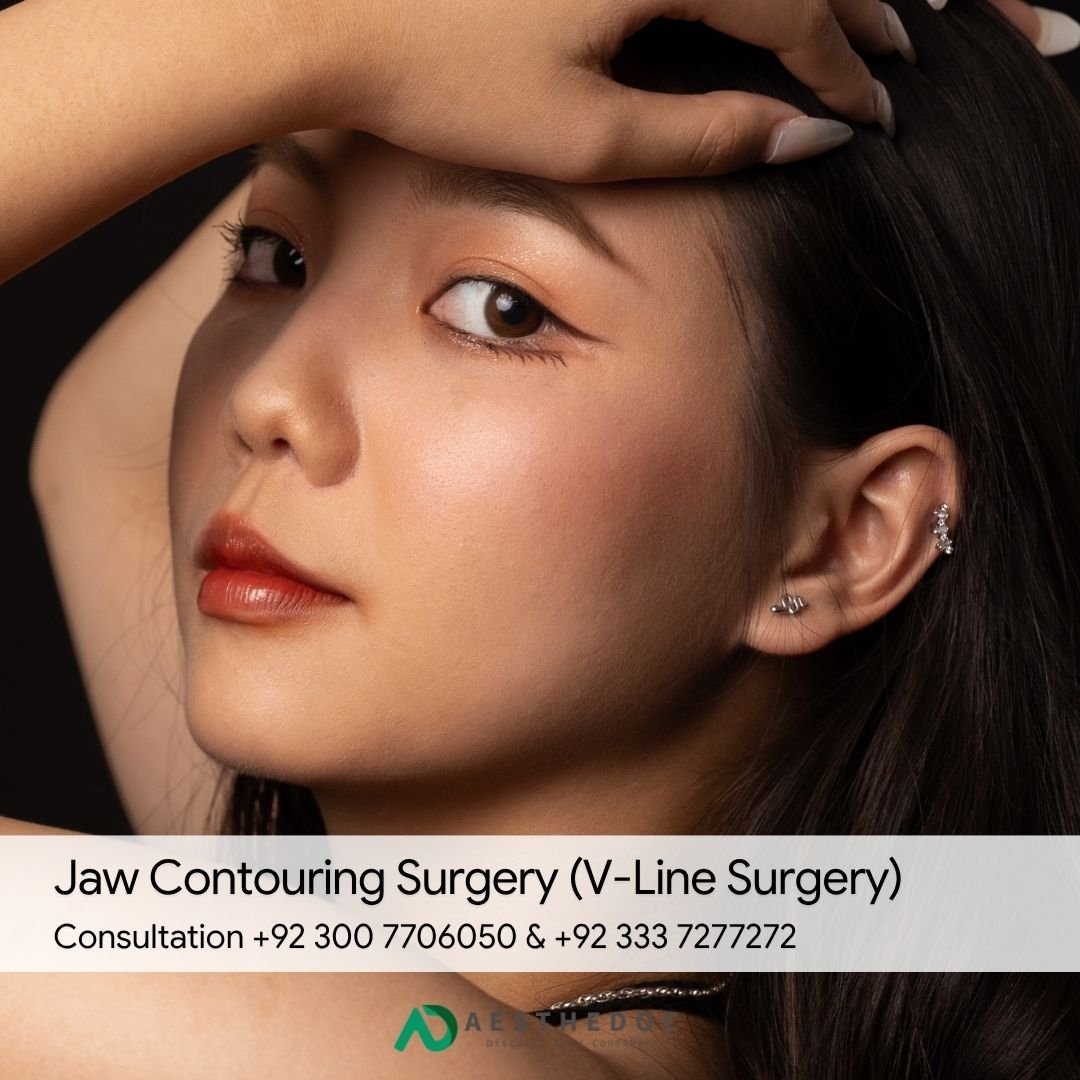
Jaw Contouring Surgery, commonly known as V-Line Surgery, is an advanced facial cosmetic procedure designed to reshape the lower face by refining the jawline and chin. The procedure reduces excessive jaw width, improves facial symmetry, and creates a slimmer, more defined facial profile. It is particularly popular among individuals seeking a softer, balanced facial appearance or a more sculpted jawline.
The shape of the lower face is influenced by the mandible (lower jawbone), chin projection, facial muscles, and overlying soft tissues. Some people naturally have a broad or square jaw, while others develop a bulky jawline due to enlarged masseter muscles or prominent mandibular angles. Jaw Contouring Surgery addresses these structural concerns by reshaping the jawbone, chin, or both.
Unlike non-surgical jawline treatments, which temporarily improve contour using injectable products, Jaw Contouring Surgery provides permanent structural changes that enhance facial harmony.
Jaw Contouring Surgery may improve:
- Wide or square jaw
- Prominent mandibular angles
- Broad lower face
- Facial asymmetry
- Weak facial balance
- Heavy jawline
- Prominent chin shape
- Congenital jaw irregularities
- Overall facial proportions
Depending on the patient’s anatomy, Jaw Contouring Surgery may be combined with:
- Chin Augmentation
- Facial Implants
- Buccal Fat Removal
- Rhinoplasty
- Facelift
- Neck Liposuction
- Facial Fat Grafting
- Forehead Reduction Surgery
At Aesthedoc Clinic, Jaw Contouring Surgery is performed by experienced Plastic, Reconstructive and Cosmetic Surgery Specialists using modern facial analysis, advanced surgical planning, and evidence-based techniques to create natural-looking facial balance while prioritizing patient safety.
What is Jaw Contouring Surgery?
Jaw Contouring Surgery is a facial skeletal procedure that reshapes the lower jaw to improve facial proportions and jawline definition.
Depending on the patient’s needs, surgery may involve:
- Mandibular angle reduction
- Chin reshaping (Genioplasty)
- Bone contouring
- V-Line osteotomy
- Combination jaw and chin surgery
The objective is to create a harmonious transition between the cheeks, jawline, and chin while preserving normal chewing, speech, and facial function.
Lower Face Anatomy
Successful Jaw Contouring Surgery requires a detailed understanding of facial anatomy.
Important structures include:
- Mandible (lower jawbone)
- Mandibular angle
- Chin (mental bone)
- Masseter muscles
- Facial nerve branches
- Inferior alveolar nerve
- Mental nerve
- Facial arteries and veins
- Temporomandibular joint (TMJ)
- Teeth and dental occlusion
- Soft tissue envelope
Protecting these structures is essential to achieving safe surgery and predictable results.
Understanding Facial Proportions
An attractive jawline depends on balance between the:
- Forehead
- Midface
- Nose
- Lips
- Chin
- Jawline
- Neck
A broad lower face or prominent jaw angles can make the face appear wider or heavier. Carefully planned jaw contouring helps improve these proportions while maintaining facial harmony and preserving natural function.
Why is Jaw Contouring Surgery Performed?
Patients choose Jaw Contouring Surgery for several cosmetic and reconstructive reasons.
Common concerns include:
- Naturally square jaw
- Broad lower face
- Excessively prominent jaw angles
- Facial imbalance
- Asymmetrical jawline
- Congenital jaw shape differences
- Dissatisfaction with facial profile
- Desire for a slimmer facial contour
The procedure aims to improve facial aesthetics while respecting each patient’s unique anatomy.
Conditions Jaw Contouring Surgery Can Improve
Square Jaw
Patients with a square lower face may benefit from reduction of the mandibular angle to achieve a smoother facial contour.
Broad Lower Face
Excess jaw width may create an unbalanced appearance. Surgical contouring narrows the lower face in appropriate candidates.
Facial Asymmetry
Mild to moderate jaw asymmetry may be improved through customized bone reshaping.
Prominent Jaw Angles
Reducing prominent mandibular angles can soften the appearance of the lower face.
Wide Chin
Some patients benefit from narrowing or reshaping the chin as part of a V-Line procedure.
Congenital Jaw Shape Variations
Jaw Contouring Surgery can improve selected congenital skeletal differences affecting facial harmony.
Benefits of Jaw Contouring Surgery
Potential benefits include:
- Slimmer lower face
- Improved jawline definition
- Better facial symmetry
- Enhanced facial balance
- Improved profile
- Permanent structural enhancement
- Customized treatment planning
- Long-lasting results
- Increased confidence
- Improved overall facial harmony
Who is a Good Candidate?
You may be a suitable candidate if you:
- Have a broad or square jaw
- Have prominent jaw angles
- Desire permanent jawline refinement
- Are in good overall health
- Have stable facial bone development
- Have realistic expectations
- Do not smoke or are willing to stop before surgery
A detailed consultation and facial assessment are necessary to determine whether Jaw Contouring Surgery is appropriate for you.
Who May Not Be a Suitable Candidate?
Jaw Contouring Surgery may not be recommended for individuals with:
- Active oral or facial infections
- Uncontrolled medical conditions
- Poor wound healing
- Untreated dental disease
- Severe TMJ disorders requiring separate evaluation
- Unrealistic cosmetic expectations
Alternative treatment options may be discussed depending on the patient’s anatomy and goals.
Types of Jaw Contouring Procedures
Mandibular Angle Reduction
This procedure reshapes the back corners of the lower jaw to reduce facial width.
V-Line Surgery
V-Line Surgery combines jaw reduction with chin reshaping to create a narrower, more tapered lower face.
Sliding Genioplasty
The chin bone is repositioned to improve projection, height, or symmetry without using an implant.
Jaw Contouring with Chin Implant
In selected patients, jaw contouring may be combined with a chin implant to improve lower facial balance.
Jaw Contouring with Buccal Fat Removal
Patients seeking a more sculpted facial appearance may combine jaw contouring with Buccal Fat Removal to enhance definition.
Jaw Contouring Surgery vs Non-Surgical Jawline Contouring
| Feature | Jaw Contouring Surgery | Non-Surgical Jawline Contouring |
|---|---|---|
| Permanent Results | ✔ | ✘ |
| Bone Reshaping | ✔ | ✘ |
| Immediate Structural Change | ✔ | Limited |
| Injectable Products Required | ✘ | ✔ |
| Repeat Treatments | Rare | ✔ |
| Suitable for Wide Jawbone | ✔ | ✘ |
| Recovery Required | ✔ | Minimal |
The most appropriate treatment depends on the patient’s anatomy, cosmetic goals, and whether the concern involves bone, muscle, or soft tissue.
Consultation and Evaluation
A successful Jaw Contouring procedure begins with a comprehensive facial assessment.
During your consultation, your specialist will evaluate:
- Facial symmetry
- Jaw width
- Chin projection
- Mandibular angles
- Bite relationship (occlusion)
- TMJ function
- Bone structure
- Medical history
- Cosmetic goals
Clinical photographs and facial measurements assist in creating an individualized surgical plan.
Preparing for Jaw Contouring Surgery
Before surgery, patients are generally advised to:
- Stop smoking at least 4–6 weeks before surgery
- Avoid aspirin and certain blood-thinning medications under medical supervision
- Complete recommended laboratory investigations
- Maintain excellent oral hygiene
- Stay well hydrated
- Eat a balanced diet
- Arrange transportation home after surgery
- Follow fasting instructions if general anesthesia is planned
- Carefully follow all personalized preoperative instructions provided by the surgical team
Proper preparation contributes to safe surgery, improved healing, and optimal long-term results.
Preparing for Jaw Contouring Surgery
Successful Jaw Contouring Surgery begins with comprehensive evaluation and careful surgical planning. During your consultation, your Plastic, Reconstructive and Cosmetic Surgery Specialist will assess your facial skeleton, bite, jawline, facial symmetry, soft tissues, and aesthetic goals to determine the most appropriate surgical approach.
Patients are generally advised to:
- Complete all recommended medical evaluations
- Undergo facial examination and imaging if required
- Discuss all medications and supplements
- Stop smoking at least 4–6 weeks before surgery
- Avoid aspirin and certain blood-thinning medications under medical supervision
- Maintain excellent oral hygiene
- Complete any necessary dental treatment before surgery
- Eat a balanced diet and remain well hydrated
- Arrange transportation home after surgery
- Follow fasting instructions if general anesthesia is planned
- Carefully follow all preoperative instructions provided by the surgical team
Proper preparation helps reduce complications and supports optimal healing.
Step-by-Step Jaw Contouring Surgery Procedure
Every Jaw Contouring procedure is individualized according to the patient’s facial anatomy. However, most procedures follow a similar sequence.
Step 1 – General Anesthesia
Jaw Contouring Surgery is almost always performed under general anesthesia to ensure patient comfort and allow precise bone reshaping.
Throughout surgery, the anesthesia team continuously monitors:
- Heart rate
- Blood pressure
- Oxygen saturation
- Respiratory status
- Overall patient safety
Step 2 – Facial Analysis and Surgical Confirmation
Immediately before surgery, the surgeon confirms:
- Jaw width
- Chin projection
- Facial symmetry
- Bone landmarks
- Planned bone reduction
- Desired facial proportions
Careful verification helps achieve balanced and predictable results.
Step 3 – Surgical Markings
External markings help identify:
- Facial midline
- Mandibular angles
- Chin position
- Symmetry reference points
- Planned contouring areas
These markings serve as important guides during surgery.
Step 4 – Intraoral Incisions
Most Jaw Contouring procedures are performed through incisions inside the mouth.
Advantages include:
- No visible facial scars
- Direct access to the jawbone
- Reduced external tissue disruption
- Improved cosmetic outcomes
The oral cavity is carefully prepared using sterile techniques to minimize infection risk.
Step 5 – Exposure of the Jawbone
After the incision is made, the surgeon carefully exposes the underlying jawbone while protecting:
- Facial nerves
- Blood vessels
- Soft tissues
- Muscles
- Dental structures
Special attention is given to preserving the inferior alveolar nerve and mental nerve, which provide sensation to the lower lip and chin.
Step 6 – Mandibular Angle Reduction
If the jaw angles are excessively prominent, specialized surgical instruments are used to reshape the mandibular angles.
Bone removal is carefully controlled to:
- Reduce facial width
- Improve symmetry
- Preserve jaw strength
- Maintain normal chewing function
The amount of bone removed is determined during preoperative planning.
Step 7 – V-Line Osteotomy (When Required)
Patients seeking a slimmer lower face may undergo a V-Line osteotomy.
This procedure involves:
- Narrowing the chin
- Reshaping the lower jaw
- Creating a smoother transition between the jawline and chin
The objective is to produce a refined, natural-looking “V-shaped” lower face while maintaining structural stability.
Step 8 – Chin Reshaping (Sliding Genioplasty)
In selected patients, the chin bone is reshaped to improve:
- Projection
- Width
- Height
- Facial balance
Depending on the patient’s anatomy, the chin may be:
- Advanced
- Reduced
- Narrowed
- Lengthened
- Shortened
- Repositioned
Sliding Genioplasty uses the patient’s own bone and does not require an implant.
Step 9 – Bone Smoothing
After reshaping, all bony edges are carefully smoothed.
This helps:
- Prevent palpable irregularities
- Improve facial contours
- Enhance long-term cosmetic outcomes
Step 10 – Bone Fixation
If bone segments have been repositioned, they are stabilized using:
- Small titanium plates
- Titanium screws
These fixation devices are biocompatible and usually remain permanently unless removal becomes medically necessary.
Step 11 – Final Symmetry Assessment
Before closure, the surgeon reassesses:
- Facial balance
- Jaw width
- Chin position
- Bone stability
- Overall facial proportions
Minor adjustments are made if necessary.
Step 12 – Wound Closure
The incisions inside the mouth are closed using absorbable sutures.
Because the incisions are entirely intraoral, there are no visible external scars in most Jaw Contouring procedures.
Combination Procedures
Jaw Contouring Surgery is frequently combined with other facial procedures to achieve comprehensive facial harmony.
Common combinations include:
- Jaw Contouring + Sliding Genioplasty
- Jaw Contouring + Chin Implant
- Jaw Contouring + Buccal Fat Removal
- Jaw Contouring + Rhinoplasty
- Jaw Contouring + Neck Liposuction
- Jaw Contouring + Facial Fat Grafting
- Jaw Contouring + Facelift
- Jaw Contouring + Facial Implants
Combining procedures may reduce the need for multiple operations and recovery periods.
How Long Does Jaw Contouring Surgery Take?
The duration depends on the complexity of surgery.
| Procedure | Estimated Surgical Time |
|---|---|
| Mandibular Angle Reduction | 2–3 hours |
| V-Line Surgery | 3–5 hours |
| Sliding Genioplasty | 2–3 hours |
| Jaw Contouring + Genioplasty | 4–6 hours |
| Jaw Contouring + Rhinoplasty | 5–7 hours |
| Comprehensive Facial Contouring | 6–8 hours |
Recovery After Jaw Contouring Surgery
Recovery varies depending on the extent of bone reshaping and the number of procedures performed.
First 24 Hours
Patients commonly experience:
- Moderate swelling
- Facial tightness
- Mild bleeding from the mouth
- Temporary numbness
- Jaw stiffness
- Mild discomfort
Cold compresses may help reduce swelling.
Days 2–7
During the first week:
- Swelling reaches its maximum
- Bruising becomes more noticeable
- A soft or liquid diet is recommended
- Oral hygiene becomes extremely important
- Walking is encouraged
- Heavy physical activity should be avoided
The first postoperative review usually occurs during this period.
Week Two
Most patients experience:
- Noticeable reduction in swelling
- Improved comfort
- Better jaw movement
- Gradual return to routine activities
Many patients return to office-based work depending on their recovery.
Weeks 3–6
Healing continues with:
- Continued reduction in swelling
- Improved chewing function
- Better facial definition
- Gradual return to exercise after medical clearance
Bone healing continues throughout this period.
Months 2–6
During this stage:
- Residual swelling gradually resolves
- Bone healing progresses
- Facial contours become increasingly refined
- Soft tissues adapt to the new jaw shape
Six to Twelve Months
By this stage:
- Bone healing is well established
- Final facial contour becomes evident
- Soft tissue adaptation is complete
- Long-term results can be fully appreciated
Recovery Timeline
| Time After Surgery | Typical Recovery Progress |
|---|---|
| Day 1 | Swelling, discomfort, jaw tightness |
| Week 1 | Peak swelling and initial healing |
| Week 2 | Significant improvement in swelling |
| Month 1 | Improved facial contour |
| Month 3 | Continued bone healing |
| Month 6 | Facial shape becoming well defined |
| Month 12 | Final long-term cosmetic outcome |
Aftercare Instructions
Proper postoperative care is essential for healing and optimal facial contour.
Patients are generally advised to:
- Sleep with the head elevated
- Apply cold compresses during the first few days if recommended
- Eat soft foods until advised otherwise
- Maintain excellent oral hygiene using prescribed mouth rinses
- Take prescribed medications exactly as directed
- Avoid smoking during healing
- Avoid strenuous exercise until medically cleared
- Attend all scheduled follow-up appointments
- Report increasing swelling, fever, severe pain, or persistent bleeding immediately
Benefits of Jaw Contouring Surgery
Potential benefits include:
- Permanent jawline refinement
- Slimmer lower face
- Improved facial symmetry
- Better facial proportions
- Enhanced profile
- More defined jawline
- Balanced chin-to-jaw relationship
- Long-lasting structural improvement
- Customized treatment for individual anatomy
- Increased confidence
Expected Results
The goal of Jaw Contouring Surgery is to create a balanced lower face that complements the patient’s natural features.
Patients may notice:
- Reduced jaw width
- Improved facial proportions
- Better jawline definition
- More harmonious facial profile
- Enhanced symmetry
Although changes are visible immediately after surgery, swelling temporarily masks the final outcome.
Before and After Expectations
Patients should understand that:
- Significant swelling is expected during the first few weeks.
- Temporary numbness of the lower lip or chin may occur and often improves gradually.
- Bone healing takes several months.
- Soft tissues continue adapting throughout recovery.
- Final cosmetic results are typically assessed between 6 and 12 months after surgery.
The objective is to achieve a refined, natural-looking jawline that enhances facial harmony while preserving normal function.
Risks and Possible Complications of Jaw Contouring Surgery
Jaw Contouring Surgery (V-Line Surgery) is a highly specialized facial skeletal procedure. When performed by an experienced Plastic, Reconstructive and Cosmetic Surgery Specialist, it has a favorable safety profile. However, as with any surgical procedure involving facial bones, patients should understand the potential risks and complications.
Possible complications include:
- Bleeding (hematoma)
- Infection
- Swelling
- Bruising
- Temporary pain or discomfort
- Temporary numbness of the lower lip or chin
- Delayed wound healing
- Facial asymmetry
- Under-correction or over-correction
- Irregular bone contour
- Injury to the inferior alveolar nerve (rare)
- Injury to the mental nerve (rare)
- Temporary difficulty chewing
- Limited mouth opening (trismus)
- Bone healing complications (rare)
- Plate or screw irritation (uncommon)
- Temporary weakness of nearby muscles (rare)
- Adverse reaction to anesthesia
- Unsatisfactory cosmetic outcome
- Need for revision surgery
Most complications are uncommon and can often be minimized through careful surgical planning, advanced imaging, meticulous surgical technique, and adherence to postoperative instructions.
How to Reduce the Risk of Complications
Patients can reduce the likelihood of complications by:
- Choosing an experienced Plastic, Reconstructive and Cosmetic Surgery Specialist
- Completing all recommended preoperative investigations
- Stopping smoking at least 4–6 weeks before and after surgery
- Maintaining excellent oral hygiene
- Taking prescribed medications exactly as directed
- Following dietary recommendations during recovery
- Avoiding strenuous physical activity until medically cleared
- Attending all scheduled follow-up appointments
- Reporting increasing swelling, fever, drainage, severe pain, or prolonged numbness promptly
Success Rate of Jaw Contouring Surgery
Jaw Contouring Surgery has a high patient satisfaction rate when performed on carefully selected patients with realistic expectations.
Long-term success depends on:
- Accurate diagnosis
- Comprehensive facial analysis
- Precise surgical planning
- Bone healing
- Facial symmetry
- Soft tissue adaptation
- Compliance with postoperative instructions
- Overall health
Once healing is complete, the results are generally permanent because the reshaped bone does not grow back.
Estimated Jaw Contouring Surgery Cost in Pakistan
The cost depends on the complexity of the procedure, whether chin reshaping is required, anesthesia, hospital charges, and whether additional facial cosmetic procedures are performed.
Estimated Price Table
| Procedure | Estimated Cost (PKR) |
|---|---|
| Consultation | 3,000 – 10,000 |
| Mandibular Angle Reduction | 500,000 – 900,000 |
| V-Line Surgery | 700,000 – 1,400,000 |
| Sliding Genioplasty | 400,000 – 800,000 |
| Jaw Contouring + Sliding Genioplasty | 900,000 – 1,800,000 |
| Jaw Contouring + Rhinoplasty | 1,200,000 – 2,300,000 |
| Comprehensive Facial Contouring Surgery | 1,800,000 – 3,500,000 |
Disclaimer: These prices are approximate estimates for educational purposes only. The actual cost varies depending on the patient’s anatomy, surgical complexity, anesthesia, hospital charges, investigations, implants (if used), and individualized treatment planning.
Estimated Jaw Contouring Surgery Cost Around the World
| Country | Estimated Cost |
|---|---|
| 🇵🇰 Pakistan | USD 3,000 – 8,000 |
| 🇮🇳 India | USD 3,500 – 7,000 |
| 🇹🇷 Turkey | USD 4,500 – 9,000 |
| 🇹🇭 Thailand | USD 5,000 – 10,000 |
| 🇲🇾 Malaysia | USD 5,500 – 10,500 |
| 🇦🇪 UAE (Dubai) | USD 7,000 – 14,000 |
| 🇰🇷 South Korea | USD 8,000 – 16,000 |
| 🇬🇧 United Kingdom | USD 10,000 – 18,000 |
| 🇨🇦 Canada | USD 11,000 – 20,000 |
| 🇺🇸 United States | USD 12,000 – 25,000+ |
Frequently Asked Questions (FAQs)
What is Jaw Contouring Surgery?
Jaw Contouring Surgery is a cosmetic procedure that reshapes the lower jawbone to improve facial balance, reduce jaw width, and create a more refined jawline.
What is V-Line Surgery?
V-Line Surgery is an advanced form of Jaw Contouring Surgery that combines jaw reduction with chin reshaping to create a slimmer, V-shaped lower face.
Are the results permanent?
Yes. Because the procedure reshapes the jawbone, the results are generally permanent once healing is complete.
Is Jaw Contouring Surgery painful?
General anesthesia is used during surgery. Afterward, discomfort is usually managed with prescribed pain medication.
How long does surgery take?
Depending on the procedure, surgery generally takes between 2 and 6 hours.
Will I have visible scars?
Most Jaw Contouring procedures are performed through incisions inside the mouth, so there are typically no visible external scars.
How long does swelling last?
Swelling is most noticeable during the first two weeks and gradually improves over several months.
When can I return to work?
Many patients return to office-based work within 2–3 weeks, depending on recovery and the extent of surgery.
Will my face become significantly smaller?
The procedure reshapes the lower jaw rather than reducing the entire face. The extent of change depends on your anatomy and surgical plan.
Will chewing be affected?
Temporary chewing discomfort is common during early healing. Normal chewing function usually returns as recovery progresses.
Can Jaw Contouring Surgery improve facial asymmetry?
Yes. Mild to moderate jaw asymmetry may be improved through individualized surgical planning.
Can Jaw Contouring be combined with Rhinoplasty?
Yes. Combining Jaw Contouring with Rhinoplasty is common and may improve overall facial balance.
Can I combine Jaw Contouring with Buccal Fat Removal?
Yes. In selected patients, combining these procedures can enhance lower facial definition.
Is the surgery suitable for men?
Yes. Jaw Contouring Surgery can be tailored for both men and women based on their individual facial structure and aesthetic goals.
Is there an ideal age for Jaw Contouring Surgery?
The procedure is generally considered after facial skeletal growth has been completed, typically in adulthood.
Will I need orthodontic treatment?
Most cosmetic Jaw Contouring procedures do not require orthodontics. However, if jaw alignment or bite correction is needed, additional evaluation may be recommended.
Can the surgery affect speech?
Temporary changes due to swelling may occur immediately after surgery, but normal speech generally returns as healing progresses.
How should I sleep after surgery?
Sleeping with your head elevated during the first few weeks helps reduce swelling.
Can I exercise after surgery?
Light walking is encouraged early in recovery. More strenuous exercise should only be resumed after approval from your specialist.
Am I a good candidate?
Healthy adults with a broad or prominent jaw, stable facial bone development, and realistic expectations may be suitable candidates after a comprehensive consultation.
Why Choose Aesthedoc Clinic?
At Aesthedoc Clinic, Jaw Contouring Surgery is performed using modern facial contouring techniques designed to improve jawline definition while preserving natural facial harmony. Our experienced Plastic, Reconstructive and Cosmetic Surgery Specialists develop individualized treatment plans based on detailed facial analysis, skeletal proportions, and each patient’s cosmetic goals.
Our approach includes:
- Comprehensive facial assessment
- Advanced facial measurements
- Personalized surgical planning
- Modern surgical facilities
- Evidence-based treatment protocols
- Natural-looking facial contouring
- Comprehensive postoperative care
- Long-term follow-up
- Patient safety as our highest priority
Whether your goal is a slimmer lower face, improved jawline definition, or enhanced facial balance, our team is committed to delivering safe, customized treatment with long-lasting results.
Related Procedures
Patients considering Jaw Contouring Surgery may also be interested in:
- Sliding Genioplasty (Chin Surgery)
- Chin Augmentation
- Facial Implants
- Buccal Fat Removal
- Facial Fat Grafting
- Rhinoplasty
- Neck Liposuction
- Facelift
- Forehead Reduction Surgery
- Facial Bone Reduction Surgery
- Facial Cosmetic Surgery
Conclusion
Jaw Contouring Surgery (V-Line Surgery) is a highly effective facial contouring procedure for individuals seeking a slimmer, more proportionate lower face. By reshaping the jawbone and, when appropriate, the chin, the procedure can enhance facial symmetry, refine the jawline, and create long-lasting improvements in facial harmony.
A detailed consultation with an experienced Plastic, Reconstructive and Cosmetic Surgery Specialist is essential to evaluate your facial anatomy, discuss your goals, and develop a personalized treatment plan.
Book Your Jaw Contouring Surgery Consultation at Aesthedoc Clinic
If you are considering Jaw Contouring Surgery (V-Line Surgery), Aesthedoc Clinic offers comprehensive consultations with experienced Plastic, Reconstructive and Cosmetic Surgery Specialists who provide individualized treatment plans using advanced facial contouring techniques.
Whether your goal is to reduce a broad jaw, improve facial balance, or achieve a more defined jawline, our team is committed to delivering evidence-based care with natural-looking results.
Schedule Your Consultation Today
📞 Phone: 0333-7277272 | 0300-7706050
📧 Email: info@aesthedoc.com
Book your confidential consultation with Aesthedoc Clinic to discuss your facial contouring goals and explore the treatment options best suited to your needs.