Skin tumors can range from harmless growths to potentially life-threatening cancers. Early diagnosis, complete surgical excision, and proper reconstruction are critical not only for removing disease but also for preserving function and appearance.
Skin Tumor Excision with Reconstruction is a specialized plastic surgery procedure designed to:
- Completely remove benign or malignant skin tumors
- Ensure oncological safety with clear margins
- Restore form, function, and aesthetics
- Minimize visible scarring
- Prevent recurrence
If you are searching for skin tumor removal in Islamabad, skin cancer surgery in Rawalpindi, or reconstructive plastic surgery after tumor excision, this comprehensive guide explains everything you need to know in a clear, medically accurate, and patient-focused manner.
This article is written with an evidence-based, professional approach to help patients understand the condition and make informed decisions.
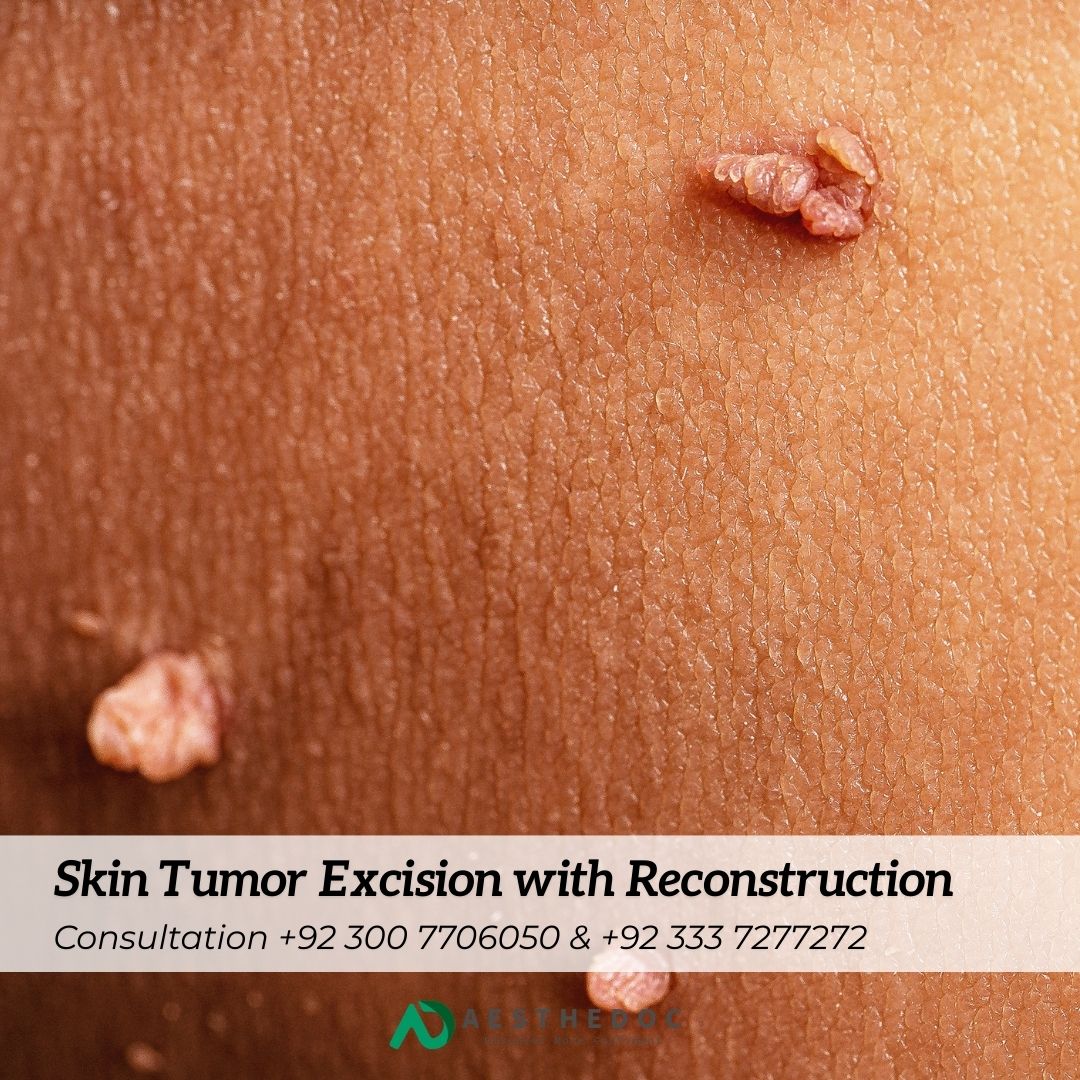
What Is a Skin Tumor?
A skin tumor is an abnormal growth of skin cells. It may be:
- Benign (non-cancerous)
- Premalignant (pre-cancerous)
- Malignant (cancerous)
Tumors may develop on:
- Face
- Nose
- Eyelids
- Lips
- Scalp
- Neck
- Arms
- Legs
- Trunk
- Genital region
Some tumors grow slowly, while others spread rapidly. Proper surgical evaluation is essential.
Types of Skin Tumors
1. Benign Skin Tumors
These are non-cancerous but may require removal if:
- They grow large
- Cause pain
- Bleed
- Become infected
- Create cosmetic concern
Examples include:
- Lipomas
- Epidoid cysts
- Sebaceous cysts
- Dermatofibroma
- Benign nevi
2. Premalignant Lesions
These have the potential to turn cancerous if untreated.
- Actinic keratosis
- Bowen’s disease
Early excision prevents progression.
3. Malignant Skin Tumors (Skin Cancer)
The most serious category includes:
- Basal cell carcinoma (BCC)
- Squamous cell carcinoma (SCC)
- Malignant melanoma
Early detection significantly improves survival.
Why Complete Surgical Excision Is Important
For malignant or suspicious tumors, simple removal is not enough. The procedure must ensure:
- Complete tumor removal
- Clear surgical margins
- Histopathological confirmation
- Reduced recurrence risk
Incomplete removal may result in regrowth and spread.
Plastic surgeons are trained not only to remove tumors but also to reconstruct the resulting defect for optimal functional and aesthetic outcome.
What Is Skin Tumor Excision with Reconstruction?
When a tumor is removed, it leaves behind a surgical defect. Depending on size and location, simple stitching may not be possible.
Reconstruction is the surgical restoration of the defect using:
- Direct closure
- Local skin flaps
- Skin grafts
- Advanced reconstructive techniques
The goal is to:
- Restore normal appearance
- Preserve movement
- Maintain symmetry
- Reduce visible scarring
This is especially critical for tumors on:
- Nose
- Eyelids
- Lips
- Cheeks
- Forehead
- Ears
When Do You Need Reconstruction?
Reconstruction is required when:
- The tumor is large
- The defect cannot close without tension
- It is located on face or cosmetically sensitive area
- Skin elasticity is limited
- Functional structures are involved
Every case is individualized.
Common Areas Requiring Advanced Reconstruction
Nose
The nose has limited excess skin. Removal of even small tumors may require local flaps to maintain contour and breathing function.
Eyelids
Precise reconstruction is needed to protect the eye and maintain blinking.
Lips
Reconstruction preserves speech, eating, and facial expression.
Cheeks & Forehead
Symmetry and scar placement are important.
Scalp
Large tumors may require flap coverage due to tight skin.
The Consultation Process
During your consultation at Aesthedoc Clinic, the following steps are taken:
- Detailed medical history
- Physical examination of tumor
- Assessment of size, depth, and mobility
- Dermoscopic evaluation if needed
- Discussion of biopsy results (if available)
- Surgical planning
- Explanation of reconstruction options
- Risk discussion
- Cost estimation
Patients are fully informed before proceeding.
Diagnostic Evaluation Before Surgery
Depending on the case, investigations may include:
- Biopsy
- Excision biopsy
- Incisional biopsy
- Imaging (if deep involvement suspected)
Histopathology confirms diagnosis and margin clearance.
Surgical Techniques for Tumor Excision
1. Wide Local Excision
For malignant tumors:
- Tumor removed with safe margin
- Margins based on tumor type
- Tissue sent for histopathology
Ensures complete removal.
2. Excision with Frozen Section (if indicated)
Allows immediate margin assessment in selected cases.
Reconstruction Options After Excision
1. Primary Closure
Used when defect is small and skin is flexible.
Benefits:
- Simple
- Quick healing
- Minimal scar
2. Local Skin Flaps
Skin from nearby area is rotated or advanced to cover defect.
Common flap types:
- Advancement flap
- Rotation flap
- Transposition flap
- Bilobed flap (for nose)
Advantages:
- Color match
- Texture match
- Good cosmetic outcome
3. Skin Grafting
Skin taken from another body area and placed over defect.
Used when:
- Large surface area involved
- Local tissue insufficient
Donor sites may include:
- Thigh
- Behind ear
- Upper arm
4. Complex Reconstruction
For large tumors:
- Combination of flaps and grafts
- Multi-stage procedures
- Functional repair
Step-by-Step Surgical Procedure
- Preoperative marking
- Local or general anesthesia
- Tumor excision with margin
- Hemostasis control
- Reconstruction planning
- Flap or graft placement
- Layered closure
- Dressing application
Duration varies from 45 minutes to 2 hours depending on complexity.
Is the Procedure Painful?
The surgery is performed under:
- Local anesthesia
- Sedation
- General anesthesia (for extensive cases)
Patients experience minimal discomfort.
Post-operative pain is mild and manageable with medication.
Recovery After Skin Tumor Excision with Reconstruction
First Week
- Mild swelling
- Bruising
- Sutures in place
- Dressing care
7–14 Days
- Suture removal
- Reduced swelling
3–6 Weeks
- Scar maturation begins
- Skin settles
3–12 Months
- Scar fades
- Final cosmetic result visible
Scar Management After Reconstruction
Plastic surgeons focus on:
- Fine suturing techniques
- Tension-free closure
- Alignment with skin creases
Post-surgical scar care may include:
- Silicone gel
- Silicone sheets
- Sun protection
- Scar massage
- Laser therapy if needed
Risks and Complications
Although uncommon, potential risks include:
- Infection
- Bleeding
- Delayed wound healing
- Partial flap or graft loss
- Recurrence of tumor
- Scar thickening
Choosing a qualified plastic surgeon minimizes risks.
Importance of Histopathology
Every excised tumor should be sent for:
- Histopathological analysis
- Margin confirmation
- Cancer staging (if applicable)
This ensures complete safety.
Signs You Should Not Ignore
Seek immediate consultation if you notice:
- Rapidly growing lump
- Bleeding skin lesion
- Non-healing ulcer
- Pigmented lesion changing color
- Persistent itching in mole
- Recurrent lesion after previous removal
Early intervention improves outcome.
Functional Preservation in Reconstruction
Aesthetic outcome is important, but function is critical.
Plastic surgeons ensure preservation of:
- Eyelid movement
- Nasal airflow
- Lip function
- Facial symmetry
- Scalp coverage
Reconstruction is planned carefully to maintain normal anatomy.
Psychological Impact of Skin Tumors
Visible tumors on the face or body can cause:
- Anxiety
- Social embarrassment
- Reduced confidence
Reconstructive surgery not only treats disease but restores emotional well-being.
Cost of Skin Tumor Excision with Reconstruction in Pakistan
Cost depends on:
- Tumor size
- Location
- Benign vs malignant
- Complexity of reconstruction
- Need for graft or flap
- Hospital or clinic setting
- Histopathology charges
Each case is individually assessed.
Consultation is required for accurate cost planning.
Why Choose a Plastic Surgeon for Skin Tumor Surgery?
Plastic surgeons are specially trained in:
- Surgical oncology principles
- Scar minimization
- Functional restoration
- Advanced reconstruction
- Aesthetic balance
This makes them ideal specialists for tumor removal on visible areas.
Why Choose Aesthedoc Clinic?
At Aesthedoc Clinic, patient safety and aesthetic outcome are priorities.
- Sterile minor surgery setup
- Modern equipment
- Personalized treatment planning
- Evidence-based surgical protocols
- Professional follow-up care
- Clinics in Islamabad and Rawalpindi
About the Surgeon
Dr Nadiya Tariq – Plastic Surgeon
Academic Qualifications
- FCPS (Plastic Surgery) – College of Physicians & Surgeons Pakistan (CPSP), 2025
- MBBS – University of Health Sciences (UHS), Lahore, 2016
Professional Registrations
- Pakistan Medical & Dental Council (PMDC) – Active Registration
- Irish Medical Council (IMC) – Active Registration
Dr Nadiya Tariq has structured postgraduate training in plastic and reconstructive surgery, with expertise in skin tumor excision, facial reconstruction, and scar management. Her approach focuses on oncological safety, functional preservation, and natural aesthetic restoration.
Clinic Locations & Contact Information
Aesthedoc – Islamabad
I-8 Markaz, Islamabad
Phone: +92 333 7277272
Email: info@aesthedoc.com
Instagram: @aesthe_doc
Timings: Mon – Sun 9:00 – 19:00
Aesthedoc Clinic – Rawalpindi
3rd Floor, Rajas United Height, Opposite Future World School, Bahria Town Phase 8, Rawalpindi
Phone: +92 300 7706050
Email: info@aesthedocclinic.com
Instagram: @aesthedocclinic
Timings: Mon – Sun 9:00 – 19:00
Book Your Consultation Today
If you or a loved one has a suspicious skin growth, non-healing lesion, or confirmed skin tumor, do not delay treatment.
Early excision combined with expert reconstruction offers:
- Complete tumor removal
- Functional preservation
- Minimal scarring
- Long-term peace of mind
Schedule your consultation at Aesthedoc Clinic in Islamabad or Rawalpindi for professional evaluation and advanced surgical care by Dr Nadiya Tariq, Plastic Surgeon.