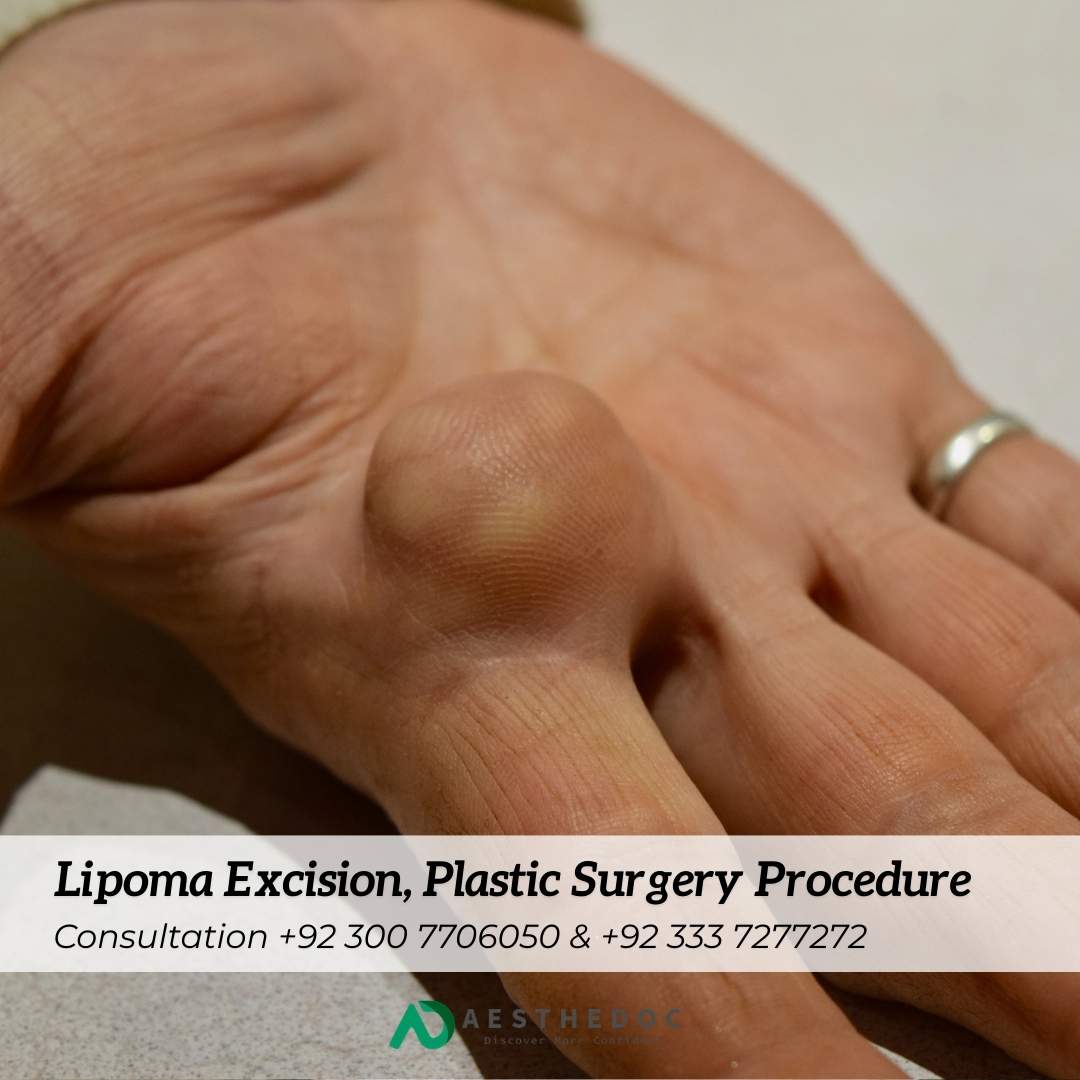
A lipoma is a benign tumor composed of fatty tissue that develops under the skin. Although generally harmless, lipomas can become painful, unsightly, or bothersome, especially when they grow in prominent areas or interfere with movement. Lipoma excision is a surgical procedure designed to safely remove these growths, restore normal contour, and prevent recurrence.
For patients in Pakistan seeking lipoma removal in Islamabad or Rawalpindi, professional care by a plastic surgeon ensures not only safe excision but also minimal scarring and optimal cosmetic results. This comprehensive article provides a detailed guide on lipoma excision, management options, recovery, and expert care at Aesthedoc Clinic.
What Is a Lipoma?
A lipoma is a soft, rubbery, and usually painless lump composed of fat cells. These growths are:
- Slow-growing
- Typically less than 5 cm in diameter, though some may exceed 10 cm
- Mobile under the skin
- Often located on the neck, shoulders, back, arms, or thighs
While most lipomas are benign and non-cancerous, they can sometimes cause discomfort or cosmetic concerns, prompting the need for surgical removal.
Causes and Risk Factors
The exact cause of lipomas is unknown, but several factors may contribute:
- Genetics: Family history increases the likelihood of multiple lipomas.
- Age: Most commonly occur between 40–60 years.
- Obesity: Excess fat may predispose certain individuals, though lipomas can appear in lean individuals too.
- Trauma: Rarely, a minor injury can trigger localized fat growth.
Types of Lipomas
Lipomas are classified according to their size, location, and composition:
- Subcutaneous Lipomas – Located just under the skin; most common.
- Intramuscular Lipomas – Within the muscle, can cause functional limitations.
- Multiple Lipomas (Familial) – Linked to hereditary conditions.
- Angiolipoma – Painful due to a higher number of blood vessels.
- Spindle Cell Lipoma – Rare, often occurring on the neck and back.
Each type requires tailored evaluation to determine the optimal surgical approach.
Signs and Symptoms
Most lipomas are asymptomatic, but common features include:
- Soft, rubbery, movable lumps under the skin
- Slow enlargement over months or years
- Mild tenderness or discomfort if pressing on nerves
- Cosmetic dissatisfaction if in visible areas
Symptoms like rapid growth, pain, skin discoloration, or firmness warrant immediate medical evaluation to rule out malignancy.
Diagnosis of Lipoma
Accurate diagnosis is essential before excision. Methods include:
- Physical Examination – Evaluates size, texture, and mobility.
- Ultrasound Imaging – Confirms the fatty nature and exact location.
- MRI or CT Scan – Used for deep or large lipomas.
- Biopsy – Rarely needed unless the growth appears atypical.
Plastic surgeons combine clinical evaluation and imaging to plan precise and safe excision.
Why Lipoma Excision Is Recommended
Surgical removal is advised in cases where:
- Lipoma is growing rapidly
- Causes pain or tenderness
- Interferes with mobility or function
- Leads to cosmetic concerns
- There is diagnostic uncertainty
Excision is typically a minor outpatient procedure with excellent results when performed by a trained surgeon.
Preparing for Lipoma Surgery
Before the procedure, a plastic surgeon will:
- Conduct a medical history review
- Assess for bleeding disorders or chronic conditions
- Plan the incision and excision technique
- Provide preoperative instructions, including fasting if sedation is required
Lipoma Excision Procedure
The procedure can vary based on size, location, and depth, but generally includes:
- Local or General Anesthesia – Depending on complexity.
- Incision Over Lipoma – Planned along natural skin creases for minimal scarring.
- Careful Dissection – Fatty tissue is removed entirely to minimize recurrence.
- Layered Closure – Muscle or fascia repaired if needed.
- Skin Closure – Fine sutures for aesthetic healing.
- Sterile Dressing – Ensures infection prevention.
Plastic surgeons focus on complete removal, functional preservation, and cosmetic optimization.
Postoperative Care
After lipoma excision:
- Keep the area clean and dry.
- Limit heavy activity for a few days.
- Take prescribed antibiotics or pain relief if indicated.
- Monitor for signs of infection or unusual swelling.
- Sutures are usually removed after 7–10 days, depending on location.
Recovery Timeline
- Day 1–3: Mild swelling, bruising, and tenderness are normal.
- Week 1: Sutures removal; wound healing starts.
- Weeks 2–4: Swelling subsides; scar begins maturing.
- 3–6 Months: Scar softens and flattens; normal appearance returns.
Following surgeon guidance ensures rapid healing and minimal scarring.
Risks and Complications
While lipoma excision is generally safe, potential risks include:
- Infection
- Hematoma or seroma
- Recurrence of lipoma
- Minor nerve injury causing temporary numbness
- Scarring
Expert plastic surgeons minimize these risks through meticulous technique, sterile conditions, and follow-up care.
Cosmetic Considerations
Because lipomas often occur in visible areas, plastic surgeons employ strategies to:
- Align incisions along natural skin folds
- Use fine sutures to minimize scarring
- Offer scar management postoperatively, including silicone gel or sheets
- Provide laser or other treatments if residual pigmentation occurs
The goal is a smooth, natural skin contour with minimal visible marks.
Alternatives to Surgical Excision
While excision is the gold standard, other options may include:
- Liposuction – Less invasive but may leave residual tissue and higher recurrence.
- Steroid injections – Occasionally used to reduce size of angiolipomas or inflamed lipomas.
- Observation – Small, asymptomatic lipomas may not require intervention.
A plastic surgeon assesses suitability of alternatives for each patient.
Lipoma Excision in Children
- Most lipomas in children are benign and slow-growing.
- Surgery is recommended if painful, large, or interfering with function.
- Pediatric patients benefit from gentle handling and aesthetic closure to prevent psychological impact.
When to Seek Urgent Evaluation
- Rapid growth within weeks
- Pain, redness, or warmth over the lump
- Hard, fixed, or irregular lump
- Changes in overlying skin
These may indicate atypical lipoma or malignancy, requiring immediate attention.
Long-Term Prognosis
- Complete excision usually prevents recurrence.
- Scars fade over months and can be minimized with proper care.
- Cosmetic and functional outcomes are excellent with expert surgical technique.
Psychological and Social Benefits
Lipomas, particularly in visible areas, can cause:
- Self-consciousness
- Social anxiety
- Reduced confidence
Excision improves self-esteem and quality of life, especially for facial, neck, or hand lipomas.
Frequently Asked Questions
Q: Is lipoma cancerous?
A: Rarely. Most lipomas are benign, but rapid growth warrants evaluation.
Q: How long does the surgery take?
A: Usually 30–60 minutes for small lipomas; larger or multiple lesions take longer.
Q: Will I have scars?
A: Expert closure minimizes scarring, and follow-up care ensures optimal cosmetic results.
Q: Can lipomas return?
A: Rarely, especially if complete excision is performed.
Q: Is hospitalization required?
A: Most cases are outpatient; complex or multiple lipomas may require brief observation.
Why Choose Aesthedoc Clinic
Aesthedoc Clinic offers:
- Experienced plastic surgeons for precise lipoma excision
- Advanced surgical techniques to minimize scars
- Safe, sterile clinical environment
- Comprehensive post-operative care and follow-up
- Clinics in Islamabad and Rawalpindi
Patient safety, comfort, and aesthetic outcomes are our priorities.
About Dr Nadiya Tariq
Academic Qualifications
- FCPS (Plastic Surgery) – College of Physicians & Surgeons Pakistan (CPSP), 2025
- MBBS – University of Health Sciences (UHS), Lahore, 2016
Professional Registrations
- Pakistan Medical & Dental Council (PMDC) – Active
- Irish Medical Council (IMC) – Active
Dr Nadiya Tariq is trained in cosmetic and reconstructive surgery, including lipoma excision, scar revision, and aesthetic procedures. Her approach prioritizes functional preservation, precise excision, and minimal scarring.
Clinic Locations & Contact Information
Aesthedoc – Islamabad
I-8 Markaz, Islamabad
Phone: +92 333 7277272
Email: info@aesthedoc.com
Instagram: @aesthe_doc
Timings: Mon – Sun 9:00 – 19:00
Aesthedoc Clinic – Rawalpindi
3rd Floor, Rajas United Height, Opposite Future World School, Bahria Town Phase 8, Rawalpindi
Phone: +92 300 7706050
Email: info@aesthedocclinic.com
Instagram: @aesthedocclinic
Timings: Mon – Sun 9:00 – 19:00
Schedule Your Consultation
For safe, effective, and cosmetically optimized lipoma excision, schedule a consultation at Aesthedoc Clinic in Islamabad or Rawalpindi. Dr Nadiya Tariq will evaluate, plan, and perform the procedure, ensuring minimal risk, optimal healing, and aesthetic results.