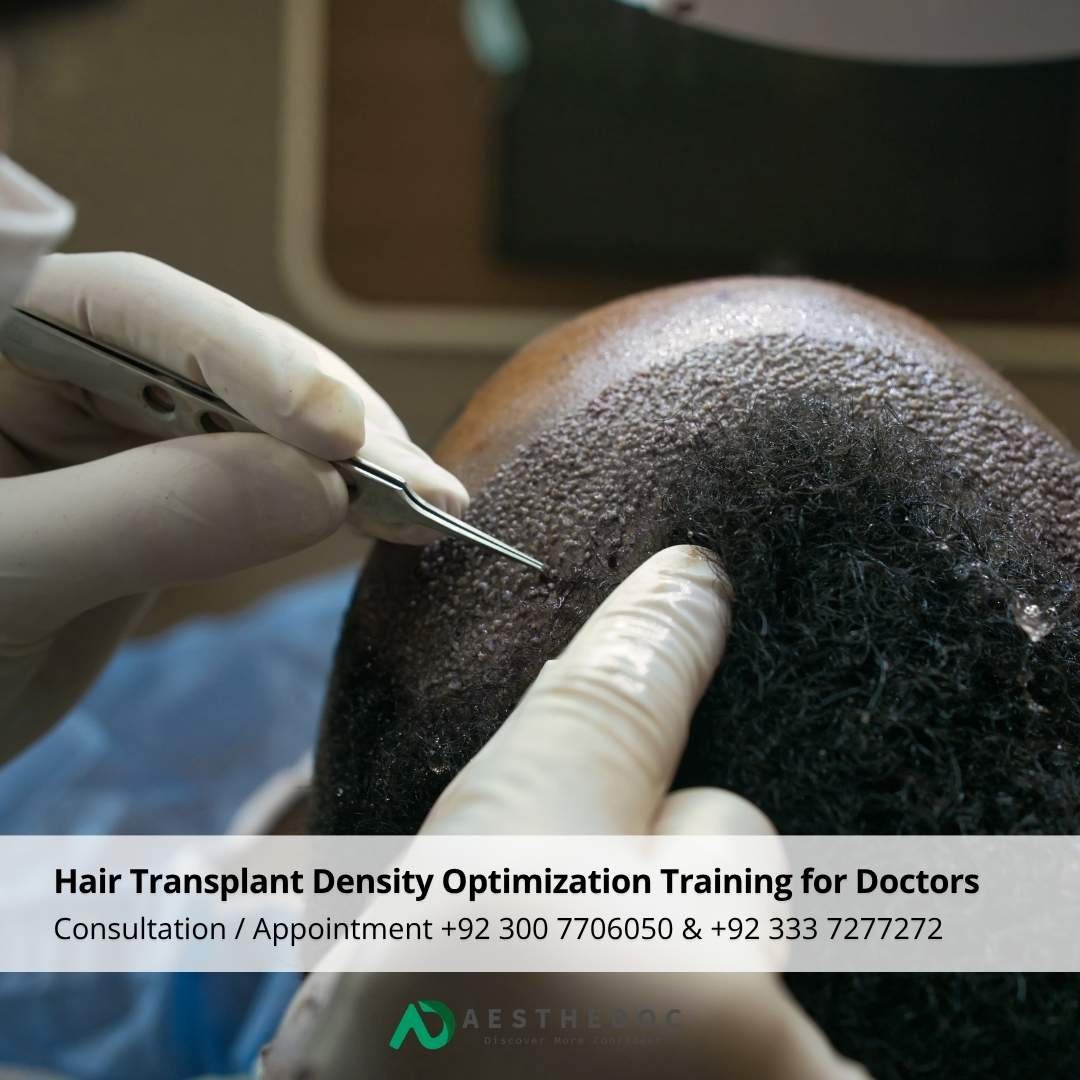
Achieving natural-looking hair density is one of the most important challenges in modern hair transplantation. Patients generally want fuller coverage, a natural hairline and a result that looks appropriate for their age and facial features. However, successful hair restoration is not simply a matter of transplanting the maximum possible number of grafts.
A hair transplant surgeon must understand how to distribute a limited supply of donor follicles across the recipient area while considering hair characteristics, scalp coverage, existing native hair and future hair loss. Poor graft distribution can produce an unnatural appearance, while excessive harvesting may compromise the donor area and reduce options for future procedures.
Hair transplant density optimization training for doctors focuses on the principles of graft planning, density calculation, donor management, recipient-site design and natural-looking hair restoration. These skills are important for medical professionals who want to develop a deeper understanding of FUE surgery and advanced hair restoration planning.
This article explains how density is evaluated, which factors influence the appearance of fullness, how surgeons plan graft distribution and what doctors should look for in an advanced hair transplant training programme.
What Is Hair Transplant Density Optimization?
Hair transplant density optimization is the process of planning and distributing transplanted follicular units to achieve an appropriate cosmetic result while preserving the patient’s available donor hair.
The objective is to create the appearance of natural coverage rather than simply maximizing the number of implanted grafts.
Density optimization involves several interconnected considerations:
- Existing hair density in the recipient area.
- The size and location of the bald or thinning region.
- Donor hair availability.
- Hair shaft thickness and characteristics.
- Follicular unit composition.
- Hairline design and transition zones.
- Natural hair direction and angulation.
- The patient’s current and future hair-loss pattern.
- The limitations of the recipient tissue.
- The patient’s expectations and treatment priorities.
A surgeon must consider all these factors together. A high graft count does not automatically mean a better result, and a lower graft count may produce an acceptable cosmetic improvement when the distribution is carefully planned.
Why Is Density Planning Important in Hair Transplant Surgery?
Hair transplantation involves transferring follicles from a donor region to a recipient area. Because donor hair is finite, every graft should be considered part of a long-term treatment strategy.
Poor planning can create several problems:
- The frontal area may receive too many grafts while the mid-scalp remains inadequately addressed.
- The hairline may look unnaturally dense or artificial.
- The donor area may become visibly depleted.
- Existing native hair may be damaged during recipient-site creation.
- The patient may have insufficient donor resources for future hair loss.
- The final appearance may not match the patient’s expectations.
Density planning is therefore both a surgical and aesthetic responsibility.
The surgeon must determine where grafts are most valuable, how they should be distributed and whether the patient’s goals are achievable with the available donor supply.
Understanding Hair Density and Follicular Unit Density
Hair density can be described in different ways. Understanding the terminology helps doctors interpret scalp assessments and communicate more accurately during treatment planning.
Hair Density
Hair density generally refers to the number of individual hair shafts present within a defined scalp area.
Follicular Unit Density
Follicular unit density refers to the number of natural follicular units within a defined scalp area.
A follicular unit may contain one, two, three or occasionally more hair follicles. Consequently, the number of follicular units is not the same as the number of individual hair shafts.
Why the Difference Matters
Consider a scalp region containing follicular units with different numbers of hairs.
Two patients may have the same number of follicular units per square centimetre but different numbers of individual hair shafts because their follicular unit composition differs.
This can influence the appearance of coverage.
For surgical planning, doctors should distinguish between:
- Follicular units per square centimetre.
- Individual hair shafts per square centimetre.
- Average hairs per follicular unit.
- The distribution of single-hair and multi-hair grafts.
These measurements provide useful information, but they should not be interpreted in isolation. Hair calibre, colour contrast, curl pattern and styling also influence perceived density.
Factors That Influence the Appearance of Hair Density
The number of transplanted grafts is only one part of the final cosmetic appearance.
Several characteristics influence how full the hair looks after transplantation.
1. Hair Shaft Thickness
Hair calibre can influence the appearance of coverage.
Thicker hair shafts may provide more visual coverage than finer hair when other characteristics are similar.
Patients with fine hair may require a different density strategy from patients with thicker hair.
2. Hair Colour and Scalp Contrast
The contrast between hair and scalp can influence the visibility of thinning.
For example, dark hair against a lighter scalp may make areas of reduced density more noticeable. Lower contrast may make the same density appear visually fuller.
3. Hair Curl and Wave Pattern
Curly or wavy hair may create more visual coverage than straight hair of similar characteristics because of the way it occupies space.
This does not mean that every patient with curly hair requires fewer grafts. The surgeon must evaluate the actual hair pattern and recipient area.
4. Follicular Unit Composition
Natural follicular units contain different numbers of hairs.
A careful distribution strategy considers the composition of available grafts and the aesthetic requirements of different scalp regions.
5. Hair Length and Styling
The length and styling of existing hair can affect the appearance of coverage.
A patient who prefers very short hairstyles may have different cosmetic concerns from someone who wears longer hair.
6. Scalp Characteristics
Scalp colour, tissue condition, previous scarring and recipient-area characteristics may influence the appearance and suitability of transplantation.
7. Progressive Hair Loss
A patient may have a satisfactory initial transplant result but experience further loss of native hair over time.
Density planning should therefore consider future progression rather than focusing exclusively on the current bald area.
How Doctors Assess Hair Density Before FUE Surgery
A structured preoperative assessment helps the surgeon understand the relationship between the donor area, recipient area and intended cosmetic outcome.
1. Clinical Examination
The examination should identify:
- The pattern of hair loss.
- Areas of complete baldness.
- Areas of miniaturization or thinning.
- Existing hair distribution.
- Hairline characteristics.
- Scalp condition.
- Previous surgical scars.
- Donor-area characteristics.
The clinical findings help establish whether surgical treatment is appropriate and which areas should receive priority.
2. Trichoscopic Assessment
Trichoscopy can help evaluate hair and scalp characteristics through magnification.
Depending on the equipment and examination, it may assist in assessing:
- Hair shaft variation.
- Follicular unit distribution.
- Miniaturization.
- Scalp condition.
- Differences between donor and recipient regions.
Trichoscopic findings should be interpreted alongside the patient’s history and clinical examination.
3. Donor Density Evaluation
The donor region is assessed to estimate the available follicular resources.
The surgeon should consider the distribution of follicles, hair characteristics, previous extraction and the potential risk of visible depletion.
4. Recipient Area Measurement
The recipient area should be assessed to estimate its size and identify the regions where additional coverage may be most beneficial.
A larger area may require a different strategy from a small frontal or crown restoration.
5. Photographic Documentation
Standardized photographs help document the initial condition and support treatment planning.
They can also help the clinical team communicate the proposed approach and compare the patient’s progress during follow-up.
Graft Distribution: Where Should Donor Hair Be Used?
Graft distribution is one of the most important decisions in hair transplant surgery.
The surgeon must determine which areas need the most attention and how to allocate the available donor follicles.
Frontal Hairline
The frontal hairline is a highly visible region and has a major influence on the overall appearance of the face.
Planning should consider:
- Age-appropriate hairline position.
- Facial proportions.
- Natural irregularity.
- Existing frontal hair.
- Appropriate use of single-hair follicular units at the leading edge.
- A gradual transition in density.
A hairline should not be designed independently of the patient’s future hair-loss pattern.
Frontal Forelock
The frontal forelock is an important visual area that can influence the appearance of fullness.
The surgeon should assess the existing hair, the extent of miniaturization and the relationship between the frontal region and surrounding scalp.
Mid-Scalp
The mid-scalp can become an important priority when hair loss progresses behind the frontal region.
Planning should consider the transition between the frontal area and crown rather than treating each region as completely separate.
Crown or Vertex
The crown presents particular planning challenges because hair grows in a changing directional pattern around the natural whorl.
The surgeon should consider:
- Natural spiral direction.
- Existing hair distribution.
- The size of the thinning region.
- The visual effect of hair direction.
- Donor availability.
- The patient’s overall restoration priorities.
The crown can consume a considerable number of grafts, so treatment planning should account for the rest of the scalp.
Temporal Regions
The temples and temporal points contribute to the shape of the hairline and facial balance.
These areas may require careful planning because incorrect direction or excessive density can appear unnatural.
The Role of Hairline Design in Density Optimization
Hairline design and density planning are closely connected.
A natural-looking hairline requires more than placing a large number of grafts at the front of the scalp. The surgeon must create a suitable transition between the frontal edge and the denser areas behind it.
Single-Hair Grafts at the Frontal Edge
Single-hair follicular units are commonly considered for the leading edge of a natural hairline.
Their placement can help create a softer transition compared with a dense line of multi-hair grafts.
Transition Zone Planning
The transition zone helps integrate the frontal hairline with the hair behind it.
The distribution should reflect the patient’s hair characteristics and the desired appearance.
Age-Appropriate Design
An excessively low or dense hairline may create difficulties as the patient ages and native hair loss progresses.
Conservative planning can preserve more donor resources for future needs.
Gender and Facial Characteristics
Hairline design should account for individual facial proportions, hair patterns and relevant gender-specific characteristics.
The objective is to create a result that looks appropriate for the individual rather than applying one standard design to every patient.
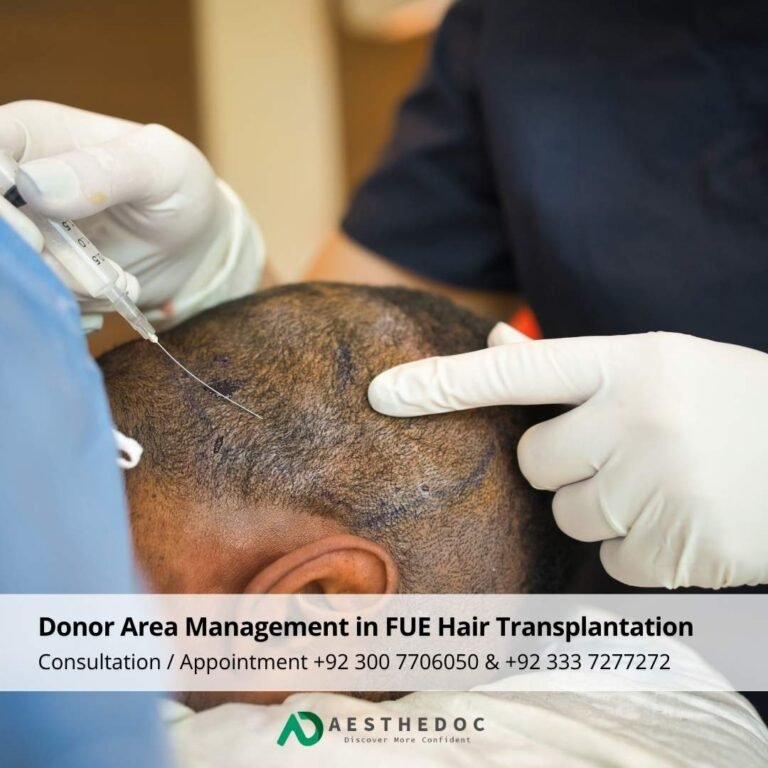
Donor Area Management: Preserving Hair for the Future
The donor area is a finite resource. Every extraction should be planned with the patient’s long-term restoration needs in mind.
Overharvesting can produce visible thinning, patchiness and an uneven donor appearance.
Understanding the Safe Donor Zone
The safe donor zone refers to the region generally considered suitable for harvesting based on the patient’s hair-loss pattern and clinical characteristics.
However, its boundaries and suitability should not be assumed to be identical in every patient.
The surgeon should assess:
- Hair density.
- Follicular unit distribution.
- Hair calibre.
- Miniaturization.
- Previous extraction.
- Scalp characteristics.
- Potential future hair loss.
Avoiding Excessive Extraction
A high graft target should not override donor safety.
Excessive extraction can reduce the donor area’s visual density and limit future treatment options.
A responsible plan considers the number and distribution of grafts that may be harvested while maintaining an acceptable donor appearance.
Long-Term Donor Preservation
Patients with progressive hair loss may require additional treatment in the future.
The surgeon should avoid using all available donor resources during the first procedure without considering future needs.
Understanding Graft Numbers and Density Calculations
Doctors need to understand how recipient-area measurements relate to graft planning.
A basic planning concept is:
Estimated graft requirement = Recipient area × Planned graft density
For example, if a hypothetical recipient area measures 40 square centimetres and a surgeon is evaluating a planning scenario of 30 follicular units per square centimetre, the arithmetic estimate would be 1,200 follicular units.
This is an educational calculation, not a recommended clinical density or a universal treatment target.
Actual graft requirements depend on the patient’s existing hair, recipient tissue, donor availability, hair characteristics and the intended cosmetic result.
Why a Simple Calculation Is Not Enough
A mathematical estimate cannot independently determine the appropriate surgical plan.
The surgeon must consider:
- Existing native hair.
- Miniaturization.
- Follicular unit composition.
- Hair shaft thickness.
- Recipient-site condition.
- Donor limitations.
- Hairline design.
- Future hair-loss progression.
A patient with existing hair may need a different distribution strategy from a patient with complete baldness in the same measured area.
Graft Count Versus Hair Count
A graft count represents follicular units, not individual hairs.
A plan involving 1,000 follicular units does not necessarily represent 1,000 individual hair shafts.
The composition of those grafts affects the overall number of hairs transplanted.
This distinction should be understood when discussing treatment plans and explaining expected coverage to patients.
How FUE Technique Influences Density Planning
Follicular Unit Extraction is a technique in which individual follicular units are harvested from a donor area and transplanted into recipient sites.
FUE planning involves more than the extraction stage. The surgeon must coordinate harvesting, graft preparation, recipient-site creation and implantation.
Punch Selection and Extraction Angles
Punch selection and extraction direction influence the ability to harvest follicular units while minimizing unnecessary damage.
Doctors should understand follicular orientation and the importance of appropriate technique.
Graft Handling and Storage
Follicular units require careful handling after extraction.
The clinical team should understand appropriate graft handling, storage and workflow considerations to reduce unnecessary trauma.
Recipient-Site Creation
Recipient-site planning determines where grafts will be placed and influences their direction and distribution.
The surgeon must account for existing hair, the natural growth pattern and the intended density.
Implantation Methods
Implantation should be coordinated with the recipient-site plan and the characteristics of the available grafts.
The objective is to achieve a natural arrangement while respecting the limitations of the recipient area.
Density Optimization in Different Hair Loss Patterns
The ideal planning approach depends on the type and distribution of hair loss.
1. Frontal Hair Loss
Patients with frontal recession may require attention to hairline position, frontal density and the transition to the mid-scalp.
The surgeon should consider the patient’s age, existing hair and long-term pattern.
2. Mid-Scalp Thinning
Mid-scalp thinning may involve a combination of miniaturized native hair and areas with reduced density.
The surgeon should assess whether transplantation is appropriate and how the planned grafts will integrate with existing follicles.
3. Crown Thinning
Crown restoration requires attention to the natural whorl and directional pattern.
The surgeon should also consider the potential graft requirements and whether treatment of the crown is the best use of the patient’s donor supply.
4. Advanced Baldness
Patients with extensive baldness may have a large recipient area but limited donor resources.
In such cases, the surgeon may need to prioritize selected regions and discuss realistic coverage expectations.
A full-density result across the entire scalp may not be achievable.
5. Diffuse Thinning
Diffuse thinning requires careful evaluation because native hair may be present throughout the recipient region.
The surgeon should assess miniaturization and the risk of damaging existing follicles during surgical planning.
Not every patient with diffuse thinning is an appropriate candidate for transplantation.
Density Optimization in Revision Hair Transplant Surgery
Revision procedures introduce additional challenges because the patient may already have transplanted grafts, scars or reduced donor availability.
The surgeon must assess the existing result before recommending additional graft placement.
Identifying Density Gaps
The examination should determine whether the problem is related to insufficient graft numbers, uneven distribution, poor growth or progressive native hair loss.
These issues may require different management strategies.
Preserving Remaining Donor Hair
Patients who have undergone multiple procedures may have limited donor resources.
The surgeon should determine whether additional extraction is reasonable and avoid creating further donor depletion.
Correcting Unbalanced Distribution
Some previous procedures may have concentrated too many grafts in one region while leaving other areas visibly thin.
Revision planning should consider the overall scalp appearance rather than treating one isolated area without considering the rest.
Managing Expectations
Patients should understand that revision procedures may improve specific concerns without producing a perfect result.
The surgeon should discuss limitations, alternatives and potential risks before recommending surgery.
Common Density Planning Mistakes Doctors Should Understand
A strong training programme should help doctors recognize errors that can compromise natural-looking hair restoration.
Mistake 1: Focusing Only on Maximum Graft Numbers
A high graft count is not necessarily an indicator of a good result.
The surgeon should prioritize appropriate distribution and donor preservation.
Mistake 2: Ignoring Future Hair Loss
A hairline and density pattern that look acceptable initially may become unbalanced if native hair continues to disappear.
Long-term planning is essential.
Mistake 3: Using the Same Density Target for Every Patient
Patients have different hair characteristics, scalp conditions and restoration goals.
A uniform target is not appropriate for every case.
Mistake 4: Neglecting Donor Area Appearance
The cosmetic result should include both the recipient and donor regions.
A fuller recipient area should not come at the expense of visible donor depletion.
Mistake 5: Ignoring Hair Direction
Incorrect orientation can make a transplant appear unnatural even when a reasonable number of grafts survive.
Mistake 6: Overlooking Existing Native Hair
Recipient-site planning should account for existing follicles and miniaturization.
Mistake 7: Promising a Specific Density Without Proper Assessment
A doctor should not promise a fixed density or guaranteed result before evaluating the patient.
Patient Counseling and Setting Realistic Density Expectations
Patients often judge hair transplant outcomes by how full their hair looks rather than by the number of grafts implanted.
Doctors should explain that cosmetic coverage depends on multiple variables.
A consultation should address:
- The current pattern of hair loss.
- The likely treatment priorities.
- The available donor supply.
- The difference between grafts and individual hairs.
- The influence of hair calibre and colour contrast.
- The possibility of progressive hair loss.
- The limitations of surgical density.
- The possibility of staged treatment.
- The need for follow-up.
Before-and-after photographs may help explain possible outcomes, provided they are authentic, properly documented and used with appropriate patient consent.
A responsible consultation avoids guarantees and helps patients understand the difference between an achievable improvement and an unrealistic expectation.
What Doctors Should Learn in Hair Transplant Density Optimization Training
Doctors interested in advanced FUE education should develop a structured understanding of how density planning relates to the entire hair restoration process.
Important learning areas include:
1. Hair Loss Assessment
Understanding different types of alopecia, patient selection and the distinction between medical and surgical treatment planning.
2. Hairline Design and Facial Harmony
Learning the principles of age-appropriate hairline planning, natural transitions and density distribution.
3. Donor Area Assessment
Understanding safe donor zone identification, density calculation, overharvesting prevention and long-term donor preservation.
4. FUE Extraction
Learning the principles of punch selection, extraction angles and follicular unit harvesting.
5. Graft Handling and Storage
Understanding the importance of careful graft handling and appropriate storage throughout the procedure.
6. Recipient-Site Creation
Understanding the relationship between site placement, direction, angle and intended density.
7. Implantation Methods
Learning the principles of graft placement and how implantation relates to the recipient-area design.
8. Advanced Hair Restoration
Understanding how density optimization applies to corrective cases, beard and eyebrow transplantation, and scar or burn-related restoration.
9. Postoperative Care and Complications
Learning about infection prevention, shock loss management, poor growth troubleshooting and revision planning.
Why Practical Training Matters in Density Optimization
Density planning is not simply a theoretical calculation. It involves clinical examination, aesthetic judgment and an understanding of the surgical workflow.
A practical learning environment can help doctors connect different stages of hair restoration.
Important educational experiences may include:
- Reviewing patient hair-loss patterns.
- Observing donor-area assessment.
- Discussing hairline design.
- Understanding density calculations.
- Observing FUE extraction.
- Learning graft handling and storage principles.
- Reviewing recipient-site creation.
- Understanding implantation methods.
- Discussing postoperative care and complications.
Doctors should ask training providers what practical activities are included and what level of supervised participation is available.
Any practical participation must follow patient consent, clinical supervision, professional scope and applicable regulations.
A short course does not automatically qualify a doctor as a specialist or authorize independent surgical practice.
Who Should Consider Advanced FUE and Density Planning Training?
This area of education may be relevant to qualified medical professionals who want to develop their understanding of surgical hair restoration.
MBBS Doctors
Medical graduates interested in hair restoration fundamentals, patient assessment and FUE education.
General Surgeons
Surgeons seeking additional knowledge of follicular unit extraction, graft management and surgical planning.
Plastic Surgeons
Plastic surgeons interested in hairline design, scalp aesthetics and reconstructive aspects of hair restoration.
Dermatologists
Dermatologists managing hair disorders who want to understand the surgical aspects of hair restoration.
Aesthetic Physicians
Qualified aesthetic physicians interested in expanding their knowledge of hair restoration and its clinical requirements.
Doctors Planning Hair Restoration Clinics
Medical professionals planning a hair restoration service should understand patient selection, donor management, graft planning, clinical workflows and postoperative care.
Applicants should confirm the programme’s eligibility requirements and the scope of practical participation before enrolling.
How to Choose a Hair Transplant Training Course for Density Optimization
Doctors comparing training programmes should evaluate the educational content and the clinical experience offered.
Consider the following points:
Trainer qualifications: Review relevant credentials and experience in hair restoration.
Density planning curriculum: Ask whether the course covers density calculation, hairline design and graft distribution.
Donor management: Confirm that the programme discusses safe donor zone identification and overharvesting prevention.
FUE education: Look for structured instruction in extraction, graft handling, recipient-site creation and implantation.
Advanced cases: Ask whether corrective procedures, density optimization and complex restoration cases are discussed.
Practical exposure: Confirm whether the programme includes live-patient exposure, demonstrations and supervised participation.
Postoperative care: Review whether complications, poor growth and revision planning are included.
Professional requirements: Understand that course completion does not replace local licensing or specialist training requirements.
Aesthedoc Hair Transplant Training for Doctors and Surgeons in Pakistan
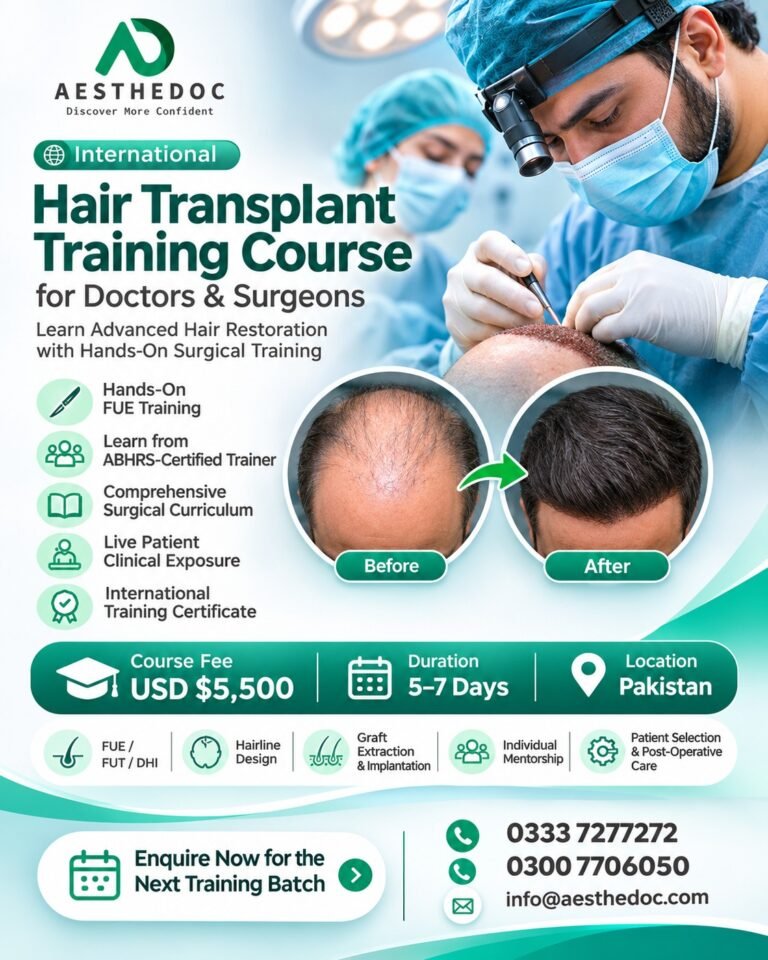
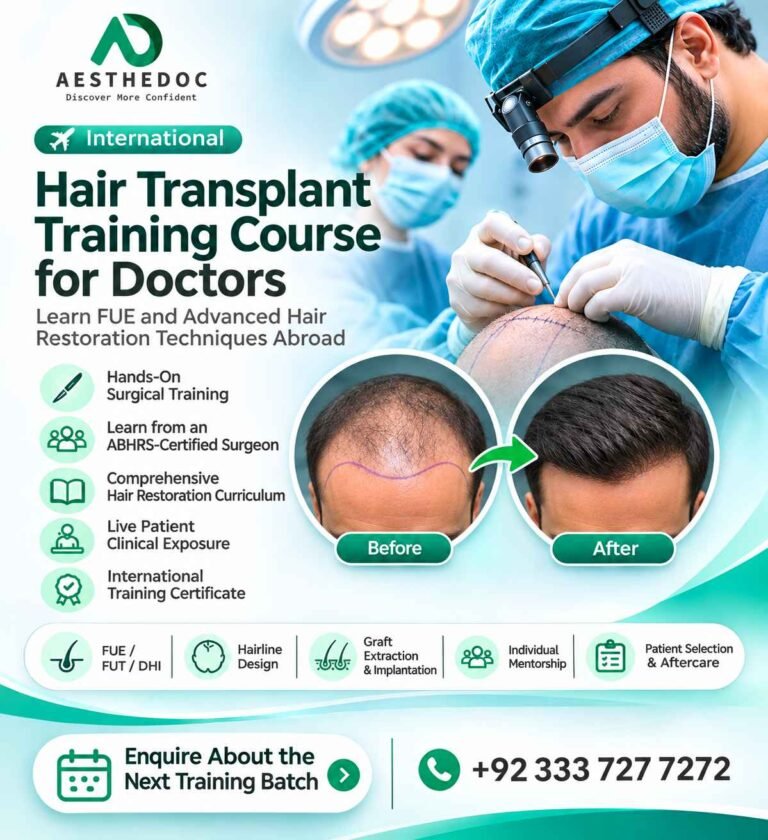
Aesthedoc offers a hair transplant training programme in Pakistan for doctors and surgeons interested in developing their knowledge of FUE hair restoration.
The published programme is led by Dr. Adnan Bashir, identified on the course page as an ABHRS-certified hair transplant surgeon and Master Aesthetic Trainer.
The course curriculum specifically includes density calculation, natural density distribution, donor management, overharvesting prevention and high graft survival strategies.
What the Published Course Includes
According to the Aesthedoc course page, the programme includes:
- Structured theoretical training.
- Full hands-on FUE surgical exposure.
- Live patient cases.
- One-to-one mentoring.
- Preoperative planning.
- Postoperative care protocols.
- Complication management.
The curriculum also covers:
- Types of alopecia.
- Patient selection and contraindications.
- Ethical patient counseling.
- Hairline design and facial harmony.
- Gender-specific and age-appropriate hairline planning.
- Safe donor zone identification.
- Density calculation.
- Long-term donor preservation.
- Punch selection and extraction angles.
- Graft handling and storage.
- Recipient-site creation.
- Implantation methods.
- High graft survival strategies.
- Corrective and repair cases.
- Scar and burn-related restoration.
- Beard and eyebrow transplantation.
- Density optimization strategies.
These subjects are listed on the published Aesthedoc course page.
Training Led by Dr. Adnan Bashir
Aesthedoc’s published course page identifies Dr. Adnan Bashir as an ABHRS-certified hair transplant surgeon. It also describes his experience in FUE procedures, corrective hair restoration, beard and eyebrow transplantation and burn-related cases.
Doctors evaluating a training programme should review the trainer’s credentials, curriculum, practical arrangements and educational objectives before enrolment.
Who Can Apply?
The published programme identifies the following intended participants:
- MBBS doctors.
- General surgeons.
- Plastic surgeons.
- Dermatologists.
- Aesthetic physicians.
- Medical professionals planning hair restoration clinics.
Interested doctors should contact Aesthedoc to confirm eligibility, course dates and the exact scope of practical participation.
Course Fee and Contact Details
The published Aesthedoc course page lists the course fee as USD $5,500. Confirm the current fee and what it includes directly with the training team.
Aesthedoc Hair Transplant Training
- Location: Pakistan
- Trainer: Dr. Adnan Bashir
- WhatsApp / Call: +92 333 727 7272
International doctors can contact the team to discuss course arrangements, eligibility and training details.
Frequently Asked Questions About Hair Transplant Density Optimization Training
1. What is density optimization in hair transplantation?
Density optimization is the process of planning and distributing available donor grafts to achieve an appropriate cosmetic result while preserving donor resources and considering the patient’s long-term hair-loss pattern.
2. What is the difference between hair density and graft density?
Hair density generally refers to individual hair shafts within a defined area, while graft or follicular unit density refers to the number of follicular units within that area. One follicular unit may contain multiple hairs.
3. Does a higher graft count always produce better hair transplant results?
No. A higher graft count does not automatically create a better cosmetic result. Graft distribution, hair characteristics, recipient-area condition and donor preservation are also important.
4. What factors influence the appearance of hair density?
Hair calibre, follicular unit composition, hair colour, scalp contrast, curl pattern, hair length and graft distribution can all influence the appearance of coverage.
5. Why is donor area management important?
Donor hair is limited. Excessive extraction can create visible thinning and reduce the resources available for future procedures. Donor management helps preserve the long-term appearance of the donor area.
6. How is the number of grafts estimated?
A surgeon evaluates the recipient area, existing hair, desired coverage, follicular unit characteristics and donor availability. Area multiplied by a proposed graft density can provide a basic mathematical estimate, but the final plan requires clinical assessment.
7. Is density planning different for the frontal scalp and crown?
Yes. The frontal scalp, mid-scalp and crown have different aesthetic and directional considerations. The surgeon should plan each region in relation to the overall scalp and available donor supply.
8. Can density be improved after an unsuccessful hair transplant?
Some patients may be suitable for additional transplantation after a detailed assessment. The surgeon must identify the cause of low density, evaluate remaining donor resources and determine whether further surgery is appropriate.
9. What is taught in advanced FUE density planning training?
A programme may cover hairline design, density calculation, donor assessment, graft distribution, FUE extraction, graft handling, recipient-site creation and implantation methods. The exact curriculum should be checked with the training provider.
10. Does Aesthedoc teach density optimization?
Yes. Density optimization strategies and density calculation are specifically listed in the published Aesthedoc hair transplant course curriculum.
11. Who can enrol in the Aesthedoc hair transplant course?
The published programme identifies MBBS doctors, general surgeons, plastic surgeons, dermatologists, aesthetic physicians and medical professionals planning hair restoration clinics as its intended participants. Eligibility should be confirmed directly.
12. Does completing a hair transplant course authorize independent surgery?
No. Course completion does not automatically provide specialist status, a medical licence or independent surgical privileges. Doctors must comply with the requirements of the relevant medical regulator.
13. Where can doctors learn FUE hair transplant techniques in Pakistan?
Aesthedoc offers a hair transplant training programme in Pakistan covering FUE fundamentals, donor management, graft handling, recipient-site creation and advanced restoration topics. Interested doctors can contact the training team for details.
Conclusion: Better Density Planning Begins With Better Surgical Judgment
Hair transplant density optimization is an essential part of natural-looking hair restoration. It requires the surgeon to understand follicular unit composition, hair characteristics, recipient-area priorities, donor limitations and future hair-loss progression.
The goal is not to transplant the highest possible number of grafts. It is to use available donor hair responsibly and develop a treatment plan that considers both the immediate cosmetic objective and the patient’s long-term needs.
For doctors interested in developing their understanding of FUE surgery, density planning and advanced hair restoration, Aesthedoc offers a structured training programme in Pakistan.
The published curriculum includes density calculation, donor management, natural density distribution, FUE techniques, graft handling, implantation methods and advanced restoration strategies.
Explore the Aesthedoc Hair Transplant Course:
WhatsApp / Call: +92 333 727 7272
Aesthedoc – Hair Transplant Training for Doctors and Surgeons in Pakistan