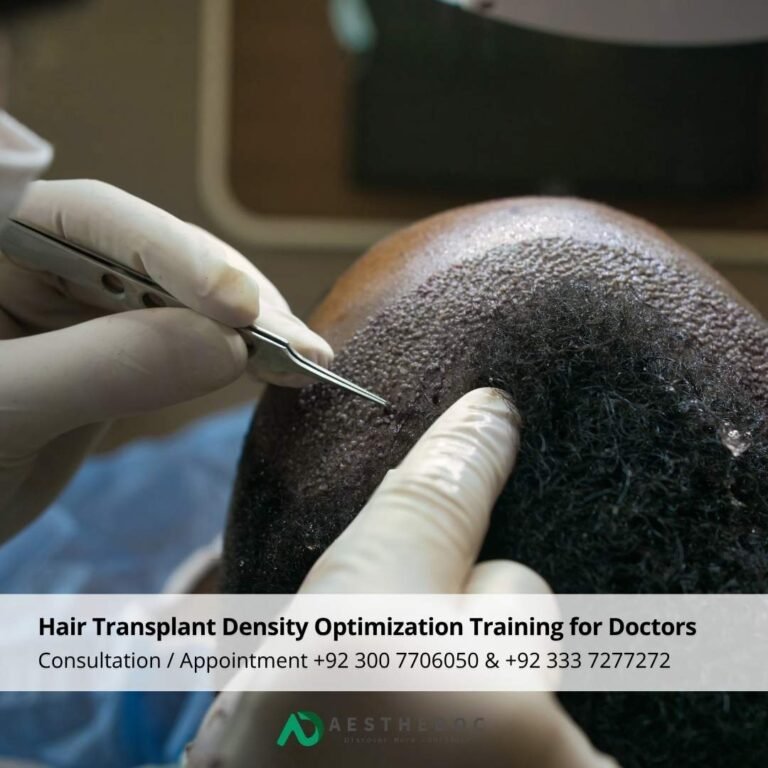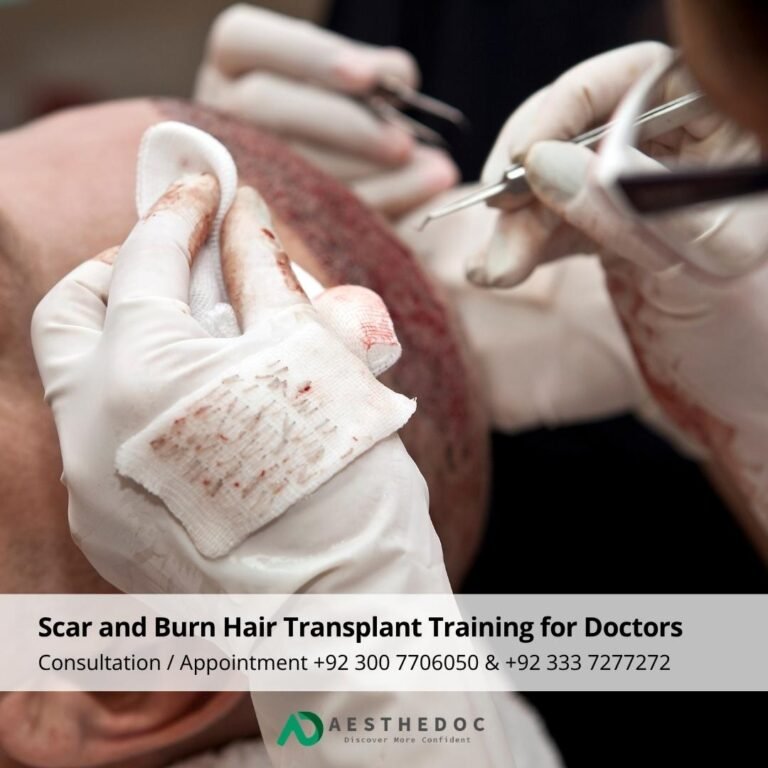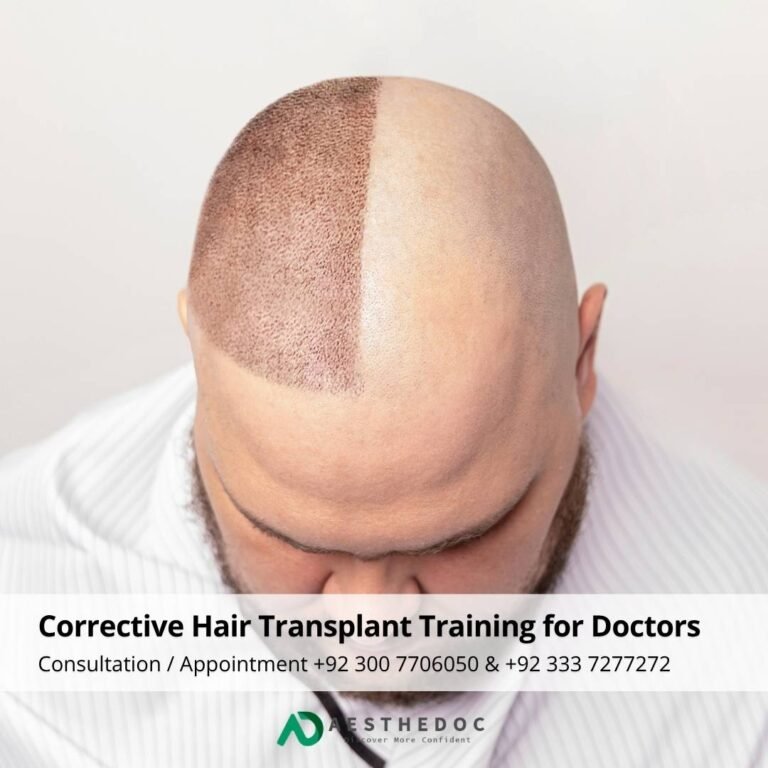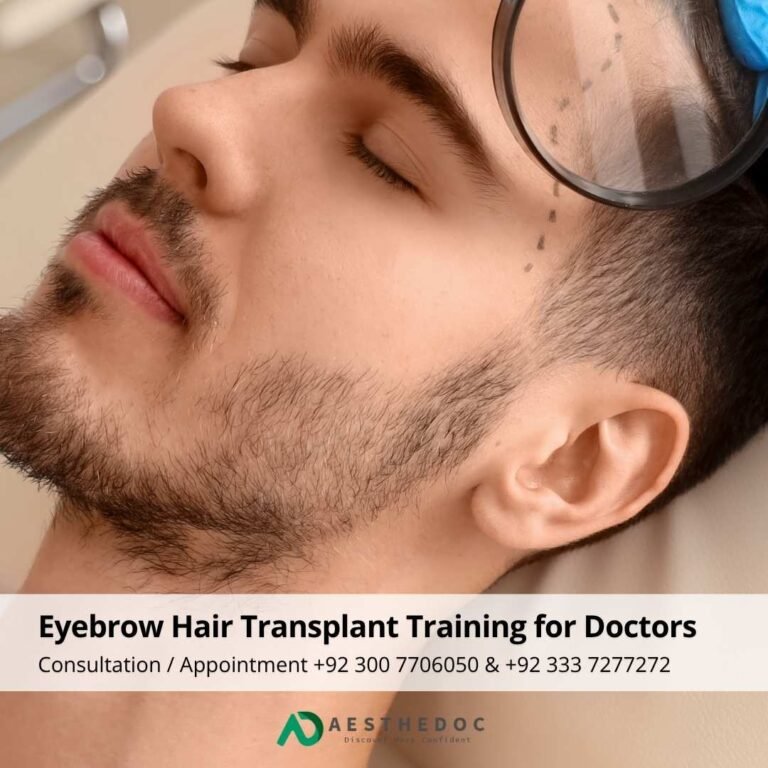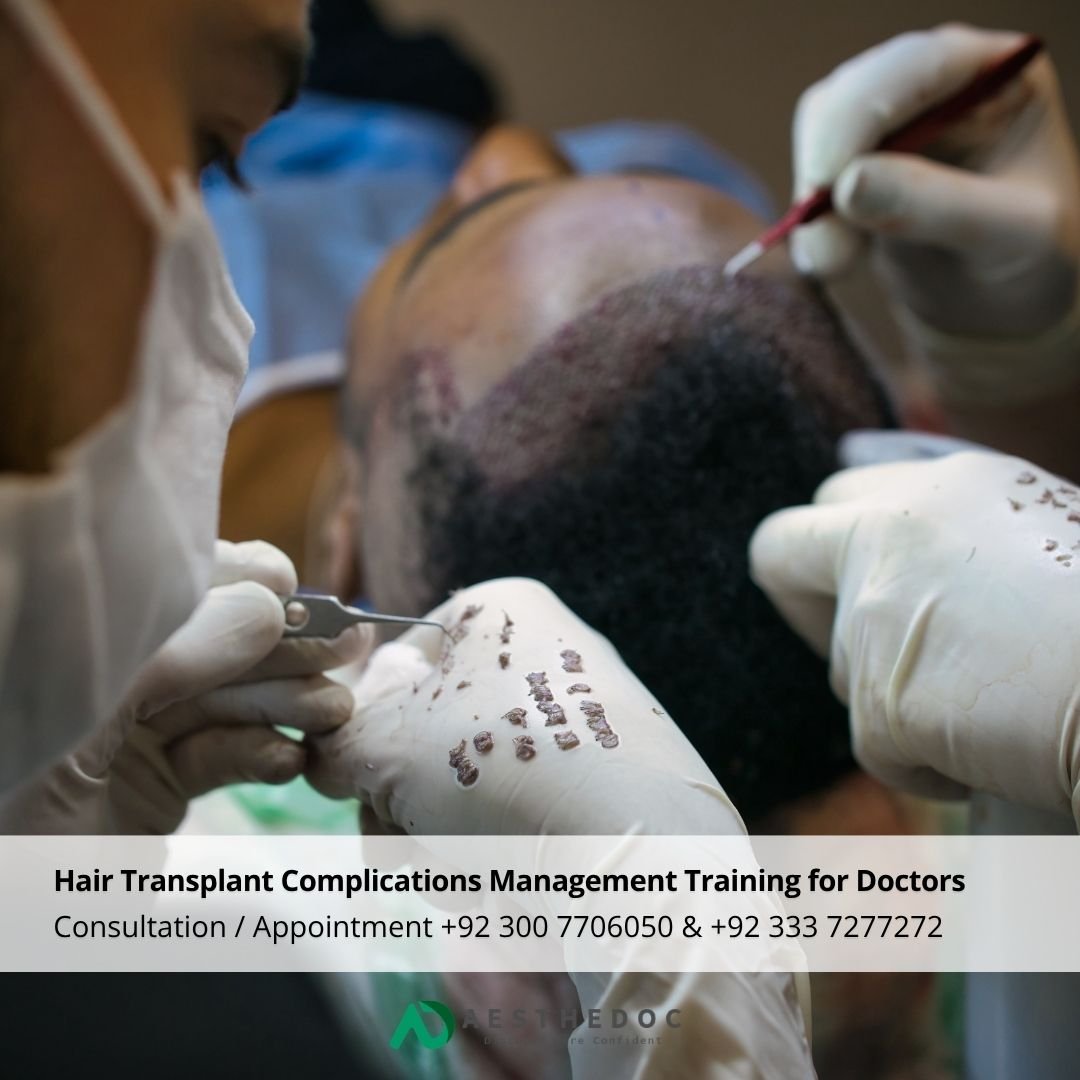
Hair transplantation is a surgical procedure that requires careful patient selection, appropriate technique, effective postoperative care and the ability to recognize complications. Although modern FUE techniques have made follicular unit harvesting more accessible, hair restoration still involves surgical risks that doctors must understand before performing or participating in these procedures.
Complications can affect the donor area, recipient area, transplanted grafts and the patient’s overall recovery. Some problems are temporary and resolve with appropriate care, while others may require medical treatment, specialist assessment or corrective surgery.
For doctors entering the field of hair restoration, learning how to prevent, recognize and manage complications is just as important as understanding graft extraction and implantation.
Hair transplant complications management training for doctors focuses on clinical assessment, infection prevention, postoperative monitoring, poor growth troubleshooting and revision planning. These subjects help medical professionals develop a more comprehensive understanding of safe hair restoration practice.
This guide explains common hair transplant complications, their possible contributing factors, the principles of prevention and the educational areas doctors should consider when selecting an advanced FUE training programme.
What Is Hair Transplant Complications Management?
Hair transplant complications management refers to the clinical processes involved in preventing, identifying, evaluating and responding to unwanted events associated with hair restoration surgery.
It covers the entire treatment journey, beginning with preoperative assessment and continuing through surgery, recovery and follow-up.
The main areas include:
- Preoperative risk assessment.
- Patient selection and contraindications.
- Surgical preparation and infection prevention.
- Donor-area monitoring.
- Recipient-area monitoring.
- Graft handling and survival considerations.
- Postoperative care protocols.
- Recognition of abnormal healing.
- Management of complications within the clinician’s scope.
- Referral and escalation when required.
- Evaluation of poor growth.
- Revision planning for selected patients.
Complication management is not limited to treating a problem after it occurs. A major part of safe surgical practice is identifying risk factors early and taking reasonable steps to reduce avoidable complications.
Why Is Complications Training Important for Hair Transplant Surgeons?
Hair transplantation is often discussed in terms of hairline design, graft numbers, extraction methods and cosmetic results. However, patient safety depends on much more than the technical ability to move follicular units.
A doctor must understand the patient’s medical history, evaluate the scalp, recognize contraindications, follow appropriate surgical protocols and respond to unexpected findings.
Without this knowledge, even a technically well-planned procedure may expose the patient to avoidable risks.
Complications training helps doctors develop the ability to:
- Identify patients who may have increased surgical risk.
- Recognize possible complications during the recovery period.
- Distinguish expected postoperative changes from warning signs.
- Understand infection prevention principles.
- Evaluate donor- and recipient-area healing.
- Investigate poor graft growth.
- Recognize when specialist assessment is required.
- Counsel patients about realistic outcomes.
- Document clinical findings and follow-up.
- Plan corrective treatment only when appropriate.
A structured understanding of complications is therefore an essential component of responsible hair restoration education.
Common Hair Transplant Complications Doctors Should Understand
Hair transplant complications can be broadly divided into donor-area problems, recipient-area problems, graft-related concerns and general postoperative issues.
Their frequency and severity vary according to the patient, surgical technique, clinical environment and other factors.
1. Swelling After Hair Transplant Surgery
Some patients develop swelling around the forehead or nearby facial areas following hair transplantation.
The extent and duration may vary. Doctors should explain expected postoperative changes and provide appropriate aftercare instructions.
However, significant, worsening or unusual swelling should not automatically be assumed to be normal. The patient may require clinical reassessment, particularly when swelling is associated with other concerning symptoms.
2. Bleeding
Minor bleeding can occur during or after surgery.
Persistent bleeding, significant blood loss or bleeding associated with other symptoms requires appropriate clinical assessment.
Preoperative evaluation should include relevant medical history, medications and factors that may influence bleeding risk.
3. Infection
Infection is an important complication that requires attention in any surgical procedure.
Potential warning signs may include:
- Increasing redness.
- Worsening pain.
- Increasing warmth.
- Pus or unusual discharge.
- Fever.
- Delayed or deteriorating wound healing.
These findings require clinical evaluation. Treatment should be determined by an appropriately qualified clinician based on the patient’s condition.
Infection prevention should be addressed through appropriate clinical hygiene, sterile practice, surgical preparation and postoperative instructions.
4. Folliculitis
Folliculitis refers to inflammation involving hair follicles.
Following hair transplantation, patients may develop small inflammatory bumps around transplanted or existing hair follicles.
The presentation may vary, and not every postoperative bump represents bacterial infection.
Doctors should evaluate the appearance, timing, symptoms and clinical context before deciding on management.
5. Itching and Irritation
Itching can occur during the healing process.
Patients should receive clear instructions about scalp care and avoiding unnecessary scratching or manipulation of the recipient area.
Persistent, severe or worsening irritation should be assessed rather than automatically attributed to routine healing.
6. Scabbing and Crust Formation
Small crusts may develop around recipient sites during the early recovery period.
Patients should follow the clinic’s postoperative washing and care instructions. Forceful removal or unnecessary manipulation may disturb healing tissue.
The clinical team should explain how to follow the prescribed aftercare plan and when to seek review.
7. Shock Loss
Shock loss refers to temporary shedding of existing hair following a hair transplant procedure.
It may involve transplanted hair or surrounding native hair, depending on the circumstances.
Doctors should understand the difference between temporary shedding and more persistent hair loss. Patients should receive realistic explanations about the hair growth cycle and the expected follow-up process.
8. Poor Graft Growth
Poor growth may be a source of significant concern for patients.
Possible contributing factors can include:
- Graft handling and storage problems.
- Surgical trauma.
- Recipient-area characteristics.
- Patient-related healing factors.
- Postoperative complications.
- Progressive loss of native hair.
- Incorrect expectations about the final result.
A doctor should not assume that every area of low density represents graft failure. The patient’s timeline, examination findings and previous treatment history should be considered.
9. Scarring
Hair transplantation can produce small scars in the donor and recipient areas.
The appearance depends on the technique, tissue characteristics, healing and individual patient factors.
Patients should understand that FUE does not mean scar-free surgery. The goal is to use appropriate technique and planning to minimize visible scarring while maintaining donor-area safety.
10. Donor Area Depletion
Excessive extraction can create visible thinning or patchiness in the donor region.
This may occur when graft harvesting is not adequately planned around the patient’s donor characteristics and long-term needs.
Donor preservation should be addressed before surgery rather than treated as an afterthought.
11. Altered Sensation
Some patients may experience temporary changes in scalp sensation after surgery.
Persistent, worsening or unusual sensory symptoms should be evaluated according to the clinical findings.
12. Unnatural Hair Growth Direction
Incorrectly planned recipient sites or implantation can produce hair that grows in an unnatural direction.
This is primarily an aesthetic and technical concern, but it may lead to patient dissatisfaction and requests for corrective treatment.
Training should therefore cover natural hair direction, hairline design and recipient-site planning.
Preoperative Risk Assessment: Preventing Complications Before Surgery
One of the most important stages of complication prevention takes place before the patient enters the operating room.
A thorough preoperative assessment helps identify factors that may influence surgical suitability, healing and recovery.
1. Review the Patient’s Medical History
The doctor should review relevant medical information, including:
- Existing medical conditions.
- Previous surgical procedures.
- Medication history.
- Allergies.
- Bleeding-related history.
- Previous wound-healing problems.
- Smoking and other relevant lifestyle factors.
- History of scalp disease.
- Previous hair transplant procedures.
The assessment should be individualized rather than based on a generic checklist alone.
2. Evaluate the Type of Hair Loss
Not every patient with hair loss is suitable for surgical restoration.
Doctors should distinguish between different types of alopecia and identify whether the underlying condition is appropriate for surgical treatment.
Active inflammatory or scarring scalp disorders may require diagnosis and management before transplantation is considered.
3. Understand Indications and Contraindications
A training programme should explain when hair transplantation may be appropriate and when it should be delayed, avoided or considered only after further assessment.
Patient selection is one of the most important ways to reduce avoidable complications and dissatisfaction.
4. Assess the Donor and Recipient Areas
The donor region should be examined for density, follicular characteristics, previous extraction and signs of depletion.
The recipient area should be assessed for scalp condition, existing hair, scarring and suitability for transplantation.
5. Discuss Expectations and Consent
Patients should understand the purpose of the procedure, expected recovery, possible risks, limitations and alternative treatment options.
The surgeon should avoid guaranteeing graft survival, a particular density or a specific cosmetic result.
Informed consent should reflect the actual procedure and the patient’s individual circumstances.
Infection Prevention in FUE Hair Transplant Surgery
Infection prevention is a core part of surgical safety.
A hair restoration clinic should have appropriate policies covering the operating environment, staff responsibilities, equipment handling, patient preparation and postoperative care.
Surgical Environment
The procedure should be conducted in an appropriate clinical environment with suitable hygiene and infection-control arrangements.
The surgical team should understand their responsibilities in maintaining a clean and safe working environment.
Sterile Technique and Instrument Handling
Surgical instruments and materials should be managed according to appropriate sterilization and infection-control protocols.
Staff training should address correct handling and the prevention of avoidable contamination.
Patient Preparation
The patient should be assessed and prepared according to the clinic’s clinical protocols.
Relevant skin and scalp conditions should be identified before surgery.
Postoperative Instructions
Patients should receive clear written or verbal instructions covering scalp care, follow-up and warning signs.
They should also know how to contact the clinical team if they develop unexpected symptoms.
Recognizing Possible Infection
Doctors should understand how to evaluate suspected infection and when additional investigation, treatment or specialist referral may be required.
Antibiotics should not be prescribed automatically for every postoperative symptom. Decisions should be based on clinical assessment and appropriate prescribing standards.
Donor Area Complications and Their Management
The donor area is where follicular units are harvested during FUE surgery.
Although extraction is performed through small openings, the cumulative effect of harvesting must be considered.
Donor Area Thinning
Excessive extraction may reduce the visual density of the donor region.
Prevention begins with appropriate donor assessment, conservative planning and attention to extraction distribution.
Patchy Appearance
Uneven harvesting may produce visible areas of reduced density.
Doctors should understand why extraction planning needs to consider the entire donor region rather than focusing only on the number of grafts required.
Donor Scarring
FUE can leave small extraction scars. Their appearance may vary according to technique, healing and patient characteristics.
Patients should receive accurate information about the possibility of scarring.
Donor Area Pain or Discomfort
Patients may experience discomfort during recovery.
Severe, persistent or worsening pain requires assessment rather than routine reassurance.
Poor Donor Healing
Delayed healing or signs of infection should be evaluated promptly.
The clinical team should document findings and arrange appropriate follow-up.
Recipient Area Complications and Their Management
The recipient area is where transplanted follicular units are placed.
Complications in this region may affect both healing and the final cosmetic result.
Recipient Area Infection
Increasing redness, pain, discharge or fever may indicate a complication requiring clinical review.
Doctors should understand the importance of early assessment and appropriate management.
Excessive Crusting or Delayed Healing
Some crusting can occur during normal recovery. However, unusual or persistent changes should be assessed in context.
Patients should follow the clinic’s aftercare instructions and avoid unnecessary manipulation.
Poor Growth
Poor growth requires evaluation of the surgical history, healing timeline, recipient tissue and other possible contributing factors.
The surgeon should establish the likely cause before recommending another procedure.
Unnatural Hairline
An excessively low, straight or poorly distributed hairline may produce an artificial appearance.
Prevention involves appropriate planning, patient counseling and an understanding of natural hairline characteristics.
Incorrect Hair Direction
The orientation of transplanted hair affects the final appearance.
Training should cover recipient-site planning and the relationship between implantation direction and natural hair growth.
Graft Handling and Its Relationship to Complications
Graft handling is an important part of FUE surgery.
Follicular units are delicate structures, and unnecessary trauma during harvesting, preparation, storage or implantation may compromise their viability.
Doctors should understand the full graft workflow.
Extraction
The extraction process requires attention to follicular direction, punch selection and minimizing transection.
Preparation
Follicular units should be handled carefully during preparation.
The clinical team should understand how grafts are identified and organized for the procedure.
Storage
Appropriate graft storage is an important part of the surgical workflow.
The handling and storage process should follow the clinic’s established clinical protocols.
Implantation
The implantation process should follow the planned recipient-site design.
Unnecessary trauma and inappropriate placement should be avoided through suitable technique and supervision.
Why Graft Survival Cannot Be Guaranteed
Graft survival depends on multiple factors, including surgical technique, handling, tissue characteristics and patient-related variables.
Doctors should understand the factors that influence graft viability without promising a guaranteed survival percentage or cosmetic outcome.
Shock Loss and Poor Growth: How Doctors Should Evaluate Postoperative Concerns
Patients may become concerned when they notice shedding or do not see immediate growth after a hair transplant.
A clear understanding of the hair growth cycle helps doctors explain the recovery process.
Understanding Temporary Shedding
Transplanted hair may shed during the postoperative period while the follicle remains in the scalp.
Patients should be counseled about this possibility before surgery.
Distinguishing Shock Loss From Other Problems
Shock loss should not be used as a blanket explanation for every case of postoperative hair loss.
The doctor should consider the timing, distribution, symptoms and clinical examination.
Evaluating Poor Growth
A patient with limited visible growth may require a detailed follow-up assessment.
Relevant factors include:
- Time elapsed since surgery.
- Original hair-loss pattern.
- Number and distribution of implanted grafts.
- Postoperative history.
- Scalp condition.
- Possible complications.
- Ongoing loss of native hair.
Communicating With Patients
Patients should know when they can reasonably expect to assess the result and when an earlier clinical review is necessary.
The clinical team should avoid premature conclusions about success or failure.
Postoperative Care After Hair Transplant Surgery
Postoperative care is a major component of the overall treatment process.
A suitable aftercare plan should be individualized according to the procedure, the patient’s condition and the clinic’s clinical protocols.
1. Written Aftercare Instructions
Patients should receive clear instructions covering scalp care, washing, activity restrictions where applicable, medication guidance and follow-up.
2. Follow-Up Appointments
Follow-up allows the clinical team to review healing, address concerns and identify complications.
The timing should follow the clinic’s protocol and the patient’s clinical needs.
3. Warning Signs
Patients should understand which symptoms require prompt medical attention.
These may include worsening pain, fever, spreading redness, unusual discharge, significant bleeding or unexpected deterioration.
4. Medication Review
Any medication instructions should be based on an appropriate clinical assessment and prescribing standards.
Patients should not independently start, stop or change prescribed treatment without suitable medical advice.
5. Documentation
Clinical documentation should include relevant examination findings, patient concerns, advice provided and any treatment or referral arranged.
Accurate documentation supports continuity of care and professional accountability.
When Should a Hair Transplant Patient Be Referred for Further Assessment?
A hair transplant clinic should have a clear approach to recognizing cases that require further investigation or specialist involvement.
Referral or escalation may be appropriate when:
- There is suspected significant infection.
- The patient develops severe or worsening pain.
- There is persistent or significant bleeding.
- The scalp shows signs of abnormal wound healing.
- There is unexpected tissue damage.
- The patient develops unusual or progressive symptoms.
- The diagnosis of hair loss is uncertain.
- An underlying scalp disorder may be active.
- The complication is beyond the treating clinician’s expertise.
The surgeon should not delay appropriate assessment when the patient’s condition suggests a potentially serious complication.
Revision Planning After Hair Transplant Complications
Some patients may seek a second procedure after an unsatisfactory outcome or complication.
Revision planning should begin with a complete assessment of the original procedure and current scalp condition.
Identify the Original Problem
The surgeon should establish whether the issue relates to:
- Poor graft growth.
- Uneven density.
- Unnatural hairline design.
- Incorrect hair direction.
- Donor overharvesting.
- Visible scarring.
- Progressive native hair loss.
- A previous surgical complication.
Evaluate Remaining Donor Hair
The donor area may have limited capacity after one or more previous procedures.
The surgeon must determine whether additional harvesting is safe and appropriate.
Assess the Recipient Area
Scarring, previous graft placement and tissue condition may affect the options available.
Consider Non-Surgical Management
Not every unsatisfactory result requires another operation.
Medical management, observation, camouflage or referral may be more appropriate in some cases.
Explain the Limitations
Revision surgery cannot guarantee complete correction. The patient should understand the risks, potential benefits and limitations before making a decision.
Building a Safe Hair Transplant Clinical Workflow
A hair restoration service requires coordinated clinical processes.
Complication prevention should be integrated into each stage rather than treated as a separate activity.
| Stage | Important clinical considerations |
|---|---|
| Initial consultation | Medical history, hair-loss assessment and patient expectations |
| Preoperative planning | Donor evaluation, recipient assessment and suitability |
| Surgical preparation | Clinical environment, patient preparation and infection prevention |
| FUE procedure | Extraction planning, graft handling and recipient-site creation |
| Immediate recovery | Clinical observation and postoperative instructions |
| Follow-up | Healing assessment, patient concerns and documentation |
| Complication review | Evaluation, treatment, escalation or referral |
| Long-term planning | Growth assessment and possible revision consideration |
A consistent workflow can help the clinical team understand responsibilities and improve continuity of patient care.
What Doctors Should Learn in Hair Transplant Complications Management Training
A comprehensive hair transplant training programme should address the technical and clinical aspects of the procedure.
For doctors interested in complication management, important learning areas include the following.
1. Hair Loss Fundamentals and Patient Selection
Understanding types of alopecia, indications, contraindications and medical versus surgical treatment planning.
2. Preoperative Assessment
Learning how to evaluate patient history, scalp condition, donor availability and relevant risk factors.
3. FUE Surgical Fundamentals
Understanding punch selection, extraction techniques, graft handling, storage, recipient-site creation and implantation methods.
4. Infection Prevention
Learning the importance of surgical hygiene, instrument handling, clinical preparation and postoperative instructions.
5. Postoperative Care
Understanding recovery monitoring, patient communication, documentation and follow-up.
6. Shock Loss Management
Learning how to explain postoperative shedding and distinguish expected changes from concerns that require further assessment.
7. Poor Growth Troubleshooting
Understanding the possible causes of limited growth and the importance of appropriate clinical evaluation.
8. Corrective and Revision Planning
Learning the principles of evaluating unsatisfactory outcomes and determining when further treatment may be appropriate.
9. Advanced Hair Restoration
Understanding how complications and postoperative considerations relate to beard and eyebrow transplantation, corrective procedures and scar or burn-related restoration.
10. Ethical Clinical Practice
Understanding patient consent, scope of practice, supervision, documentation and professional responsibility.
Why Practical Training Matters in Hair Transplant Complications Management
Clinical judgment develops through a combination of theoretical knowledge, supervised experience and appropriate professional practice.
Doctors need to understand not only how an FUE procedure is performed but also how the clinical team prepares the patient, handles grafts, monitors recovery and responds to unexpected findings.
A structured practical training environment can help doctors understand:
- Patient assessment and preoperative planning.
- Surgical preparation and clinical workflow.
- Donor-area evaluation.
- FUE extraction principles.
- Graft handling and storage.
- Recipient-site creation.
- Implantation methods.
- Postoperative care protocols.
- Infection prevention.
- Poor growth troubleshooting.
- Revision planning.
Aesthedoc’s published programme lists structured theoretical training, full hands-on FUE surgical exposure, live patient cases and one-to-one mentoring. The page also lists postoperative care protocols and complication management as course components.
The exact scope of supervised participation should be confirmed with the training team. All practical activity must follow patient consent, clinical supervision, professional scope and applicable regulations.
Who Should Consider Hair Transplant Complications Training?
Complications management education may be relevant to qualified medical professionals interested in developing their understanding of surgical hair restoration.
MBBS Doctors
Medical graduates interested in learning hair loss assessment, patient selection and the clinical principles of FUE surgery.
General Surgeons
Surgeons seeking structured education in hair transplant techniques, surgical workflows and postoperative care.
Plastic Surgeons
Plastic surgeons interested in hairline design, scalp reconstruction, donor management and corrective hair restoration.
Dermatologists
Dermatologists managing hair and scalp disorders who want to understand surgical hair restoration and its potential complications.
Aesthetic Physicians
Qualified aesthetic physicians interested in hair restoration education, patient assessment and the professional requirements associated with surgical procedures.
Doctors Planning Hair Restoration Clinics
Medical professionals planning to establish a hair restoration practice should understand clinical protocols, patient selection, postoperative care and complication management.
Eligibility and the permitted scope of practical participation should be confirmed with the training provider.
How to Choose a Hair Transplant Training Course With Complications Education
Not all hair transplant courses offer the same level of clinical education.
Doctors should review the curriculum and practical arrangements before enrolling.
Trainer Credentials
Review the trainer’s relevant qualifications and clinical experience in hair restoration.
Complications Curriculum
Ask whether the programme addresses infection prevention, shock loss, poor growth, postoperative care and revision planning.
FUE Surgical Education
Confirm that the course covers extraction, graft handling, storage, recipient-site creation and implantation methods.
Practical Exposure
Clarify whether the programme includes demonstrations, live patient cases, supervised participation or theoretical instruction.
Patient Safety
Ask how the training environment addresses informed consent, clinical supervision, infection prevention and patient confidentiality.
Course Documentation
Request written details about duration, eligibility, course fee, certificate, learning objectives and any additional costs.
Professional Recognition
A course certificate should not be confused with a medical licence, specialist qualification or independent surgical authorization. Doctors must follow the regulations of their intended country of practice.
Aesthedoc Hair Transplant Training for Doctors and Surgeons in Pakistan
Aesthedoc offers a hair transplant training programme in Pakistan for doctors and surgeons interested in developing their knowledge of FUE hair restoration.
The published course page identifies Dr. Adnan Bashir as a Master Aesthetic Trainer and ABHRS-certified Hair Transplant Surgeon.
Published Course Components
According to the Aesthedoc course page, the programme includes:
- Structured theoretical training.
- Full hands-on FUE surgical exposure.
- Live patient cases.
- One-to-one mentoring.
- Preoperative planning.
- Postoperative care protocols.
- Complication management.
Complications and Postoperative Topics
The published curriculum specifically lists:
- Infection prevention.
- Shock loss management.
- Poor growth troubleshooting.
- Revision planning.
The wider curriculum also includes types of alopecia, patient selection, ethical counseling, donor-area assessment, FUE extraction, graft handling and storage, recipient-site creation, implantation methods and advanced restoration techniques.
These course details are published on the official Aesthedoc hair transplant training page. <Cite ref=”turn911599view0″/>
Training Led by Dr. Adnan Bashir
Aesthedoc identifies Dr. Adnan Bashir as the programme’s trainer and describes his experience in FUE hair transplantation, corrective procedures, beard and eyebrow transplantation and burn-related restoration.
The published page also describes more than 15 years of combined clinical, academic and training experience and thousands of FUE procedures. Prospective trainees should review the trainer’s credentials and discuss the curriculum and practical arrangements directly with Aesthedoc. <Cite ref=”turn911599view0″/>
Who Can Enquire?
The published programme identifies:
- MBBS doctors.
- General surgeons.
- Plastic surgeons.
- Dermatologists.
- Aesthetic physicians.
- Medical professionals planning hair restoration clinics.
Applicants should confirm eligibility and the scope of practical participation before enrolment.
Course Fee and Contact Details
The published course page lists the programme fee as USD $5,500. Confirm the current fee, inclusions and payment arrangements directly with the training team.
Aesthedoc Hair Transplant Training
- Location: Pakistan
- Trainer: Dr. Adnan Bashir
- WhatsApp / Call: +92 333 727 7272
International doctors can contact Aesthedoc to discuss course dates, eligibility, travel arrangements and programme details.
Frequently Asked Questions About Hair Transplant Complications Management Training
1. What is hair transplant complications management training?
It is education focused on understanding, preventing, recognizing and responding to complications associated with hair restoration surgery. It may cover infection prevention, shock loss, poor growth, postoperative care and revision planning.
2. What are the common complications of FUE hair transplantation?
Potential complications include bleeding, infection, swelling, folliculitis, scarring, shock loss, altered sensation, poor growth and donor-area depletion. Their likelihood and severity vary according to the patient and procedure.
3. Is infection common after a hair transplant?
Infection is a recognized surgical risk, although the likelihood varies. Appropriate clinical hygiene, sterile practice, patient preparation and postoperative care are important parts of prevention.
4. What is shock loss after a hair transplant?
Shock loss refers to temporary shedding of hair following transplantation. It may involve transplanted or surrounding native hair. Doctors should evaluate unusual or persistent shedding rather than assuming every case is routine.
5. What causes poor hair growth after transplantation?
Possible contributing factors include graft handling, surgical trauma, recipient tissue characteristics, patient-related factors, postoperative complications and progressive native hair loss. The cause should be assessed before further treatment is recommended.
6. Can FUE hair transplantation leave scars?
Yes. FUE creates small extraction sites that may leave tiny scars. Their visibility varies according to technique, healing and individual characteristics. FUE should not be described as completely scar-free.
7. How can donor-area complications be reduced?
Appropriate donor assessment, conservative extraction planning and attention to the distribution of harvested grafts are important. Doctors should consider long-term donor preservation rather than focusing only on the immediate graft requirement.
8. What should a doctor do if a patient develops signs of infection after a hair transplant?
The patient should receive prompt clinical assessment. Management depends on the findings and may require treatment or referral. Worsening pain, fever, spreading redness or unusual discharge should not be dismissed as routine recovery.
9. Does Aesthedoc include complications management in its hair transplant course?
Yes. The published Aesthedoc programme lists complication management, infection prevention, shock loss management, poor growth troubleshooting and revision planning among its course components.
10. Does the Aesthedoc course include practical FUE exposure?
The published course page lists full hands-on FUE surgical exposure, live patient cases and one-to-one mentoring. Applicants should confirm the precise practical arrangements and supervision available for their enrolment.
11. Who can enrol in the Aesthedoc hair transplant training programme?
The published programme identifies MBBS doctors, general surgeons, plastic surgeons, dermatologists, aesthetic physicians and medical professionals planning hair restoration clinics as its intended audience. Eligibility should be confirmed directly.
12. Does a hair transplant course qualify a doctor to practise independently?
No. Completing a short training programme does not automatically provide specialist status, a medical licence or independent surgical privileges. Doctors must meet the applicable professional and regulatory requirements.
13. Where can doctors learn hair transplant complications management in Pakistan?
Aesthedoc offers a hair transplant training programme in Pakistan that lists postoperative care and complication management in its published curriculum. Doctors can contact the training team for further information.
Conclusion: Complication Management Is Essential to Responsible Hair Restoration
Hair transplantation requires more than technical knowledge of extraction and implantation. Doctors must understand patient selection, surgical preparation, infection prevention, postoperative monitoring and the recognition of complications.
A strong understanding of these areas helps medical professionals make better clinical decisions, communicate more effectively with patients and recognize when further assessment or referral is needed.
For doctors interested in structured FUE education, Aesthedoc offers a hair transplant training programme in Pakistan that includes postoperative care protocols, complication management, infection prevention, shock loss management, poor growth troubleshooting and revision planning.
To explore the curriculum, eligibility and upcoming training arrangements, visit the official course page or contact the Aesthedoc training team.
Aesthedoc – Hair Transplant Training for Doctors and Surgeons
WhatsApp / Call: +92 333 727 7272 & +92 300 770 6050