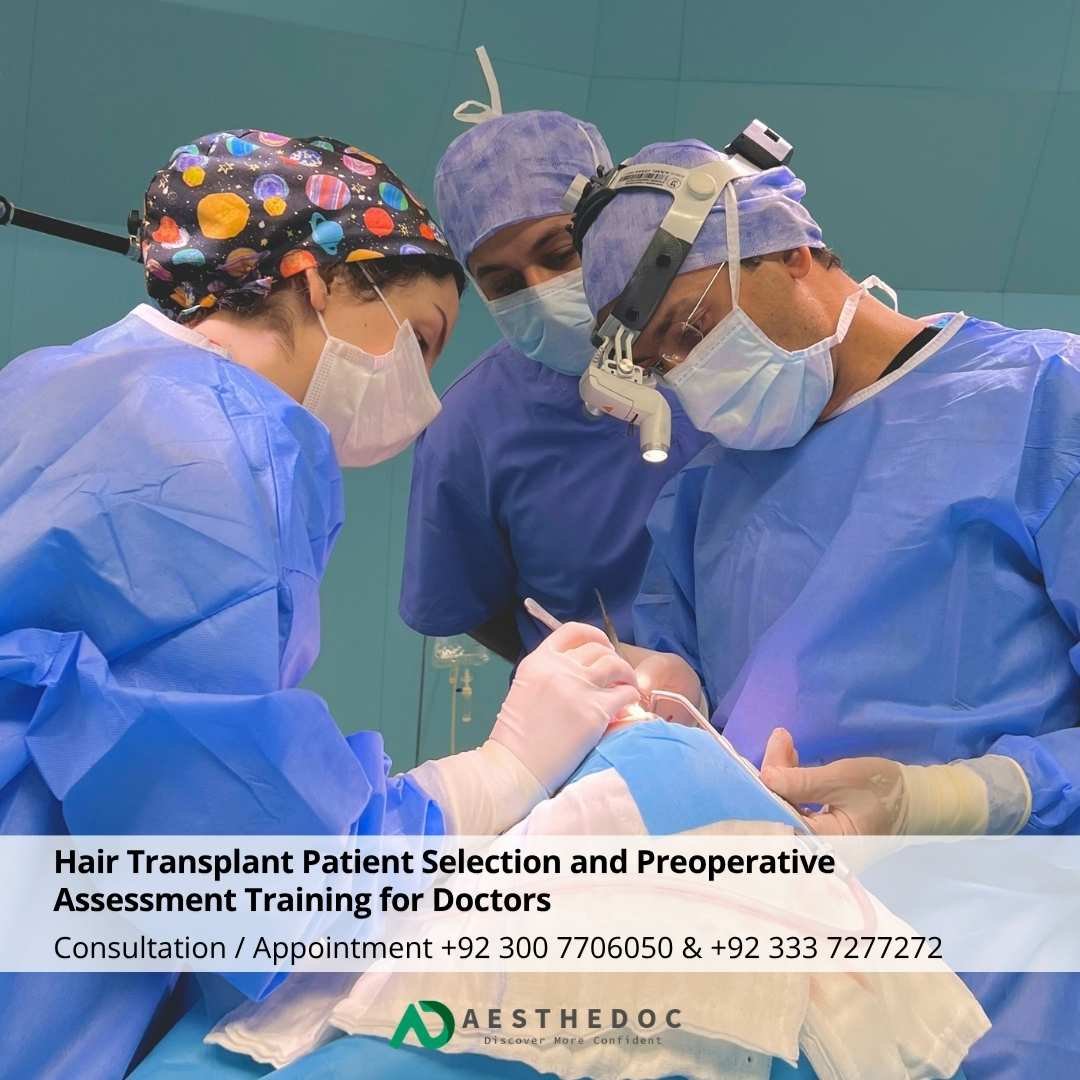
Successful hair transplant surgery begins long before the first follicular unit is extracted. One of the most important responsibilities of a hair restoration surgeon is identifying whether a patient is an appropriate candidate for surgery and determining whether the proposed procedure is likely to address the patient’s concerns safely and realistically.
Not every individual experiencing hair loss is suitable for an immediate hair transplant. Some patients may have progressive androgenetic alopecia, while others may have temporary shedding, inflammatory scalp conditions, nutritional deficiencies, scarring alopecia or other medical causes of hair loss. Treating these different conditions as if they were identical can result in inappropriate surgical decisions.
Patient selection is therefore a fundamental part of professional hair transplant training. Doctors must learn how to evaluate hair loss patterns, review medical history, examine the scalp, assess donor availability, identify potential contraindications and understand when medical management or further investigation should take priority over surgery.
Preoperative assessment also involves understanding the patient’s expectations. A patient may request a particular hairline, a specific graft count or a density level that is not compatible with their donor supply. The surgeon must be able to explain the limitations of treatment and develop a plan based on clinical suitability rather than commercial expectations.
This comprehensive guide explores patient selection and preoperative assessment for hair transplant surgery. It covers alopecia evaluation, medical history, scalp examination, donor assessment, psychological considerations, contraindications, informed consent, treatment planning and the importance of structured FUE training for doctors and surgeons.
1. Why Patient Selection Is Essential in Hair Transplant Surgery
Patient selection is the process of evaluating whether an individual is clinically and practically suitable for hair transplantation.
The assessment considers the cause of hair loss, its progression, the condition of the scalp, available donor hair, general health, treatment expectations and potential risks.
A technically successful procedure does not necessarily produce a satisfactory outcome if the patient was unsuitable for surgery or the treatment plan was poorly designed.
The consequences of poor patient selection
Inadequate candidate evaluation can contribute to:
- Surgery being performed for an incorrectly diagnosed hair loss condition.
- Transplantation in an unstable or unsuitable scalp condition.
- Unrealistic expectations about density or coverage.
- Excessive use of limited donor resources.
- Poor integration with existing native hair.
- Unnecessary surgical intervention.
- Dissatisfaction with cosmetic outcomes.
- Difficulty managing future hair loss.
Patient selection is not simply about deciding whether a patient wants surgery. It is about determining whether surgery is appropriate and whether its likely benefits justify the risks and limitations.
The surgeon’s responsibility
The surgeon should evaluate the complete clinical picture before recommending a procedure.
If the diagnosis is uncertain, additional investigation or referral may be appropriate. If the patient has unrealistic expectations, the surgeon should explain the limitations. If the donor supply is inadequate, an alternative treatment strategy may be more suitable.
A responsible decision may sometimes be to delay or decline surgery.
2. Understanding the Different Causes of Hair Loss
One of the first steps in preoperative assessment is identifying the likely cause of hair loss.
Hair transplantation is primarily used to restore hair in selected areas where follicles are absent or significantly affected by hair loss. It does not treat every underlying condition responsible for shedding or scalp disease.
Androgenetic alopecia
Androgenetic alopecia is a common form of progressive hair loss in men and women.
It is influenced by genetic susceptibility and hormonal factors. In men, it often presents with frontal recession, temporal changes, mid-scalp thinning and crown involvement. In women, it may present as diffuse thinning, often with preservation of the frontal hairline, although patterns vary.
Assessment should consider the distribution, duration and progression of hair loss.
Telogen effluvium
Telogen effluvium is a form of diffuse hair shedding that may occur following physiological or psychological stressors, illness, nutritional changes, hormonal changes or other triggers.
Some patients may interpret increased shedding as permanent baldness and request a hair transplant.
The underlying cause and clinical course should be assessed before surgical treatment is considered. A transplant is not a substitute for evaluating the reason for active diffuse shedding.
Alopecia areata
Alopecia areata is an immune-mediated hair loss condition that may cause patchy or more extensive hair loss.
Its activity and clinical pattern require appropriate medical assessment. Hair transplantation is generally not considered an appropriate routine treatment during active disease because the condition may affect transplanted follicles or recur.
Traction alopecia
Traction alopecia can develop following repeated tension on the hair, often affecting the frontal and temporal regions.
The assessment should consider the patient’s hair practices, duration of hair loss and whether the condition is active or longstanding. The presence of scarring may influence surgical suitability.
Scarring alopecia
Scarring alopecia includes conditions in which inflammation damages hair follicles and may lead to permanent hair loss.
Examples include different forms of primary cicatricial alopecia and secondary scarring caused by trauma or other conditions.
Active inflammatory disease requires appropriate diagnosis and management. Transplantation into an unsuitable or actively affected area may have an unpredictable outcome.
Other causes of hair loss
The differential diagnosis may also include:
- Nutritional deficiencies.
- Thyroid-related conditions.
- Medication-associated hair loss.
- Hormonal disorders.
- Infectious scalp conditions.
- Hair shaft disorders.
- Postoperative or traumatic hair loss.
- Other inflammatory scalp diseases.
The purpose of preoperative assessment is to avoid assuming that all hair loss represents androgenetic alopecia.
3. Understanding the Pattern and Progression of Hair Loss
The pattern of hair loss provides important information about diagnosis, treatment planning and potential future requirements.
Male pattern hair loss
Male androgenetic alopecia commonly affects the frontal hairline, temples, mid-scalp and crown.
The Norwood-Hamilton classification is widely used as a descriptive framework for categorising common patterns of male pattern hair loss.
It can help clinicians communicate the extent and distribution of hair loss, but it does not replace an individual clinical assessment.
Female pattern hair loss
The Ludwig classification is one recognised system for describing female pattern hair loss. Other classification approaches may also be used.
Female patients may have diffuse central thinning, widening of the parting or more extensive loss.
The clinician should evaluate whether the presentation is consistent with female pattern hair loss or whether another diagnosis requires investigation.
Why progression matters
A patient with early hairline recession may have a relatively small current recipient area but a substantial possibility of further hair loss.
A patient with a more established pattern may have different planning considerations.
The surgeon should therefore evaluate not only the amount of hair currently lost but also the possibility of future progression.
Documenting the hair loss pattern
A structured record may include:
- Current pattern of hair loss.
- Duration of symptoms.
- Previous progression.
- Family history.
- Existing areas of miniaturisation.
- Previous medical treatments.
- Patient-reported changes.
- Standardised clinical photographs.
This information supports future comparison and helps establish whether the treatment plan remains appropriate.
4. Medical History Review Before Hair Transplant Surgery
A comprehensive medical history is essential before any elective surgical procedure.
Hair transplant candidates may have medical conditions, medication use or previous surgical experiences that influence assessment and perioperative planning.
General medical history
The clinician should review relevant information, including:
- Existing medical conditions.
- Previous operations.
- History of anaesthesia-related problems.
- Allergies and medication reactions.
- Bleeding or clotting history.
- Relevant cardiovascular conditions.
- Diabetes and other metabolic conditions.
- Immune-related disorders.
- History of poor wound healing.
- Current or recent infections.
The relevance of each factor depends on the individual patient and the proposed procedure.
Medication history
A complete medication review is important because some medicines may affect bleeding risk, healing or other aspects of perioperative care.
The clinician should document prescription medicines, over-the-counter products, supplements and relevant topical treatments.
Patients should not independently discontinue prescribed medication because they are planning a hair transplant. Any changes must be discussed with the appropriate prescribing clinician and surgical team.
Previous hair loss treatment
The surgeon should ask about previous medical and non-surgical treatments.
This may include:
- Topical hair loss treatments.
- Prescription hair loss medicines.
- Previous hair restoration procedures.
- Platelet-rich plasma treatments.
- Other scalp procedures.
- Cosmetic or dermatological treatments.
Understanding previous treatment can help explain the patient’s current condition and expectations.
Family history
Family history may provide useful context when evaluating androgenetic alopecia.
The clinician may ask about the pattern and extent of hair loss among close relatives, although family history cannot predict an individual’s future course with certainty.
5. Scalp Examination and Clinical Assessment
A physical examination is a core part of preoperative assessment.
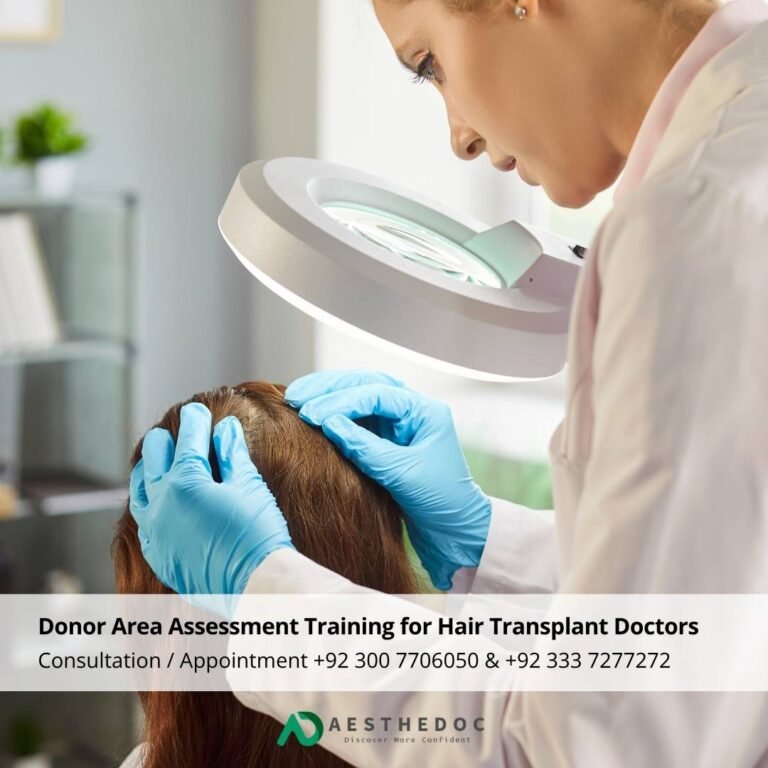
The surgeon should examine the donor and recipient areas rather than focusing only on the patient’s main cosmetic concern.
Recipient area examination
The recipient area is the region where follicular units are intended to be transplanted.
Assessment may include:
- Existing hair density.
- Distribution of thinning.
- Miniaturisation.
- Scalp condition.
- Visible inflammation.
- Scarring.
- Previous transplantation sites.
- Hair direction and characteristics.
The examination helps establish whether the recipient area is suitable for surgery and what treatment objectives may be realistic.
Donor area examination
The donor area is evaluated to understand the available follicular supply and its long-term suitability.
Important considerations include:
- Follicular unit density.
- Hair shaft calibre.
- Hair texture.
- Miniaturisation.
- Scalp characteristics.
- Previous extraction scars.
- Distribution of density.
- Potential future donor requirements.
Donor assessment should be individualised. A patient with apparently good density may still have limitations if miniaturisation or an unfavourable distribution is present.
Examination of scalp health
The surgeon should look for signs of active inflammation, scaling, infection, irritation or scarring.
If the findings suggest an underlying scalp disease, additional assessment may be necessary before surgery is considered.
6. The Role of Trichoscopy in Preoperative Assessment
Trichoscopy is a non-invasive examination technique that allows clinicians to inspect scalp and hair structures under magnification.
It can provide additional information when evaluating patients with hair loss and may be particularly useful when the diagnosis or donor suitability is uncertain.
What trichoscopy may help identify
Depending on the condition and equipment, trichoscopy can help assess:
- Hair shaft diameter variation.
- Miniaturisation.
- Follicular openings.
- Hair density patterns.
- Signs associated with inflammatory scalp conditions.
- Features that may suggest scarring alopecia.
- Differences between affected and less affected scalp regions.
Trichoscopy and androgenetic alopecia
Hair shaft diameter variation and miniaturisation may provide useful evidence when evaluating androgenetic alopecia.
These findings should be interpreted alongside the clinical pattern, history and other examination findings.
When further investigation is appropriate
Some patients may require additional investigations or specialist evaluation before a diagnosis is established.
A trichoscopic examination alone does not replace a complete clinical assessment. The clinician should select further tests based on the suspected condition and the patient’s history.
7. Assessing Donor Area Suitability
A patient may have significant recipient-area hair loss but insufficient donor supply for the desired result.
Donor suitability is therefore one of the key elements in determining whether hair transplantation is appropriate.
Donor density
The clinician should assess follicular unit density and individual hair count across representative donor regions.
A distinction should be maintained between graft numbers and the number of individual hairs.
Hair calibre and texture
Thicker hair may create a different visual coverage effect compared with fine hair.
Curl pattern, colour contrast and follicular unit composition can also influence cosmetic planning.
Miniaturisation in the donor area
Evidence of miniaturisation in a proposed donor region may raise concerns about its long-term suitability.
The surgeon should consider the possibility of donor thinning and whether further evaluation is needed.
Previous donor harvesting
Patients who have undergone previous FUE or FUT procedures require an assessment of their remaining donor resources.
The number and distribution of previous extractions, existing scars and current density should be considered.
Long-term donor preservation
The donor area is a limited resource. The surgeon should consider the patient’s possible future needs rather than planning only for the current recipient area.
8. Identifying Suitable Hair Transplant Candidates
A suitable candidate is not defined by age or hair loss severity alone.
The decision depends on diagnosis, donor characteristics, scalp condition, expectations, overall health and the proposed treatment plan.
Characteristics that may support suitability
A patient may be considered for surgery when:
- The cause of hair loss has been appropriately evaluated.
- The condition is suitable for surgical restoration.
- The donor area provides a reasonable supply.
- The scalp is clinically suitable for the proposed procedure.
- The patient’s expectations are realistic.
- The treatment plan considers future hair loss.
- Relevant medical risks have been assessed.
- The patient understands the procedure and its limitations.
These are broad considerations, not a checklist that automatically establishes eligibility.
Why suitability is individual
Two patients with similar patterns of hair loss may have different surgical suitability because of differences in donor density, hair characteristics, medical history and expectations.
The surgeon should avoid applying a fixed graft package or standard treatment plan to every patient.
9. When Hair Transplant Surgery Should Be Delayed or Avoided
Recognising when surgery is unsuitable is as important as identifying appropriate candidates.
Some conditions require further investigation, treatment or stabilisation before surgery can be considered.
Active scalp infection or inflammation
Patients with an active scalp infection or significant inflammatory condition may require diagnosis and appropriate management before elective transplantation.
Active scarring alopecia
Transplantation into an actively affected area may produce unpredictable results. Specialist evaluation and evidence of disease control may be necessary before considering surgery.
Unexplained or rapidly progressive hair loss
Rapid or unexplained hair loss should be investigated rather than treated immediately as a routine surgical indication.
Insufficient donor supply
A patient may have a recipient area that is too extensive relative to the available donor hair.
In such cases, the surgeon should discuss realistic alternatives and avoid promising coverage that the donor supply cannot support.
Uncontrolled medical conditions
Medical conditions that may increase perioperative risk should be evaluated and managed appropriately before elective surgery.
Unrealistic expectations
A patient expecting complete restoration of adolescent density despite extensive hair loss and limited donor supply may not be a suitable candidate for the requested procedure.
Other reasons for additional assessment
Further evaluation may be needed when there is:
- Uncertain diagnosis.
- Significant scalp scarring.
- A history of unusual healing problems.
- Relevant bleeding or clotting concerns.
- Unresolved medical issues.
- Unclear understanding of the procedure.
- Inability to provide informed consent.
The final decision should be made by the appropriately qualified clinician following an individual assessment.
10. Hair Transplant Patient Selection in Younger Individuals
Younger patients frequently seek hair restoration because they are concerned about early recession or changes in hairline appearance.
However, younger age introduces important long-term planning considerations.
The risk of progressive hair loss
Androgenetic alopecia may continue to progress after a transplant.
If a low hairline is created early in the disease process, surrounding native hair may later recede and leave the transplanted region looking isolated.
Evaluating long-term suitability
The clinician should consider:
- Duration of hair loss.
- Pattern of progression.
- Family history.
- Evidence of miniaturisation.
- Donor supply.
- Patient expectations.
- Potential medical management.
- Future recipient-area requirements.
Avoiding premature surgery
Some younger patients may benefit from further observation, medical assessment or appropriate non-surgical management before a surgical decision is made.
Age alone should not determine eligibility, but a short-term cosmetic concern should not override long-term planning.
11. Hair Transplant Patient Selection in Women
Female hair restoration requires careful diagnostic assessment because women may experience several different forms of hair loss.
Not every woman with diffuse thinning or frontal recession is an appropriate candidate for transplantation.
Common presentations
Female patients may present with:
- Female pattern hair loss.
- Traction alopecia.
- Congenital high hairline.
- Frontal or temporal thinning.
- Scarring alopecia.
- Hair loss following trauma or surgery.
- Other forms of diffuse shedding.
The importance of diagnosis
A patient with diffuse shedding may require medical investigation rather than immediate transplantation.
The surgeon should identify whether the hair loss pattern is stable and whether the proposed recipient area is suitable.
Donor evaluation in women
Women may have different donor and recipient patterns from men. The clinician should examine the complete scalp and assess whether sufficient stable donor hair is available.
Setting realistic expectations
The patient should understand that transplantation may improve selected areas but does not necessarily restore the original density throughout the scalp.
12. Psychological Assessment and Patient Expectations
Hair loss can affect self-image, confidence and social experiences. Patients may approach a hair transplant consultation with strong emotional expectations.
Understanding these concerns is an important part of patient-centred care.
Understanding the patient’s motivation
The clinician should explore:
- Why the patient is considering surgery.
- Which aspect of hair loss causes the most concern.
- What outcome the patient expects.
- Whether the patient has realistic reference images.
- Whether the decision is voluntary.
- Whether the patient understands the limitations.
Unrealistic expectations
Warning signs may include expectations of complete restoration despite severe donor limitations, demands for a very low hairline or an insistence on a guaranteed result.
The surgeon should explain what may be achievable and why certain requests may not be clinically appropriate.
Body image concerns
Some patients may have significant distress about perceived physical imperfections.
If the patient’s concerns appear disproportionate or are associated with substantial psychological distress, an appropriate psychological assessment or referral may be beneficial before elective surgery.
Informed decision-making
Patients should have sufficient information and time to make a voluntary decision. The surgeon should not use pressure, unrealistic promises or misleading before-and-after images to encourage treatment.
13. Preoperative Photography and Clinical Documentation
Photography is an important component of hair transplant assessment.
Standardised photographs help document the baseline condition and provide a reference for postoperative follow-up.
Areas to photograph
Depending on the patient’s presentation, documentation may include:
- Frontal hairline.
- Left and right temporal regions.
- Central scalp.
- Mid-scalp.
- Crown.
- Occipital donor region.
- Left and right parietal donor areas.
Standardisation matters
Photographs should be captured using consistent lighting, distance, angles and positioning where practical.
Different hairstyles, lighting conditions or camera distances can make comparisons misleading.
Clinical documentation
The record may include:
- Patient history.
- Working diagnosis.
- Relevant examination findings.
- Donor assessment.
- Recipient-area assessment.
- Proposed treatment objectives.
- Discussed alternatives.
- Risks and limitations.
- Consent documentation.
- Follow-up plan.
Appropriate records support continuity of care and responsible clinical practice.
14. Preoperative Counselling and Informed Consent
Informed consent is a central part of elective hair restoration surgery.
The patient should understand the nature of the procedure, its potential benefits, limitations, risks and alternatives before agreeing to treatment.
Topics to discuss
Preoperative counselling may include:
Diagnosis: Explain the suspected cause and pattern of hair loss.
Treatment objective: Describe what the proposed transplant is intended to achieve.
Donor limitations: Explain that available donor follicles are finite.
Expected outcomes: Discuss that results vary and that complete restoration cannot be guaranteed.
Potential risks: Discuss relevant surgical risks and possible complications.
Future hair loss: Explain that native hair may continue to thin after transplantation.
Alternatives: Discuss medical management, observation or other suitable options where appropriate.
Postoperative requirements: Explain follow-up, recovery expectations and the importance of following the clinical team’s instructions.
Avoiding guaranteed claims
No clinician should guarantee a particular density, graft survival percentage or cosmetic outcome without an appropriate basis.
Patients should receive balanced information that supports an informed decision.
15. Medical Versus Surgical Treatment Planning
Hair transplantation is one component of hair restoration. Some patients may benefit from medical management, while others may be appropriate for a combination of medical and surgical approaches.
Medical management
Medical treatment may be considered depending on the diagnosis, patient characteristics and suitability.
For androgenetic alopecia, clinicians may discuss evidence-based medical options where appropriate.
The choice of treatment, contraindications, potential adverse effects and monitoring requirements should be evaluated by the treating clinician.
Surgical management
Surgery may be considered when the patient has an appropriate diagnosis, suitable donor resources and realistic expectations.
The surgical plan should be based on the patient’s clinical findings rather than a standard package.
Combined treatment planning
Some patients may benefit from medical management alongside surgical restoration.
A transplant does not stop the underlying progression of androgenetic alopecia, so ongoing assessment may be important.
When medical management should come first
When hair loss is active, unexplained or associated with an untreated scalp condition, medical evaluation may need to take priority over surgery.
The clinician should determine the appropriate sequence of care based on the diagnosis.
16. Planning the Recipient Area Before Surgery
Once the patient has been assessed and considered suitable, the next stage is developing a realistic recipient-area plan.
Defining treatment priorities
The surgeon should identify the areas that matter most to the patient’s cosmetic goals.
These may include:
- Frontal hairline.
- Temporal regions.
- Mid-scalp.
- Crown.
- Selected areas of previous transplant failure.
- Localised areas of scarring, where appropriate.
Linking recipient goals to donor availability
The planned recipient coverage must be compatible with the available donor supply.
A patient requesting extensive coverage may need a staged or more conservative approach.
Hairline planning
The proposed hairline should consider facial harmony, age, hair characteristics and potential future hair loss.
It should not be designed solely according to the patient’s preferred forehead height.
Graft estimation
The estimated graft requirement should consider recipient area size, existing density, hair calibre, follicular unit composition and the overall treatment objective.
The difference between grafts and individual hairs should be explained clearly to patients.
17. Special Considerations in Patients With Previous Hair Transplants
Patients seeking a second or corrective procedure need a more detailed assessment.
Previous surgery may have changed donor density, created scars or produced an unnatural recipient pattern.
Reviewing surgical history
The clinician should ask about:
- Number of previous procedures.
- Technique used.
- Approximate graft numbers, if known.
- Previous complications.
- Patient satisfaction.
- Donor healing.
- Current hair loss progression.
- Previous medical treatment.
Evaluating remaining donor supply
The surgeon should not assume that a patient who previously underwent FUE has enough donor hair for another procedure.
The current donor area must be assessed independently.
Identifying the reason for dissatisfaction
The patient may be concerned about poor growth, low density, an unnatural hairline, visible scars or ongoing native hair loss.
Each concern requires a separate evaluation, and not every problem can be corrected surgically.
18. A Structured Preoperative Assessment Workflow for Hair Transplant Doctors
A structured assessment helps clinicians organise information and make consistent decisions.
The following framework is educational and should be adapted to the clinician’s training, local regulations and professional scope of practice.
Step 1: Initial consultation
Understand the patient’s primary concern, treatment goals and expectations.
Step 2: Hair loss history
Review onset, duration, progression, family history and previous treatments.
Step 3: Medical history
Assess relevant conditions, medication use, allergies and previous surgical experiences.
Step 4: Scalp examination
Evaluate the recipient area, donor area, scalp health, hair characteristics and possible signs of underlying disease.
Step 5: Diagnostic assessment
Establish the likely cause of hair loss and determine whether additional investigations or referral are necessary.
Step 6: Donor evaluation
Assess donor density, miniaturisation, follicular unit composition and long-term donor availability.
Step 7: Candidate suitability
Determine whether surgery is appropriate, should be delayed or should be avoided.
Step 8: Treatment planning
Develop a plan that considers recipient priorities, donor limitations, future progression and available alternatives.
Step 9: Patient counselling
Discuss expected outcomes, risks, limitations and the possibility of future treatment.
Step 10: Documentation and consent
Record the clinical findings, proposed treatment plan and consent process according to applicable professional standards.
19. Common Patient Selection Mistakes Made by Inexperienced Hair Transplant Practitioners
Patient selection requires clinical judgement and should not be reduced to a sales consultation.
Common mistakes include:
Mistake 1: Treating all hair loss as androgenetic alopecia
Different conditions can produce similar complaints. The underlying diagnosis should be evaluated.
Mistake 2: Recommending surgery before examining the scalp
A proper examination is necessary to assess donor and recipient suitability.
Mistake 3: Ignoring active scalp disease
Inflammatory, infectious or scarring conditions may require investigation and treatment before surgery.
Mistake 4: Failing to assess future hair loss
A treatment plan should consider the possibility of continued progression.
Mistake 5: Focusing only on graft numbers
A large graft count does not automatically mean a better result.
Mistake 6: Overlooking donor limitations
The available donor supply should determine what is realistic, not the patient’s preferred package.
Mistake 7: Ignoring psychological concerns
The patient’s motivation, expectations and understanding are important parts of elective surgical decision-making.
Mistake 8: Failing to review medication history
Medication and medical history may influence perioperative planning.
Mistake 9: Using misleading before-and-after images
Photographs should be authentic, appropriately presented and not used to promise an identical result.
Mistake 10: Skipping informed consent
Patients must understand risks, limitations and alternatives before agreeing to surgery.
20. Why Patient Selection Training Matters for Doctors
Hair transplant surgery requires both technical competence and clinical decision-making.
A doctor may learn about FUE extraction and implantation but still need further education in diagnosing hair loss, evaluating candidates and deciding when surgery is appropriate.
Patient selection training helps medical professionals understand:
- Different types of alopecia.
- Indications and contraindications.
- Clinical history-taking.
- Scalp examination.
- Donor and recipient evaluation.
- Ethical patient counselling.
- Medical versus surgical treatment planning.
- Preoperative documentation.
- Long-term hair restoration planning.
These competencies support a more responsible approach to hair restoration and help doctors recognise the limits of surgical treatment.
21. Choosing a Hair Transplant Training Course With Patient Selection Education
Doctors and surgeons comparing professional hair transplant programmes should evaluate whether the course teaches clinical assessment as well as surgical technique.
A course that focuses exclusively on extraction and implantation may not provide sufficient attention to the decisions made before surgery.
Important areas to evaluate
Alopecia education: Does the curriculum cover different types of hair loss?
Patient selection: Does it explain indications and contraindications?
Clinical assessment: Does it cover history-taking and scalp examination?
Donor evaluation: Does it include donor density, miniaturisation and long-term preservation?
Ethical counselling: Does it teach realistic communication about outcomes and limitations?
Medical versus surgical planning: Does it explain when medical treatment or further investigation may be appropriate?
Practical education: Are the training environment, supervision and trainee responsibilities clearly explained?
Trainer credentials: Are qualifications and relevant experience transparent?
Prospective trainees should also confirm eligibility, course duration, fees, practical arrangements and any applicable regulatory considerations.
22. Learn Patient Selection and Preoperative Planning at Aesthedoc
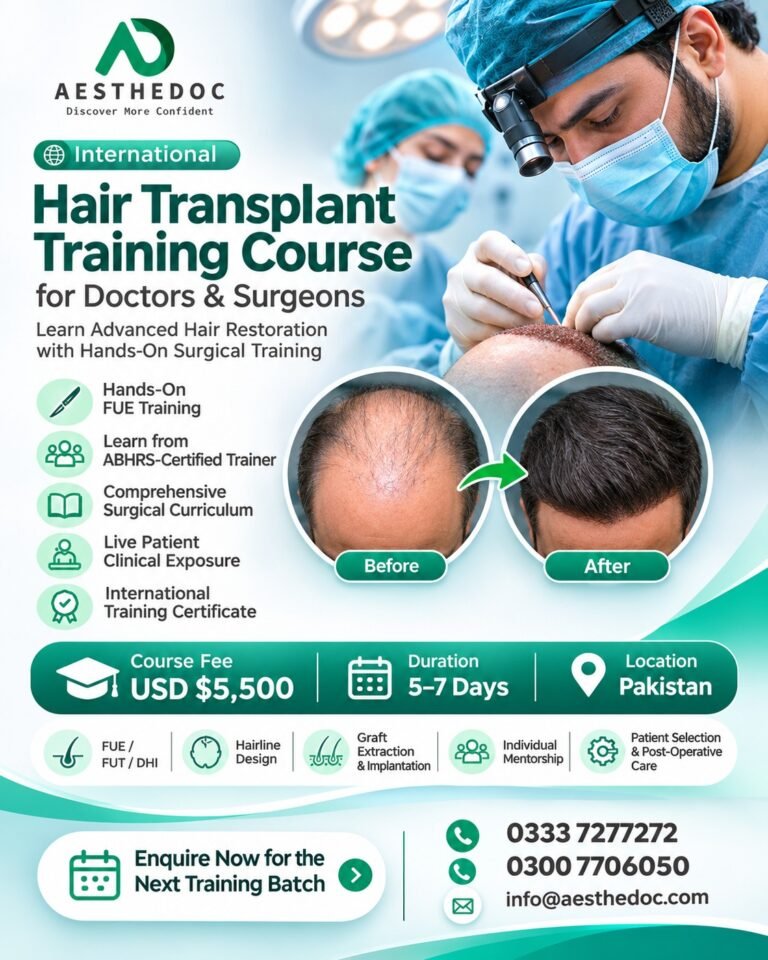
Doctors and surgeons interested in developing their knowledge of hair restoration can explore the Hair Transplant Course for Doctors & Surgeons at Aesthedoc, Pakistan.
The published Aesthedoc curriculum includes a dedicated module on the fundamentals of hair loss and patient selection. Its stated topics include types of alopecia, indications and contraindications, ethical patient counselling, and medical versus surgical treatment planning.
The programme is led by Dr. Adnan Bashir, identified on the Aesthedoc course page as a Master Aesthetic Trainer and ABHRS-certified Hair Transplant Surgeon.
According to the published course information, the programme includes structured theoretical training, hands-on FUE surgical exposure, live patient cases, one-to-one mentoring, preoperative planning, postoperative care protocols and complications management.
The published course fee is USD $5,500. Doctors should confirm current course dates, eligibility, fee inclusions, practical participation arrangements and other details directly with Aesthedoc before enrolling.
Explore the course:.
WhatsApp / Call: +92 333 727 7272
The programme is intended for medical professionals, including MBBS doctors, general surgeons, plastic surgeons, dermatologists and aesthetic physicians. Completing a course does not automatically grant specialist recognition, medical licensure or independent surgical privileges. Participants must comply with the licensing, credentialing and scope-of-practice requirements applicable in their own country.
Conclusion
Patient selection and preoperative assessment are among the most important foundations of responsible hair transplant surgery.
Before recommending FUE, a surgeon must understand the cause and progression of hair loss, examine the scalp, assess donor availability, review relevant medical history and evaluate the patient’s expectations.
Some patients may be suitable for surgery, while others may benefit more from medical management, further investigation or a delay in treatment. Recognising these differences is an essential clinical responsibility.
For doctors developing expertise in hair restoration, patient selection should be treated as a core competency rather than a preliminary administrative step. Good surgical planning begins with the right diagnosis, a realistic assessment and an informed patient.
Frequently Asked Questions
1. What is patient selection in hair transplant surgery?
Patient selection is the clinical process of determining whether an individual is suitable for hair transplantation. It considers the cause of hair loss, scalp condition, donor supply, medical history, expectations and potential risks.
2. Why is preoperative assessment important before FUE?
Preoperative assessment helps identify suitable candidates, evaluate donor and recipient areas, recognise possible contraindications and develop a realistic surgical plan.
3. Who is a suitable candidate for hair transplantation?
A suitable candidate generally has an appropriately evaluated hair loss condition, adequate donor resources, a clinically suitable scalp, realistic expectations and acceptable medical risk. Final suitability requires an individual assessment by a qualified clinician.
4. Can every person with hair loss undergo a hair transplant?
No. Hair loss can result from several different conditions. Some require medical treatment or further investigation, and some patients may not have sufficient donor supply for surgery.
5. What medical conditions should be reviewed before hair transplant surgery?
The clinician should review relevant medical conditions, allergies, medication use, bleeding history, previous surgical experiences and factors that may influence healing or perioperative risk.
6. What is the difference between androgenetic alopecia and telogen effluvium?
Androgenetic alopecia is a progressive pattern of hair loss influenced by genetic and hormonal factors. Telogen effluvium is a form of diffuse shedding that may follow physiological or other triggers. They have different clinical characteristics and management considerations.
7. Why is donor area assessment important during patient selection?
The donor area contains the follicular units available for transplantation. Its density, quality, miniaturisation and long-term suitability influence how much restoration may realistically be planned.
8. Can patients with active scalp inflammation undergo a hair transplant?
Active inflammation or infection may require diagnosis and appropriate management before elective surgery. Suitability depends on the underlying condition and clinical findings.
9. Is a young patient automatically unsuitable for a hair transplant?
No. Age alone does not determine eligibility. However, younger patients may have a longer period of future hair loss progression, making long-term planning particularly important.
10. Are women suitable candidates for hair transplantation?
Some women may be suitable, depending on the cause and pattern of hair loss, donor characteristics, scalp condition and expectations. Diffuse shedding and certain medical conditions may require further assessment before surgery.
11. What is the role of trichoscopy in hair transplant assessment?
Trichoscopy allows magnified examination of scalp and hair characteristics. It may help identify miniaturisation, hair shaft variation and features associated with certain scalp disorders.
12. Should patients stop their medication before hair transplant surgery?
Patients should not independently stop prescribed medication. Medication changes must be reviewed by the appropriate prescribing clinician and surgical team.
13. What is informed consent in hair transplantation?
Informed consent is the process through which patients receive and understand relevant information about the procedure, potential risks, benefits, alternatives and limitations before voluntarily agreeing to treatment.
14. What should doctors learn in hair transplant patient selection training?
Doctors should learn about alopecia types, indications and contraindications, medical history, scalp examination, donor assessment, ethical counselling and medical versus surgical treatment planning.
15. Does a hair transplant training certificate allow independent surgical practice?
No. Course completion does not automatically provide medical licensure, specialist recognition or independent surgical privileges. Doctors must meet the professional and regulatory requirements of the country where they intend to practise.